The strongest case for AI data centres is not that they are harmless. It is that refusing them does not remove the demand for computing. It moves the investment, jobs and strategic capacity somewhere else, while leaving communities to buy the resulting services from elsewhere.
That makes the real business question less comfortable than either side usually admits. Data centres can create substantial economic and technological capacity, but they can also impose local costs on electricity systems, water resources, land and public trust. A net positive outcome is possible. It is not automatic.
The distinction matters because public debate often treats a data centre as either a clean industrial investment or an environmental burden. In practice, it is a large new customer for infrastructure. The quality of the deal depends on who pays for that infrastructure, how quickly it can be expanded, and whether the surrounding community receives a meaningful share of the benefit.
The electricity argument illustrates the problem. A recent analysis that tracks data-centre energizations alongside electricity prices found a measurable effect from new facilities, particularly large and recent buildouts. It also found that the effect was small, appeared to plateau, and left room for additional capacity without major effects on household bills, based on the existing data.
That is useful evidence, but it is not a universal clearance certificate. Electricity impacts will vary with the local grid, the timing of new demand and the cost of adding generation and transmission. A community with spare capacity is not in the same position as one already facing constrained supply. The sensible conclusion is not that data centres never raise costs. It is that claims of inevitable, unlimited price increases are too simple to guide investment decisions.
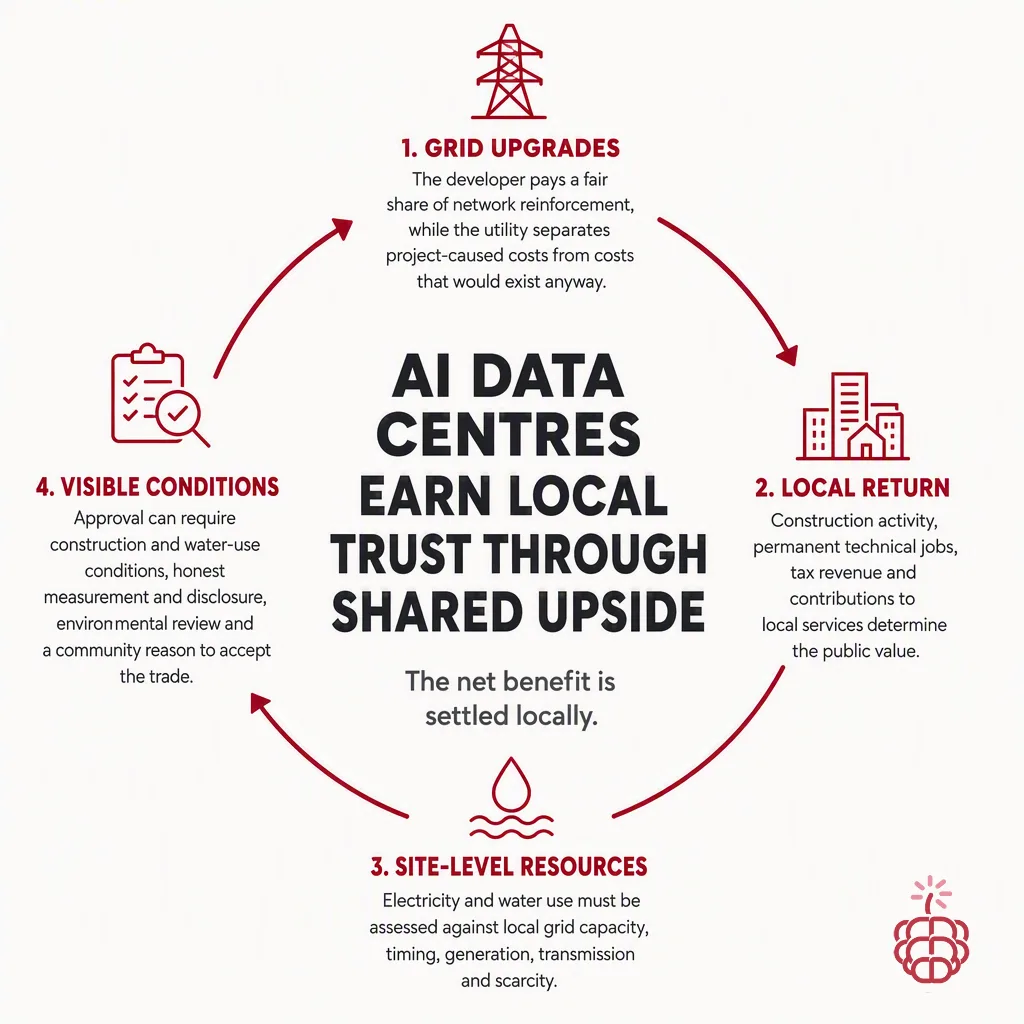
Consider a hypothetical town deciding whether to approve a large facility. The developer wants a reliable power connection. The utility must reinforce part of the network. The council wants construction activity, permanent technical jobs and tax revenue, but residents worry that their bills will rise and that public resources will be redirected.

A weak approval process asks residents to trust the developer and dismisses their concerns with national talking points. A stronger process makes the commercial arrangement visible. The developer can be required to pay a fair share of grid upgrades, accept conditions on construction and water use, and contribute to local services. The utility can show which costs are caused by the project and which would have existed anyway. The council can define what it expects in return rather than treating any investment as automatically beneficial.
Those details change the operating outcome. If the new customer funds necessary capacity, the utility gains an anchor for infrastructure that may serve other users. If the project brings tax revenue, the council can improve services or reduce pressure elsewhere. If the developer creates mainly construction work but few long-term jobs, the public value is different from the original headline. If local residents see only disruption and higher costs, opposition is rational even when the national economic case is strong.
The same logic applies to environmental concerns. Modern facilities are becoming more efficient through better cooling, power management and hardware design. That can reduce the resources required for each unit of computing. But efficiency does not settle the question when total demand grows quickly, and national averages do not resolve local scarcity. Water use, like electricity use, must be assessed at the site and system level.
The most persuasive argument for building is therefore not that every concern is based on bad information. Some objections will be overstated, and some widely repeated estimates may rely on errors or attribute resource use to data centres inaccurately. But a technically weak objection can still point to a legitimate governance problem: who bears the cost, who controls the decision and who benefits from the capacity created?
This is also why the comparison with railways, highways and power grids is helpful but incomplete. Earlier infrastructure connected markets and increased productive capacity. AI infrastructure may do something similar by supporting research, education, health care, manufacturing and business productivity. It may also strengthen domestic capability at a time when countries are competing to control advanced computing.
Yet infrastructure becomes economically valuable through use, not through construction alone. A data centre is a compelling demonstration of investment. It becomes an operating capability only when the power system, permitting process, workforce and surrounding economy can absorb it. Building servers without building the institutional capacity to govern their effects creates a stranded political asset, even if the hardware runs efficiently.
The strongest objection is that local agreements can become little more than payments to secure permission. That risk is real. A contribution from a developer should not excuse poor disclosure, weak environmental review or an overstretched grid. Nor should a community be told that strategic competition eliminates its right to negotiate.
But the objection changes the claim rather than defeating it. The case for AI data centres is conditional: build them where the system can support them, charge for the infrastructure they require, measure local effects honestly and give communities a reason to accept the trade.
Opposing all new capacity will not stop global AI development. It will mainly decide where the investment and associated benefits occur. The larger choice is whether data-centre growth is governed as a private real-estate decision or treated as shared economic infrastructure. The technology may be global, but the net benefit is settled locally.