Customer context
AI adoption is moving from experimentation toward operational change. For customers, the important question is not simply whether a system can complete a task. It is whether the system can reliably carry part of the work—and what that changes for service quality, cost, risk, and people.
That distinction matters because an increase in individual productivity does not automatically create lasting business value. Recent research from McKinsey describes the next stage of AI adoption as workflow redesign: changing roles, processes, skills, and operating models rather than placing a new tool on top of existing work.
Operational challenge
When a team can produce more than it could before, the same output may eventually require fewer people. That possibility deserves to be discussed plainly, especially with the people whose work may change.
But productivity measurement is not the same as a headcount recommendation. Leadership remains responsible for decisions about staffing, redeployment, service levels, employee relationships, and business risk. A technology provider can inform those decisions; it cannot own their consequences.
The practical risk is moving before the facts are clear. Teams may mistake faster task completion for genuine capacity, or assume that an automated step eliminates the need for review, escalation, context, or judgment. Evidence from US firms suggests that AI adoption is currently widespread but shallow, with perceived productivity gains running ahead of measured results.
AI-enabled approach
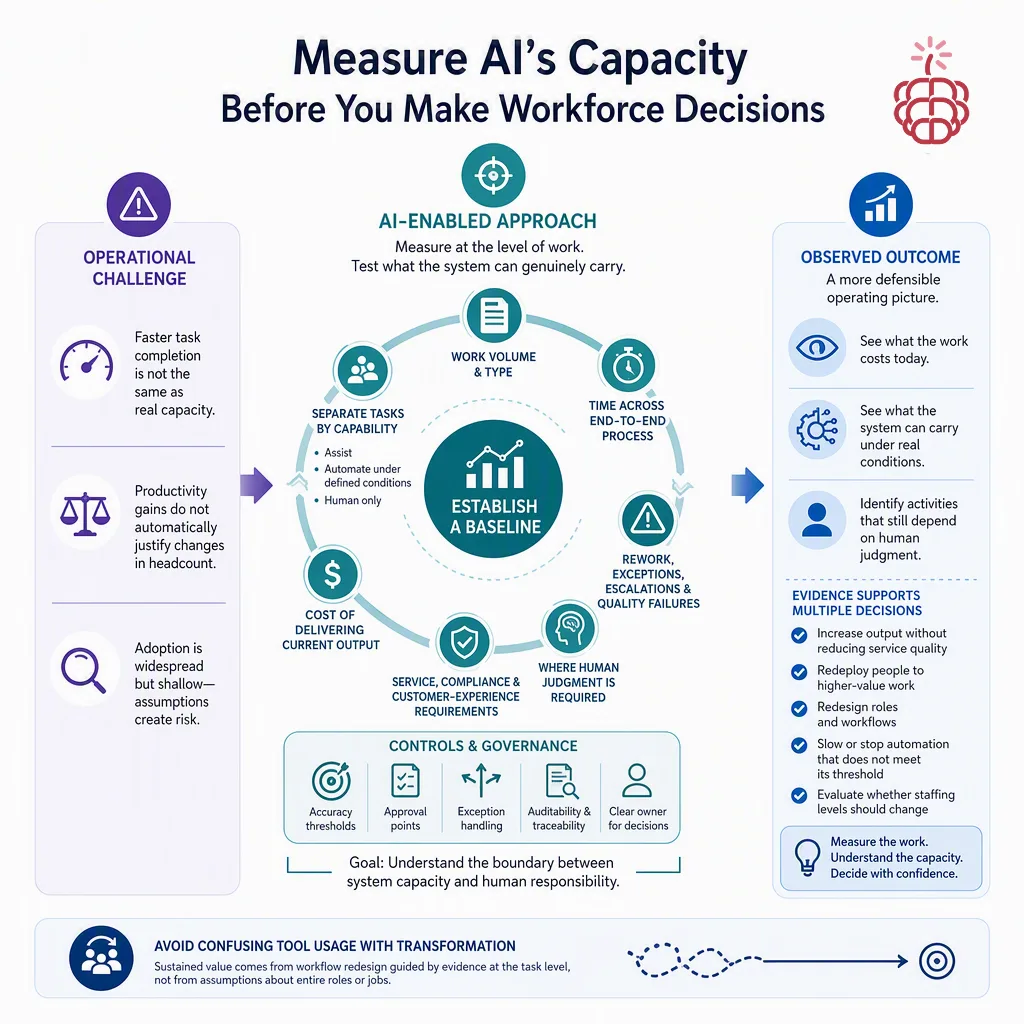
A sound approach starts with measurement at the level of work. Establish a baseline for:
- The volume and type of work handled today
- Time spent across the end-to-end process
- Rework, exceptions, escalations, and quality failures
- Where human judgment is required
- Service-level, compliance, and customer-experience requirements
- The cost of delivering the current output
Then test what an AI-enabled system can genuinely carry. Separate tasks that can be assisted, tasks that can be automated under defined conditions, and tasks that must remain with a person. Measure performance against the baseline rather than against an optimistic demonstration.
This task-level view is important because occupations are collections of different activities. Research cited by McKinsey argues that AI may be effective for some tasks within a role but not others, making role and workflow redesign more useful than broad assumptions about whole jobs.
The assessment should also include controls: accuracy thresholds, approval points, exception handling, auditability, and a clear owner for decisions. The goal is not to maximise automation. It is to understand the boundary between system capacity and human responsibility.
Observed outcome
The immediate outcome of this approach is a more defensible operating picture. Leaders can see what the work costs today, what the system can carry under real conditions, and which activities still depend on human judgment.
That evidence supports several possible decisions: increase output without reducing service quality, redeploy people to higher-value work, redesign roles, slow or stop an automation that does not meet its threshold, or consider whether staffing levels should change. None of those outcomes should be assumed in advance.
This discipline also helps avoid confusing tool usage with transformation. McKinsey’s research distinguishes between giving employees access to general-purpose AI, automating cross-functional workflows, and reinventing how work is organised. The greatest value depends on progressing beyond access alone.
Next step
Choose one operational workflow with a measurable output and a clear customer impact. Record the current baseline, define the system’s intended responsibility, and agree in advance how quality, exceptions, human review, and capacity will be measured.
Only after that evidence is available should leadership decide what happens to the work and the workforce around it. The useful promise of AI is not a predetermined headcount outcome. It is a clearer view of capacity—and better decisions about how that capacity should serve customers and people.