
The first sign that a business needs automation is often not a technology problem. It is a capable employee spending Friday afternoon copying the same customer information into three systems, then sending messages to people who already received the request.
That work looks harmless in isolation. At scale, it becomes an operating constraint. A sales order waits for a finance check. A finance check waits for an email reply. A customer waits while someone reconciles two spreadsheets that should have agreed in the first place. Growth then creates more administrative work before it creates more revenue.
The cost is not limited to hours. Manual handoffs introduce delay, inconsistent records and opportunities for small errors to become customer-facing problems. They also consume the attention people need for work that requires judgement. The organisation pays twice: once for the repetitive task and again for the decision that was postponed because nobody had enough time to make it.
Our view is that useful automation changes the movement of work, not just the speed of an individual task. It should decide what happens next, carry trustworthy information to the right system, and bring a person in when judgement is required. A script that fills a spreadsheet faster may be useful. A workflow that prevents the spreadsheet from being needed is more valuable.
The handoff is the real unit of work
Consider a mid-sized equipment distributor. A customer emails a request for a replacement part. A service coordinator reads the message, searches the customer record, checks warranty status in one system, looks up inventory in another, asks a manager to approve an exception, and then sends a response. None of these actions is especially complex. Together, they create a queue.
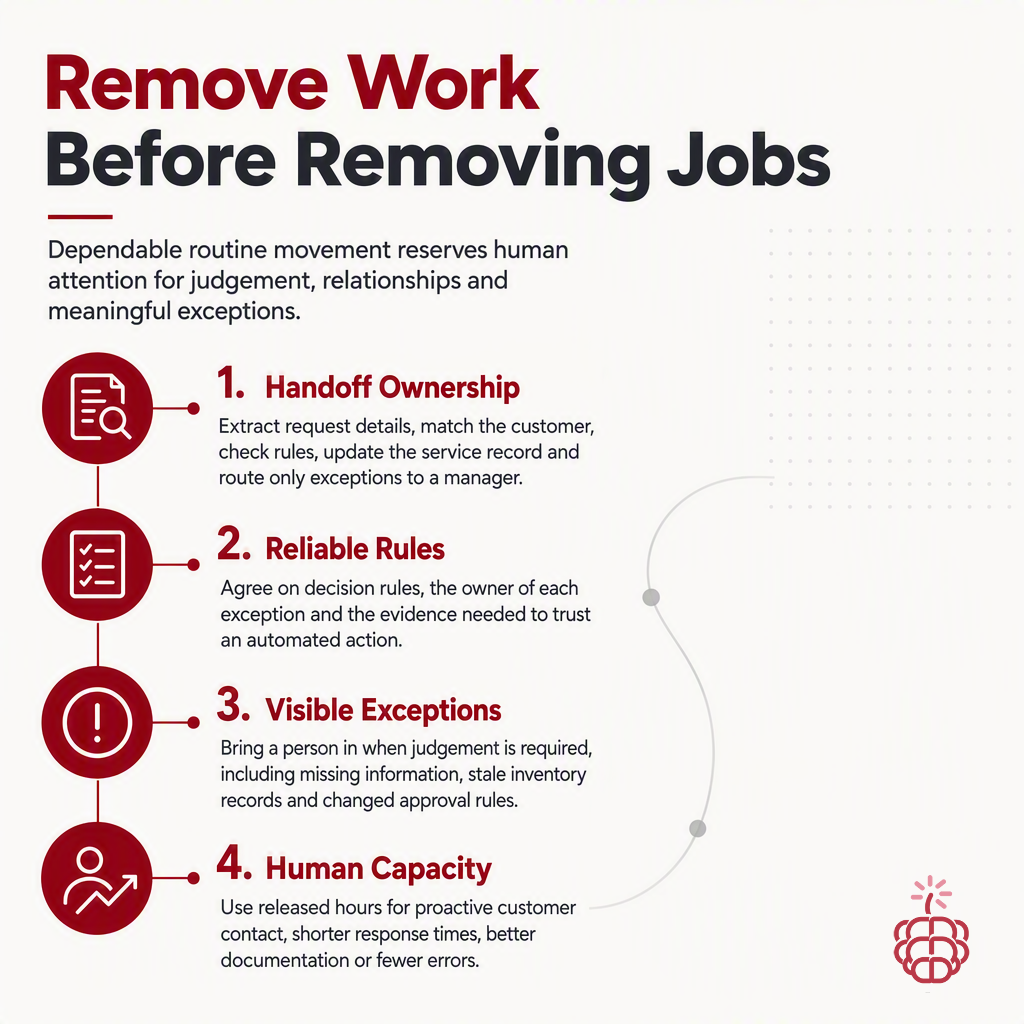
A well-designed workflow can extract the request details, match the customer, check the relevant rules and route only the exception to the manager. It can update the service record and prompt the coordinator with the information needed for a clear reply. The coordinator still owns the customer relationship. The repetitive search and follow-up work has changed ownership from a person to a controlled process.
That distinction matters. The customer receives a faster answer, but speed is not the only gain. The coordinator has more capacity for ambiguous cases, better conversations and problems that cannot be resolved by matching fields. The manager sees fewer routine approvals and more meaningful exceptions. The business can handle additional demand without assuming that every increase in volume requires a matching increase in headcount.
This is also where demonstrations can mislead. It is easy to show software moving data between applications. It is harder to make the process reliable when customer names do not match, an inventory record is stale, an approval rule has changed or an email contains missing information. Automation that succeeds only in the cleanest case simply moves the manual work into exception handling.
The difficult part is usually not connecting systems. It is agreeing on the decision rules, the owner of each exception and the evidence needed to trust an automated action. If those questions remain vague, the new workflow may produce faster confusion.
A practical implementation therefore starts with a narrow, high-volume process whose outcome is clear. Map the work as it actually happens, including the informal checks people perform outside the official system. Remove unnecessary steps before automating them. A recent independent guide to business workflow automation makes the same practical point: teams should begin with a simple, frequent workflow, involve the people who use it and avoid automating a broken process.
Capacity is not the same as headcount reduction
The strongest objection is that automation can be presented as employee protection while its real purpose is to reduce payroll. That concern is legitimate. Removing tasks can reduce the need for some roles, particularly when leaders treat saved capacity as a reason not to replace departing staff.
It would be dishonest to claim otherwise. Automation changes the economics of work, and organisations will make different choices about where to spend the capacity it creates. The responsible claim is narrower: repetitive work should not be confused with the contribution of the person performing it. Whether the released capacity becomes better service, faster growth, fewer errors or fewer employees is a management decision, not a technical outcome.
That decision should be visible. If a workflow removes ten hours of weekly administration from a service team, leaders should specify what those hours are for. More proactive customer contact? Shorter response times? Better documentation? Without a new expectation, the work often returns in another form. People fill the space with new checks, duplicate reports or workarounds because the organisation never resolved the underlying ownership problem.
Controls matter as much as convenience. Automated actions need clear permissions, records of what happened and a route for correction. Sensitive decisions may require human review even when the surrounding process is automated. The right measure is not how little human involvement remains. It is whether human attention is concentrated where it can change the outcome.
The pattern we keep seeing is simple: businesses do not become more scalable by asking people to endure more repetition. They become more scalable when routine movement is dependable and exceptions are visible. That requires process ownership, reliable data and the willingness to redesign work rather than decorate an old process with new software.
Automation therefore marks an organisational choice before it marks a technology choice. It says that customer information should not be retyped, approvals should not disappear into inboxes and skilled employees should not be the glue between systems. The larger consequence is not that machines perform more tasks. It is that the business can reserve human capacity for the decisions and relationships on which growth actually depends.