An AI deployment can be technically complete and still be nowhere near production.
The code may work. The model may answer accurately. The workflow may look better in a demonstration. Then the project reaches security review and stops. A new vendor means a new data processing agreement, a new subprocessor list, new evidence, new architecture questions and a new owner for the risk.
The engineering work is visible because it produces something. The approval work is slower and less visible because it produces permission.
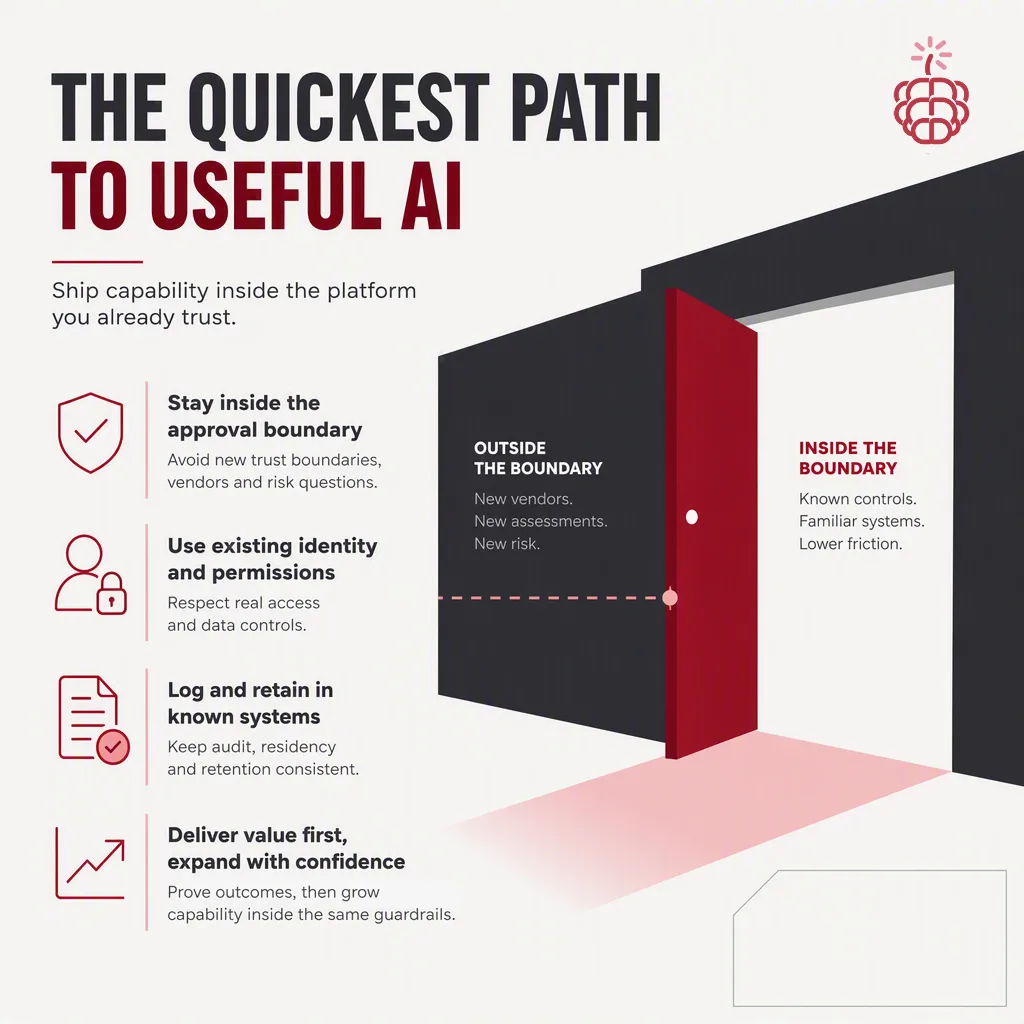
That changes how organisations should think about deployment. The quickest route to useful AI is often not adding another tool. It is putting a narrowly defined capability inside a platform the organisation already knows how to govern.
The approval boundary is part of the product
A new AI service creates more than a technical integration. It creates a new trust boundary.
Data may leave the company’s existing environment. Identity may be managed somewhere else. Logs may be incomplete or unavailable to the security team. The model provider may rely on subprocessors that the buying team has not encountered before. The service may retain prompts and outputs under terms that do not match the organisation’s own retention rules.
Independent assessments of AI vendor risk point to these differences as material. AI systems can involve model providers, cloud platforms, databases, logging services and identity systems, so the organisation’s review has to follow the data through the whole chain, not stop at the company named on the invoice.
This is why “we can build it in six weeks” is often the wrong estimate. The relevant question is not how long it takes to make the capability work. It is how long it takes to make the capability acceptable to the people accountable for data, access and operational risk.
An existing tenant can shorten that path because some of the questions already have an answer. The organisation may already have its identity model, permissions, audit logs, data residency arrangements and administrator controls in place. The security team is not assessing an entirely new environment. It is assessing a change within one.
That is not a loophole. It is a design choice.
Consider the claims team that cannot search its own knowledge
Imagine an insurer whose claims specialists spend hours searching policy documents, internal guidance and previous correspondence before deciding what information a customer needs. A platform team builds a retrieval assistant inside the company’s existing collaboration and document environment. It uses the employee’s existing identity, respects document permissions and records the questions and answers in the organisation’s established logging system.

The first benefit is not that the assistant writes fluent responses. It is that a claims specialist can find the relevant policy language without moving documents into a new service or asking an administrator to create a second access system.
That changes the work in several linked ways. The specialist spends less time searching and more time resolving the customer’s issue. The customer receives an answer sooner. The organisation avoids duplicating documents across another system. The security team has a familiar place to inspect access and usage. The platform team can improve retrieval quality without reopening every question associated with a new vendor.
None of this makes the assistant automatically safe or correct. It does make the risk easier to locate.
The difficult part is usually not generating an answer. It is ensuring that the assistant can retrieve only what the employee is allowed to see, that its response makes clear when evidence is missing, and that a person remains responsible for a consequential decision. A capability embedded in an approved environment still needs careful permissions, testing and operational ownership.
The business effect is capacity, not novelty. If the assistant removes repetitive searching from a specialist’s day, the organisation may handle more claims with the same team, or give the team more time for complex cases. That outcome depends on the workflow around the model. A clever demonstration does not create it by itself.
Existing does not mean trusted forever
The strongest objection is also the necessary correction: an existing tenant is not a free pass.
A familiar platform can change its underlying model, add a subprocessor, alter retention behaviour or introduce a new action that the original review never considered. An assistant that begins by summarising documents may later send messages, update records or make recommendations. Each change can alter the risk even if the product name remains the same.
AI vendor assessments increasingly treat these systems as dynamic data engines rather than static software. Questions about training data, model behaviour, audit logs, access controls and fourth party providers cannot be settled once and forgotten.
The practical implication is that governance should attach to the capability and its data flows, not simply to the vendor. A low risk internal search assistant may need a proportionate review. A system that recommends claim outcomes, screens applicants or takes action in a customer account needs a much deeper one. The platform reduces duplicated approval work. It does not remove accountability.
This distinction also prevents a common mistake. Teams sometimes argue that building inside an approved environment eliminates vendor risk. It does not. It reduces the amount of new vendor risk introduced by the project. The model provider, connectors, permissions and behaviour still need examination. The advantage is that the organisation can concentrate its review on what changed instead of revalidating the entire surrounding environment.
That is a more useful definition of speed. Fast deployment is not the absence of controls. It is the absence of avoidable new control surfaces.
The broader organisational shift is easy to miss. AI adoption is often described as a choice between buying a tool and building a model. In practice, a more consequential choice is whether each new capability creates another place where the organisation must manage data, identity and evidence.
When the answer is yes, engineering may be the smallest part of the schedule. When the answer is no, the organisation can spend its scarce attention on the parts that actually changed: the decision, the permissions, the evidence and the person accountable for the result.
The best AI deployment may therefore look less impressive from the outside. It may introduce no new login, no new data store and no new vendor relationship. But it changes how work gets done inside the boundaries the organisation already knows how to defend.