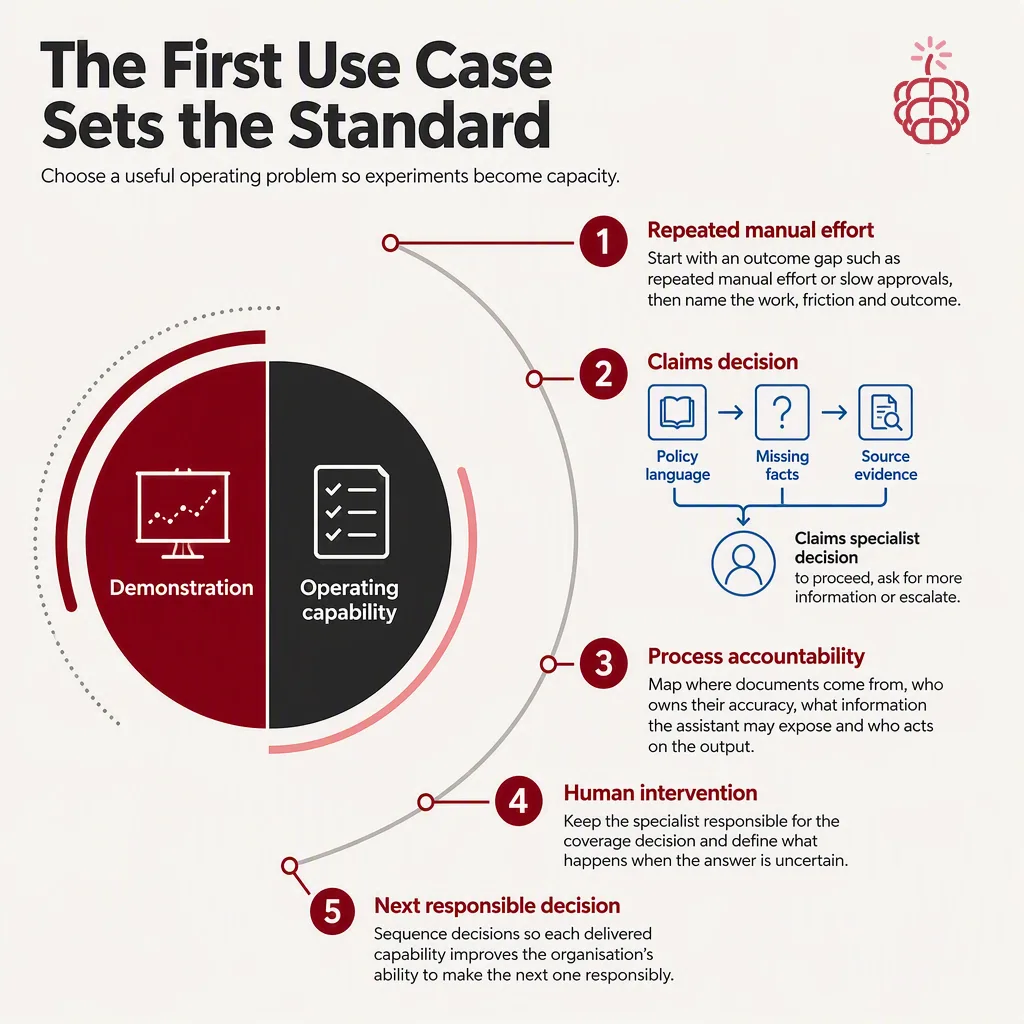
Most organisations do not need more AI ideas. They need a defensible reason to choose one idea before the others.
That sounds like a modest problem. It is not. The first use case sets the standard for evidence, ownership and risk that every later initiative will inherit. Choose a clever demonstration and the organisation learns that AI is a series of disconnected experiments. Choose a useful operating problem and it learns how to turn experiments into capacity.
This is the practical question behind many enterprise AI conversations, including those taking place around Microsoft 365: not whether AI matters, but what should be built first.
The model is not the bottleneck
The usual response is to gather a long list of possible applications. Summarise meetings. Search policies. Draft proposals. Answer employee questions. Classify service requests. The list grows faster than the organisation can assess it.
The difficult part is usually not imagining a use case. It is describing the business problem precisely enough to compare it with another problem. “Use AI in customer service” is not a decision. “Reduce the time a claims specialist spends locating policy conditions before responding to a customer” is closer. It names the work, the friction and the outcome without pretending that a particular tool is already the answer.
Microsoft’s own adoption guidance makes the same practical point: start with outcome gaps such as repeated manual effort or slow approvals, then translate them into a specific use case before selecting technology. It also warns that teams can run many experiments while seeing little return, or build conflicting solutions across the organisation.
That ordering matters because technical feasibility is only one part of readiness. A use case can be easy to demonstrate and still be a poor first investment if nobody owns the process, the data is unreliable, or the output does not change a decision.
Consider a regional insurer deciding what to build first. Its executive team is interested in an employee-facing assistant that answers questions about benefits. The service team, meanwhile, spends hours assembling information for claims specialists who need to interpret coverage conditions across multiple documents.
The assistant is more visible. It would produce an impressive demonstration. But the claims workflow has a clearer decision attached to it: whether a specialist has enough evidence to proceed, ask for more information or escalate a case.

A narrowly designed assistant could retrieve the relevant policy language, identify missing facts and present the source for review. The specialist would still make the coverage decision. The customer would receive a more consistent response, although the organisation could not assume that speed alone would improve the experience. The real test would be whether the system reduces searching and rework without increasing incorrect escalations.
That distinction changes the build. The team must map where the documents come from, who is accountable for their accuracy, what information the assistant may expose, and when a human must intervene. It must also define what happens when the answer is uncertain. The output is not a chatbot. It is a change to the claims process.
If the change works, the gain is not limited to minutes saved by individual specialists. Experienced employees spend less time hunting through material and more time resolving difficult cases. New employees have a clearer path through unfamiliar policies. Managers see fewer avoidable escalations. The organisation can handle more demand without assuming that every increase requires more staff.
The value is therefore operational, not theatrical. The system becomes useful because it sits inside a decision, with a person responsible for acting on its output.
The ownership problem
A prioritised backlog is not automatically a good one. Scoring ideas can create the appearance of discipline while hiding the hardest questions. Who will change the process? Who will accept the risk? Who will measure whether the result is better? What work will stop when this work begins?
A governance intake process can help by giving proposals a common route, capturing their problem statement, data sources, dependencies and sponsor before implementation starts. A Microsoft 365 based workflow is one possible way to create that visibility, and practitioners have identified duplicate initiatives, late compliance reviews and unofficial “shadow AI” as recurring consequences when requests are handled informally.
But governance should not become a queue that every promising idea enters and few leave. The official route must be easier than the unofficial route. A business employee should be able to explain the problem in plain language, and the review should return a decision that is useful: proceed, reshape, defer or reject.
The strongest objection is that this approach may favour small, safe improvements over more ambitious opportunities. That objection is valid. Some high-value uses will require new data foundations, redesigned controls or changes to roles. If readiness becomes the only criterion, an organisation will keep choosing what is convenient rather than what matters.
The answer is not to ignore readiness. It is to separate the first use case from the largest possible use case. The first should be valuable enough to matter and contained enough to learn from. Alongside it, the organisation can prepare harder opportunities whose benefits are larger but whose dependencies are not yet resolved.
This produces a sharper definition of prioritisation. It is not ranking ideas once. It is sequencing decisions so that each delivered capability improves the organisation’s ability to make the next one responsibly.
The most useful first AI project may not attract the most attention in a conference room. It may remove a stubborn search task, clarify an approval, or give a specialist better evidence at the moment a customer is waiting.
That is precisely why the choice has organisational consequences. A demonstration proves that a system can produce an answer. An operating capability proves that people can use the answer to make better decisions, within known limits, at a cost the business can sustain. The difference between the two is where enterprise AI stops being a portfolio of ideas and starts becoming a way of allocating capacity.