
Most organisations can point to an AI experiment. Far fewer can say which business decision, workflow or cost base the experiment is meant to change. The gap between broad use and scaled use is therefore less a technology problem than an ownership problem. Leaders should stop asking where AI is being tried and decide where the business will operate differently because of it.
The pattern we keep seeing is simple: adoption is measured by activity, while scale is earned through consequence. A team using an assistant to draft documents may be more productive, but that does not mean the organisation has changed its service model, reduced capacity requirements or improved a material decision. A demonstration proves that a tool can perform a task. An operating capability proves that the surrounding work can absorb the change.
Independent research supports that distinction. McKinsey’s 2025 global survey found that more than three quarters of respondents said their organisations used AI in at least one business function, while only 21 per cent of respondents reporting generative AI use said their organisations had fundamentally redesigned at least some workflows. The same research found workflow redesign had the strongest relationship among the attributes tested with reported earnings impact from generative AI.
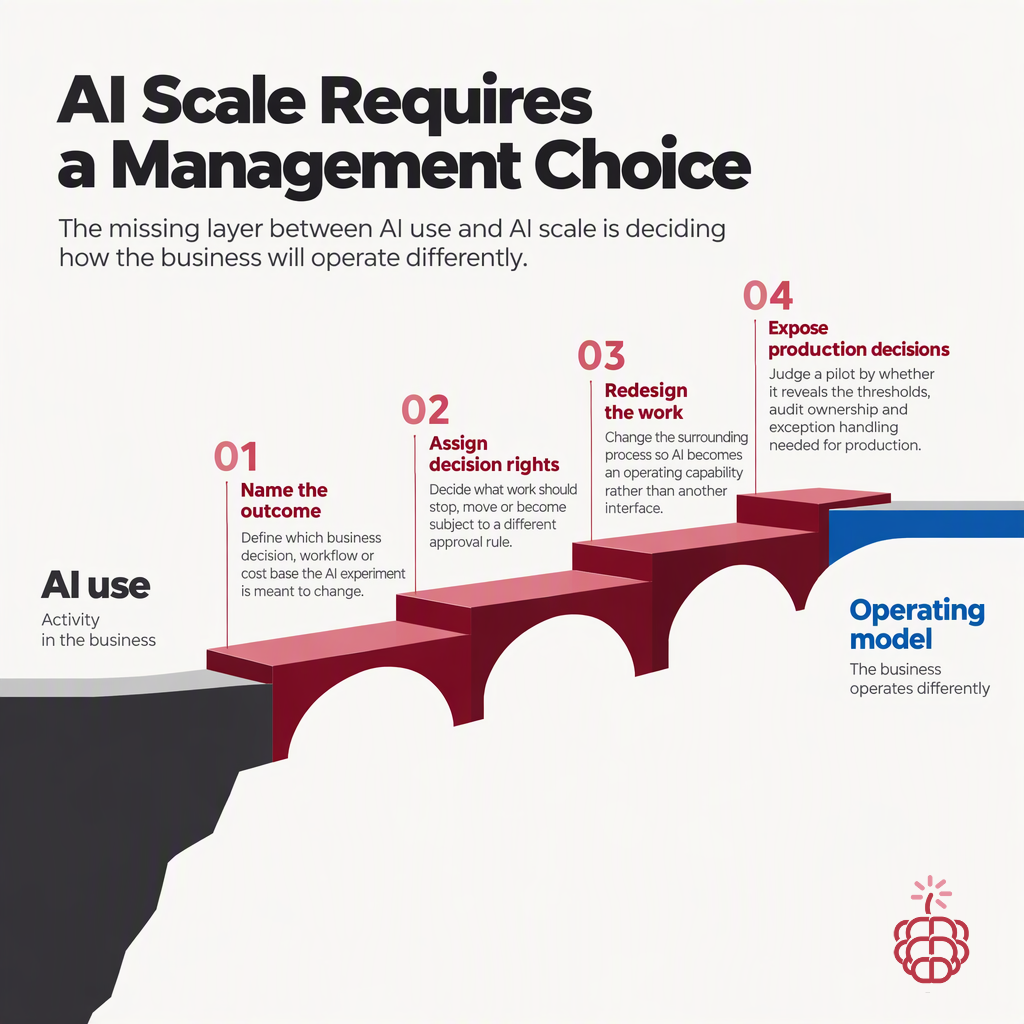
That points to the decision most companies avoid: what work should stop, move, or become subject to a different approval rule? Without that decision, AI is added to an existing process. Employees gain another interface, managers inherit another risk, and the organisation pays for speed in one step while preserving delay in the next.
Consider a claims team at an insurer. An AI assistant can summarize incoming evidence for an adjuster in seconds. The visible gain is faster reading. The consequential question is whether the insurer will change the triage rule, route straightforward claims directly to settlement, and reserve expert attention for ambiguous or high-risk cases. That requires agreed thresholds, audit ownership, exception handling and a clear answer when the summary is wrong. The model is only one part of the change.
If those decisions are made, the benefit is not simply that adjusters write less. The organisation may handle more claims with the same specialist capacity, make response times more predictable, and focus human judgement where it affects loss and customer trust. If they are not made, the assistant becomes a faster way to prepare work for the same queue.
The strongest objection is that workflow redesign is expensive and disruptive. That is true. Some processes are too regulated, fragmented or poorly measured to change safely in one move. A small, contained use case can still be worthwhile. But a pilot should be judged by whether it exposes the decisions needed for production, not by whether users enjoy it or whether a model performs well in isolation.
Our view is that the missing layer between AI use and AI scale is a management choice: name the outcome, assign the decision rights, and redesign the work around the new constraint. The organisations that make that choice will not merely have more AI in the business. They will have fewer unnecessary handoffs, better use of scarce expertise and a clearer basis for investment. The apparent technology gap is really a difference in how seriously leaders are prepared to change the operating model.