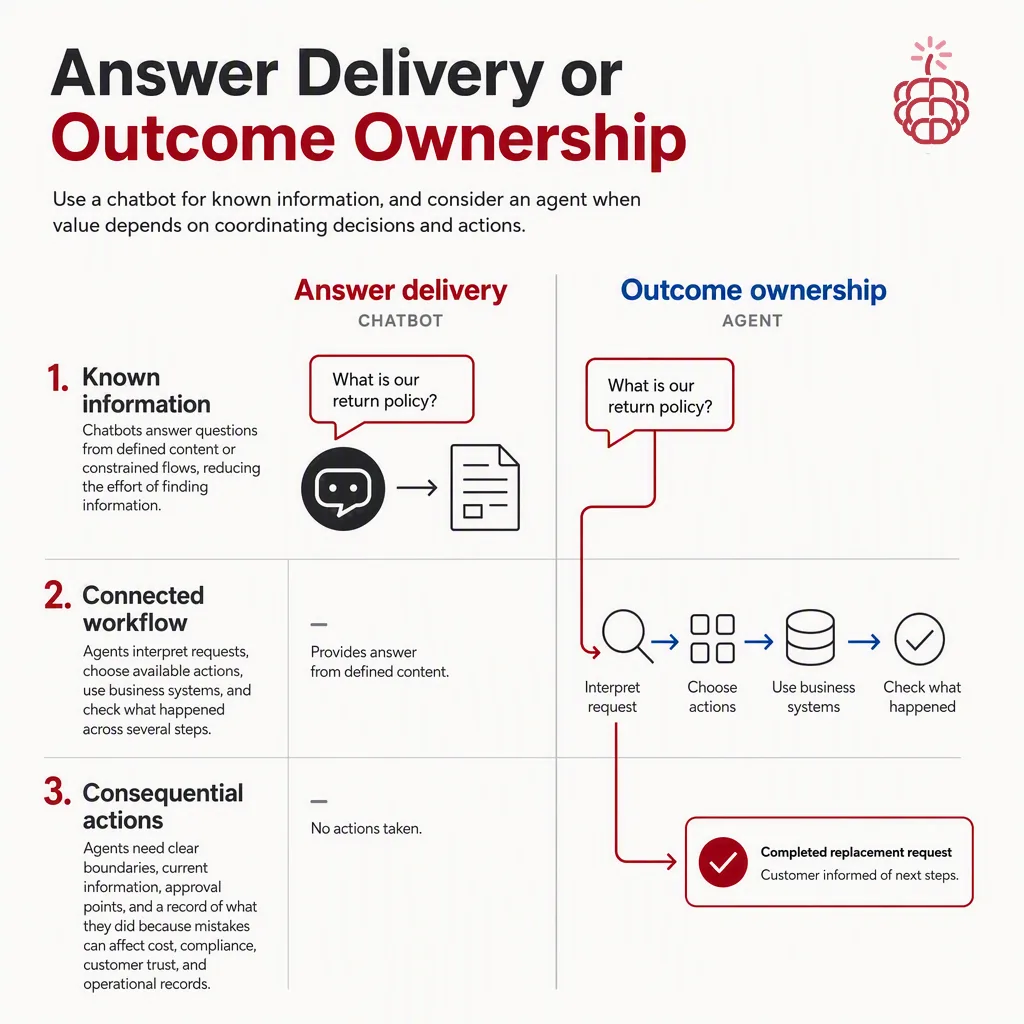
Most organizations do not need to replace every chatbot with an AI agent. They need to decide where a conversation should end with an answer and where it should end with completed work. That distinction matters commercially: chatbots can reduce the effort of finding information, while agents can reduce the number of steps required to make a decision or execute a process.
The pattern we keep seeing is that the label matters less than the authority granted to the system. A traditional chatbot primarily responds to a user’s question, usually from defined content or a constrained set of flows. An AI agent is intended to pursue an outcome across several steps, which can include interpreting a request, choosing among available actions, using business systems, and checking what happened.
That difference changes the operating model. A chatbot can answer, “What is our return policy?” An agent might determine whether a particular return qualifies, retrieve the order, create the request, and route an exception. The commercial benefit is not that the agent produces a more impressive sentence. It is that fewer people have to move information between systems and decide what to do next.
Consider a service team handling a request to replace a damaged product. A chatbot can explain the policy and ask the customer to contact another department. An agent could gather the order details, check the applicable rule, identify whether evidence is missing, create a replacement request, and tell the customer what will happen next. The useful capability is the connected workflow. The customer gets a resolution rather than another conversation, and the service team can spend more time on cases that need judgement.

That example also shows why agents are not simply better chatbots. The more actions a system can take, the more its mistakes can affect cost, compliance, customer trust, and operational records. A fluent answer can be corrected in the next message. An incorrect refund, cancellation, or account change may require investigation and remediation. Agents therefore need clear boundaries, reliable access to current information, approval points for consequential actions, and a record of what they did.
This is where the strongest objection holds: many organizations are still struggling to make basic knowledge accurate and accessible. Giving an agent more tools does not repair unclear ownership, inconsistent policies, or poorly connected systems. In some cases, a well-designed chatbot is the more useful choice because the task is informational, the risk is low, and the desired workflow is already simple.
Our view is that the practical comparison is not chatbot versus agent. It is answer delivery versus outcome ownership. Use a chatbot when speedier access to known information is the goal. Consider an agent when the value depends on coordinating decisions and actions, and when the organization is prepared to control those actions.
That makes the shift organizational before it is technical. Moving from chatbots to agents means deciding which work can be delegated, which decisions remain human, and who is accountable when the system acts. The winners will not be the organizations with the most autonomous systems, but those that give autonomy to the right parts of the workflow.