
The commercial difference between a traditional chatbot and an AI agent is not how naturally either one speaks. It is whether the system can move a customer request through the business. That should change the buying decision: assess these tools by the work they complete, not the conversations they simulate.
The pattern we keep seeing is a mismatch between a polished front end and a static operating model. A chatbot can understand that a customer wants to change an address, cancel a subscription or reschedule a delivery. If it can only explain the procedure, the customer still has to do the work, or ask an employee to do it. Better language has improved the answer layer without necessarily improving resolution.
Traditional chatbot apps are useful when information is the outcome. They can search a knowledge base, summarize a policy, check some customer data and route an issue to a person. That can reduce simple enquiries and make support available outside normal hours. But the value is limited when the request is an instruction rather than a question.
An AI agent changes the unit of work. It interprets the request, decides which approved steps are needed, uses connected systems and records what happened. In a support setting, that might mean checking an order, applying an eligibility rule, updating the customer record, triggering a delivery change and closing the ticket. The language interface is still there, but it is no longer the main event. The workflow is.
Consider a customer who asks a retailer to change the delivery address for an order already in transit. A chatbot can identify the intent, retrieve the retailer’s policy and tell the customer to contact the carrier. An agent could verify the order, check whether the change is permitted, submit the request to the relevant system, tell the customer what was accepted and leave an auditable record for the support team. The important result is not a more convincing reply. It is fewer handoffs and a decision completed inside one interaction.
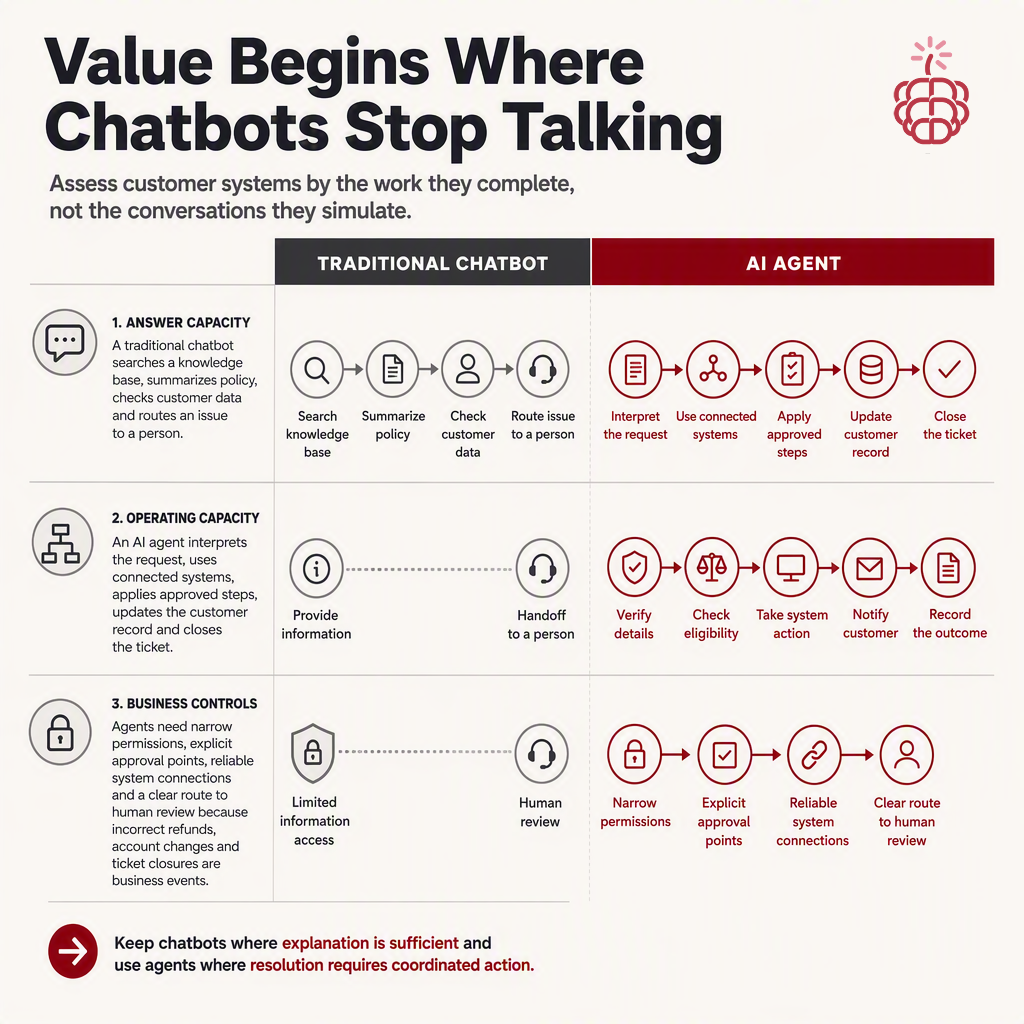
That distinction also exposes the risk. An agent with permission to write to operational systems can create a much larger failure than a chatbot that produces an incomplete answer. Incorrect refunds, account changes or ticket closures are not conversational defects. They are business events. Agents therefore need narrow permissions, explicit approval points, reliable system connections and a clear route to human review. The difficult part is usually not choosing a more capable model. It is deciding which actions are safe to automate and making the underlying data and processes dependable enough to support them.
There is a strong objection: many customer requests are simple, and a chatbot may be cheaper and easier to govern. That is true. Replacing every FAQ interaction with an autonomous workflow would add complexity without adding value. The practical choice is to keep chatbots where explanation is sufficient and use agents where resolution requires coordinated action.
Our view is that the comparison should not be framed as chatbot versus agent in the abstract. It is answer capacity versus operating capacity. A chatbot improves access to information; an agent can change what the organisation does. That makes the shift organisational as much as technical: the lasting advantage will belong to companies that redesign ownership and controls around completed work, not those that merely give a familiar interface a more fluent voice.