
The commercial value of AI will not be measured by the number of tasks it completes. It will be measured by whether the organisation converts saved effort into better decisions, stronger customer relationships and work that previously went undone. Leaders should therefore fund AI deployments with a capacity plan, not a headcount target.
The pattern we keep seeing is simple: removing repetitive work does not automatically create valuable work. It creates room for it. Unless someone decides how that room will be used, the organisation usually fills it with more requests, more documentation and more activity that looks productive without changing the outcome.
That is why the replacement question is too narrow. A purchasing team may use AI to compare supplier proposals in minutes instead of hours. The gain is not the comparison itself. The gain is the negotiation the team can now prepare for, the exception it can investigate, or the supplier risk it can examine before a contract is signed. The technology changes the cost of attention. Management still has to decide where attention belongs.
Consider a claims manager at an insurer. An AI system drafts a summary from correspondence, policy documents and adjuster notes. The obvious demonstration is faster file preparation. The useful capability appears only when the workflow changes: the adjuster spends less time reconstructing the case and more time resolving an ambiguous claim, explaining a decision to the customer or identifying a pattern that needs escalation. The value sits in the decision around the summary, not in the summary.
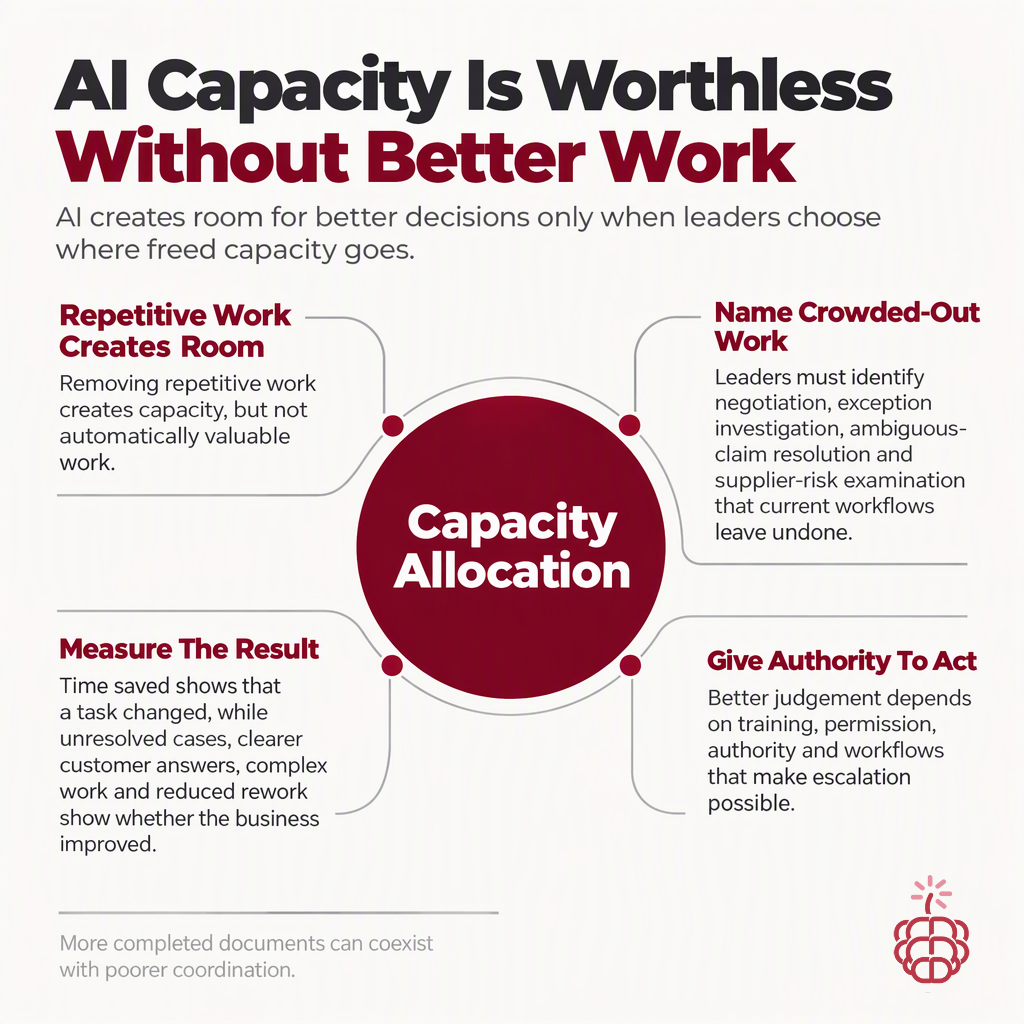
This distinction also changes what should be measured. Time saved is evidence that a task has changed. It is not evidence that the business has improved. Leaders need to ask what happened to the freed capacity: did unresolved cases fall, did customers receive clearer answers, did specialists handle more complex work, or did the team simply produce more files?
The strongest objection is that employees may not have spare capacity in the first place. They may be dealing with backlogs, service targets and work that cannot be paused. That objection is valid. AI cannot manufacture strategic time by itself. In some operations, the first benefit will be resilience: fewer handoffs, less rework and more consistent execution. The next benefit may be better judgement, but it depends on training, authority and a workflow that makes escalation possible.
There is a second risk. AI can increase output while weakening the connections that make organisations intelligent. A recent study of workplace activity found increases in both productivity and communication actions among frequent AI users, but a larger increase in individual, documentation-focused work. The authors warn that less relative communication may reduce the spread of diverse information that supports innovation. More completed documents can therefore coexist with poorer coordination.
MIT Sloan’s reporting on research across more than 20 companies makes the operational lesson sharper: deployments fail through disuse, misuse or overuse. Successful efforts began with a business problem, measured quality and rework, and scaled only when the evidence beat the alternative. That is a better standard than counting licences or prompts.
Our view is that AI strategy is principally a capacity-allocation decision. The organisation must name the valuable work that is currently crowded out, give people permission and authority to do it, and test whether the new workflow improves the result. Otherwise, AI will make the existing operating model more efficient at consuming its own time. The decisive shift is not from people to machines. It is from task completion to organisational judgement.