
AI data centres should be judged as productive infrastructure, not treated as an unavoidable cost of innovation. The commercial decision is whether governments and communities can capture their economic and strategic benefits while requiring developers to manage energy, water and grid impacts transparently.
The recurring mistake is to treat a data centre as a large new load and stop there. That describes the facility, not its value. A railway consumes land and power, but its case rests on the activity it makes possible. AI infrastructure has a similar role: it supplies capacity for research, manufacturing, education, health care and business processes that cannot run reliably on scarce or distant computing resources.
That does not make every proposed facility worthwhile. It changes the question from “How much electricity will it use?” to “Who pays for the capacity, who benefits from it, and what obligations come with approval?”
The available evidence on electricity prices is more limited than either side of the debate often suggests. One continuously updated analysis found a measurable effect from new data centres, with the sharpest impact associated with large, recent buildouts. It also found that the effect was small and appeared to plateau, and that existing conditions left room for further capacity without major effects on household bills. That is not proof that every region will see the same result. It is evidence against treating a national average or a dramatic forecast as a local verdict.
Consider the practical decision facing a utility, a developer and residents in a community asked to approve a 250 megawatt hyperscale facility. The useful negotiation is not a promise that the project has no impact. It is a contract covering connection costs, new generation, grid upgrades, water use and local revenue. If the developer pays more than its historical share of those costs, residents are less likely to subsidize the project, while the community gains tax revenue and construction and operating employment. The utility gets a clearer basis for planning rather than absorbing an unpriced demand shock.
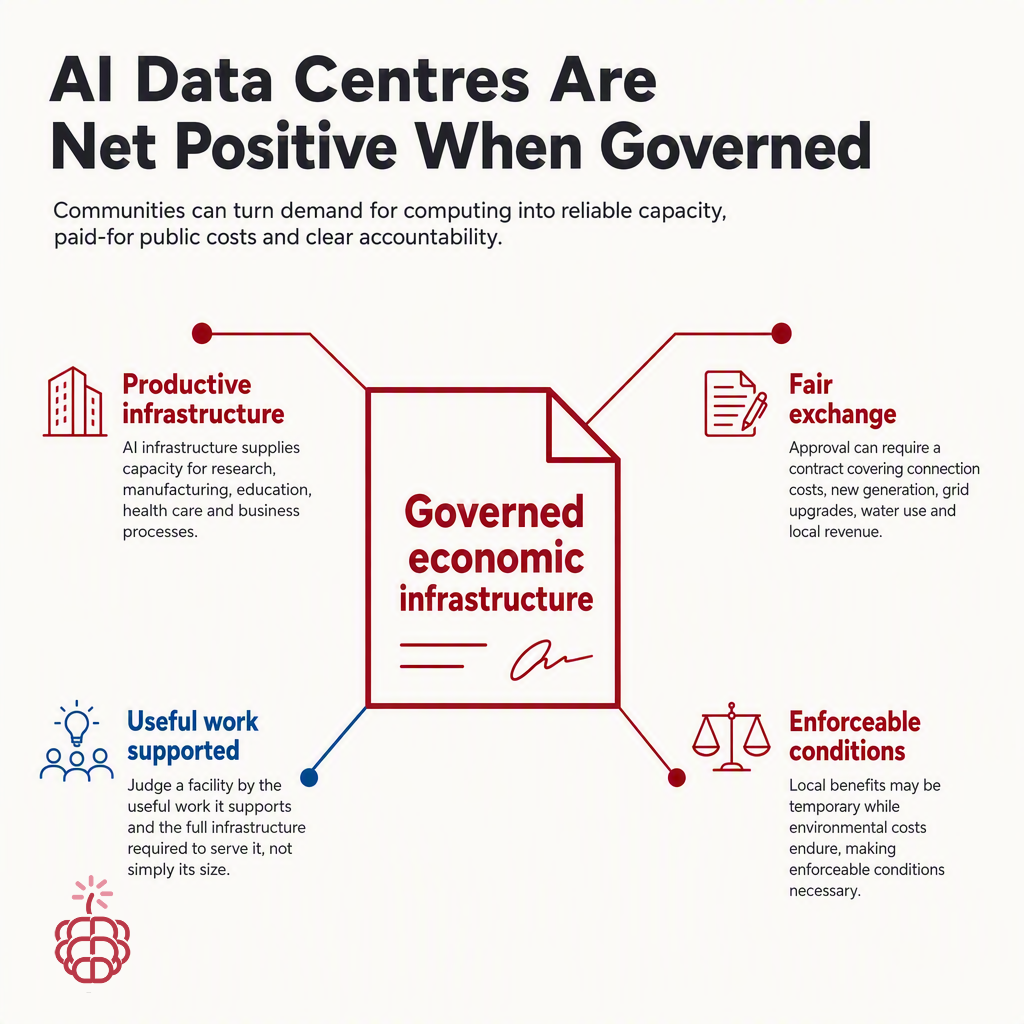
Efficiency strengthens this case, but it does not remove the need for scrutiny. Advances in cooling, power management and hardware design can reduce the resources required for a given amount of computation. The relevant measure is therefore not simply the size of a facility, but the useful work it supports and the full infrastructure required to serve it. Efficiency can also encourage more use, so absolute demand may still rise.
The strongest objection is that local benefits may be temporary while environmental costs endure. That is a valid reason for enforceable conditions, not for assuming that refusing one site stops AI development. Investment can move elsewhere, leaving a region dependent on foreign infrastructure and unable to shape the standards governing it.
Our view is that AI data centres are a net positive when treated as governed economic infrastructure. The strategic issue is not permission without conditions. It is whether communities can turn demand for computing into a fair exchange: reliable capacity for innovation, paid-for public costs and clear accountability. The technology shift is also an ownership shift. Places that build responsibly will influence where value, capability and decision-making accumulate.