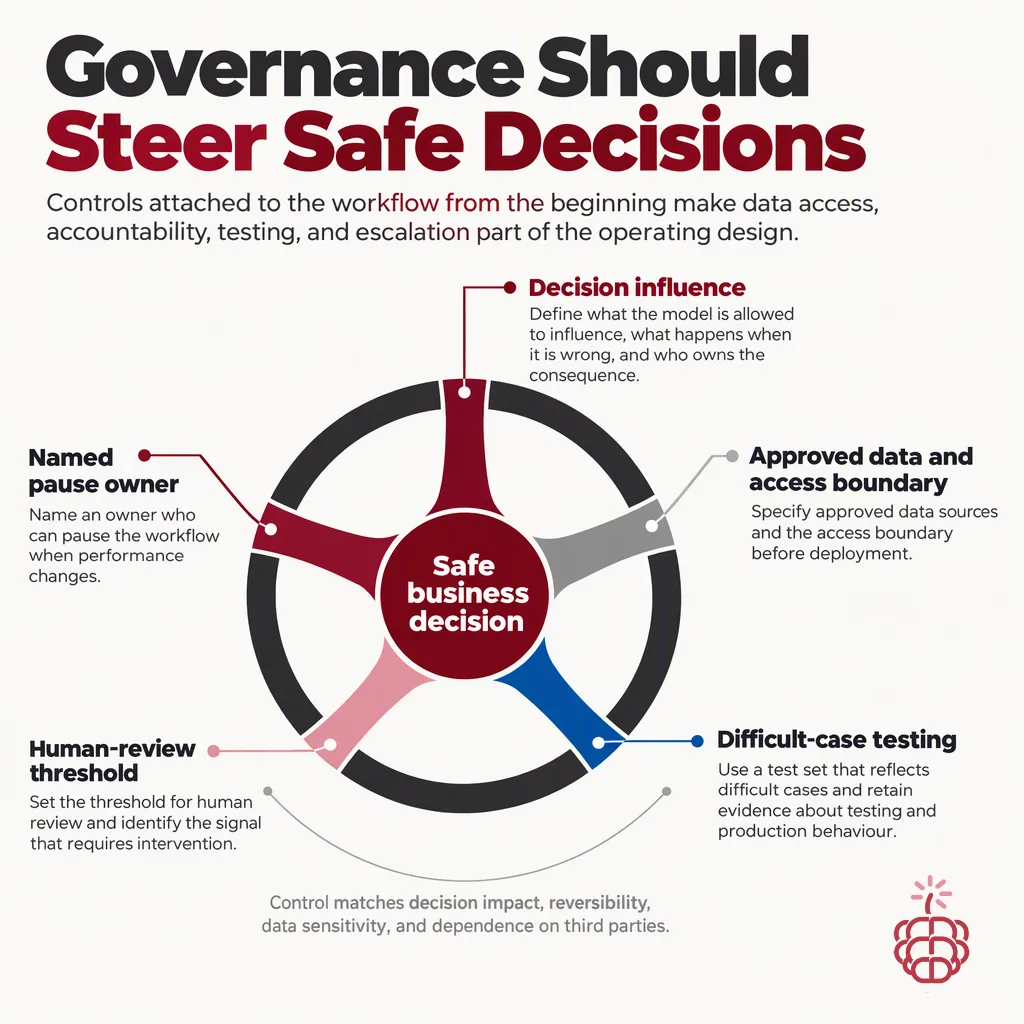
AI governance should change which decisions an organisation can make with confidence, not simply decide whether a project may proceed. When controls are attached to the workflow from the beginning, teams can move faster because data access, accountability, testing, and escalation are already part of the operating design.
The contradiction is that governance often arrives after the business decision has been made. A team builds a promising demonstration, then asks legal, security, privacy, and risk functions to approve it. Those functions are left to reconstruct the use case, identify affected people, and determine what evidence is missing. The result is not careful adoption. It is late-stage uncertainty disguised as review.
The model is not the bottleneck
The difficult part is usually not choosing a model. It is deciding what the model is allowed to influence, what happens when it is wrong, and who owns the consequence. A governance process that answers those questions before deployment reduces rework. One that answers them after deployment creates a queue.
This is why a policy library alone has limited value. The NIST AI Risk Management Framework separates ongoing governance from the use-case work of mapping context, measuring performance, and managing risk. That distinction matters because governance is not a single approval event. It is the operating layer that makes those activities repeatable across systems.
Consider a claims operations lead at an insurer who wants an AI system to sort incoming claims by urgency. A demonstration may show that the system can classify documents quickly. A useful operating capability requires more: approved data sources, an access boundary, a test set that reflects difficult cases, a threshold for human review, and a named owner who can pause the workflow when performance changes.

Those controls do not merely protect the insurer. They change the economics of the work. Staff no longer spend time debating whether every new claim should enter the experiment. They focus on exceptions and decisions the system cannot safely make. The business gains capacity, while the risk team gains evidence instead of promises.
The strongest objection is valid: integrated governance can become bureaucracy wearing technical language. A low-risk internal assistant should not face the same controls as a system that affects a customer’s coverage or payment. Proportionality is therefore part of governance, not an exception to it. The control should match the decision’s impact, reversibility, data sensitivity, and dependence on third parties.
The same logic applies to vendors. A framework mapped on paper does not prove that a deployed system is being monitored or that an incident process exists. Operational implementation means retaining evidence about purpose, data, testing, thresholds, owners, and production behaviour, rather than treating documentation as completion.
Our view is that governance earns its place when it makes the next safe decision easier. It should tell a product team what can proceed, under which conditions, and what signal requires intervention. That is closer to a steering wheel than a brake pedal.
The larger shift is organisational. AI adoption will not be limited mainly by access to capable models. It will be limited by whether companies can turn uncertain machine output into accountable business decisions. Governance is the mechanism for doing that at operating speed.