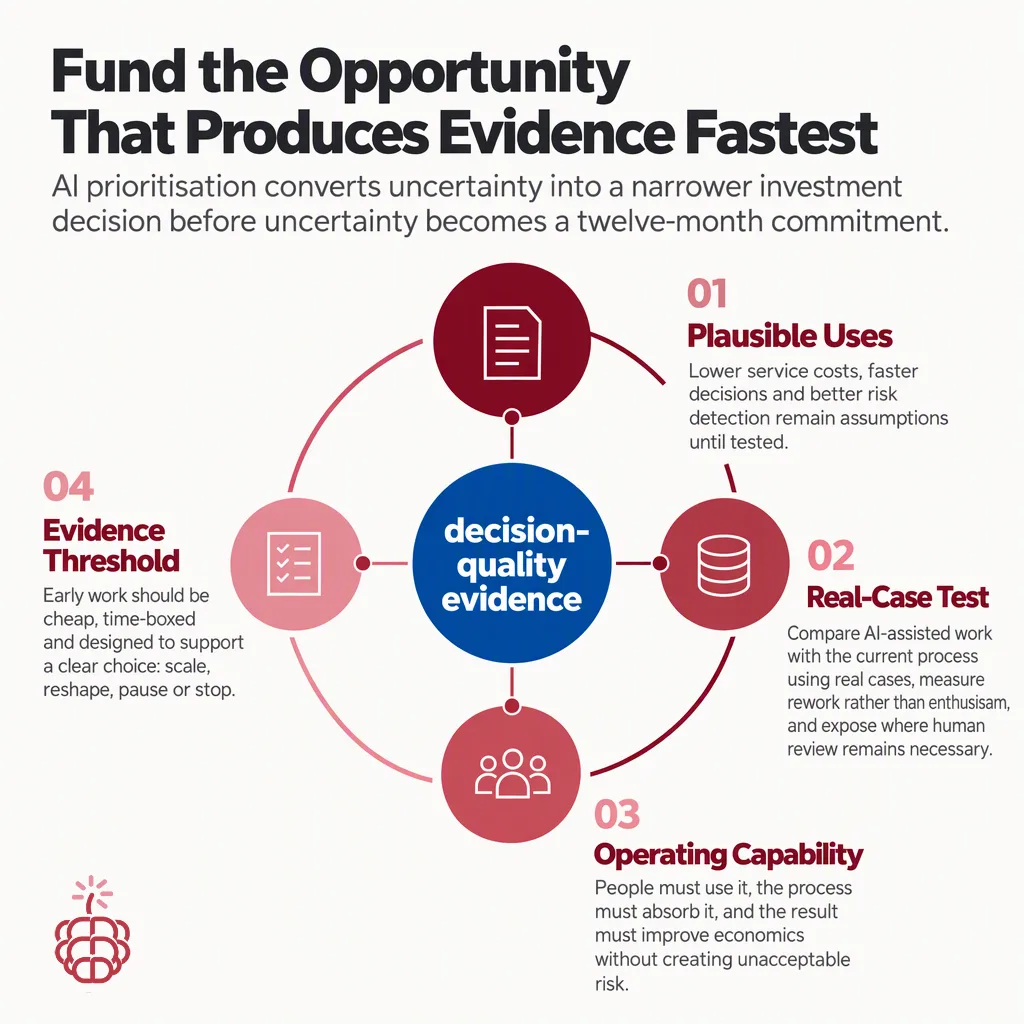
Most AI programmes do not fail because a model cannot perform the task. They stall earlier, when leaders cannot decide which of several plausible uses deserves scarce money, data and operating attention. The commercial decision should therefore change: fund the opportunity that can produce decision-quality evidence fastest, not the one with the most impressive demonstration.
The pattern we keep seeing is a category mistake. Organisations treat prioritisation as a ranking exercise, then discover that the ranking depends on assumptions nobody has tested. An idea may promise lower service costs, faster decisions or better risk detection. None of those outcomes is established by a convincing prototype.
A demonstration answers, “Can the system do this?” An operating capability must also answer, “Will people use it, can the process absorb it, and does the result improve the economics without creating unacceptable risk?” Those are different questions. The second set determines whether funding compounds or disappears into another pilot.
This is why the difficult part is usually not access to a model. It is designing a small piece of work that removes the most expensive uncertainty. A useful test might compare AI-assisted work with the current process using real cases, measure rework rather than enthusiasm, and expose where human review remains necessary. Its output is not a polished demo. It is a narrower investment decision.
Consider a claims director choosing between three proposals: summarising adjuster notes, detecting possible fraud and automating customer updates. A prototype can make each look credible. But a properly bounded test may show that summarisation saves minutes while fraud detection requires data the business cannot reliably assemble. Customer updates may be technically easy but create escalation work when confidence is low. The result is not a universal winner. It is evidence that changes the order of investment and identifies the process owner who must be involved next.

That distinction matters financially. Funding the wrong opportunity does not only waste software spend. It consumes scarce data engineering capacity, frontline trust and leadership attention. It also makes later decisions harder, because an abandoned pilot is often described as an AI failure when it was really an untested operating assumption.
There is a legitimate objection: demanding evidence before funding can become a polite form of delay. A test can expand until every uncertainty is resolved, which is impossible. The answer is not to remove discipline, but to set the evidence threshold in proportion to the decision. Early work should be cheap, time-boxed and designed to support a clear choice: scale, reshape, pause or stop.
Independent research points in the same direction. McKinsey’s study of 20 companies that created significant value from AI found that successful organisations concentrated on a small number of economic leverage points and aligned leadership, operating foundations and execution, rather than treating technology selection as the main advantage. That is consistent with the practical lesson: value comes from choosing where organisational effort should go, then making the workflow capable of receiving it.
Our view is that AI prioritisation is becoming an evidence-design capability. The strongest organisations will not necessarily have more ideas or larger experimentation budgets. They will be better at converting uncertainty into a decision before uncertainty becomes a twelve-month commitment. The real shift is therefore organisational: from asking where AI might work to deciding which change the business is prepared to make real.