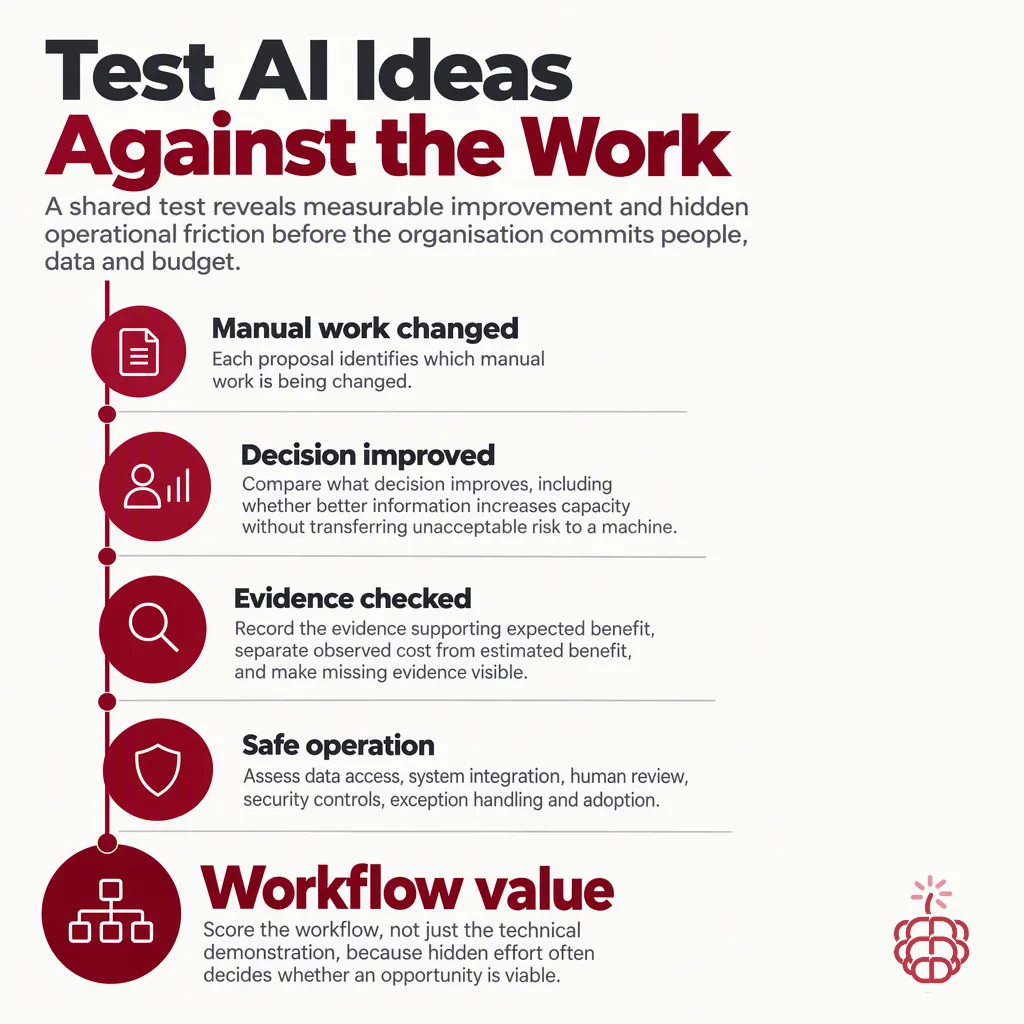
An AI backlog becomes expensive when every proposal follows a different path to approval. The commercial decision is not which idea sounds most impressive, but which piece of work can produce a measurable improvement with the least hidden operational friction.
The pattern we keep seeing is simple: organisations have no shortage of ideas, but no agreed way to compare them. The loudest sponsor gets attention, or every proposal is sent through the same sequence of evidence, validation, approval and action. That creates two bad outcomes. Weak ideas survive because they are politically visible, while useful ideas wait for a meeting that never reaches a decision.
A shared test changes the quality of the conversation. It forces each proposal to answer the same questions: which manual work is being changed, what decision improves, what evidence supports the expected benefit, and what must be true before the workflow can operate safely? This is not administrative discipline for its own sake. It exposes the cost of implementation before the organisation has committed people, data and budget.
The difficult part is usually not finding a model that can perform the task. It is connecting the model to the work around it. Data access, system integration, human review, security controls, exception handling and adoption can determine whether an apparently valuable use case reaches production. A useful prioritisation method therefore scores the workflow, not just the technical demonstration. Hidden effort in these areas often decides whether an opportunity is viable.
Consider a claims manager choosing between nine proposals. One would summarize incoming claims, another would help adjusters find policy clauses, and a third would automate a low-volume email classification task. The last option may be easiest to demonstrate. The first may matter more because adjusters spend much of their day assembling information before deciding what requires investigation.

A proper comparison would ask what each proposal removes from the process, how often the work occurs, what evidence can be checked, and where a human must remain accountable. If summarization shortens preparation but leaves the adjuster to verify every field manually, its value may be modest. If policy retrieval gives the adjuster reliable supporting passages at the point of review, the larger gain may be better and faster decisions, not fewer employees.
That distinction matters. Automation is often measured by the number of steps removed. Operating value is measured by the quality and speed of the decision that remains. The best candidate may not be the task with the clearest automation path. It may be the expensive bottleneck where better information increases capacity without transferring unacceptable risk to a machine.
The strongest objection is that a common scorecard can create false precision. A committee can assign numbers to uncertain benefits and then mistake the total for fact. That objection is valid. The answer is not to return to intuition, but to make uncertainty visible. Separate observed cost from estimated benefit, record missing evidence, and treat early approval as permission to test a claim, not proof that the claim is true.
This also explains why prioritisation should end in a sequence, not a leaderboard. One recent enterprise assessment moved from more than 150 documented pain points to 31 opportunities and 12 recommendations, linking selection with governance, workflow integration and readiness. The order matters because one project may establish the data, controls or trust needed by the next.
Our view is that AI prioritisation is less a technology exercise than a capacity decision. It determines which work the organisation is willing to understand deeply enough to change. The mature portfolio will contain fewer polished demonstrations and more evidence about where human judgement, systems and machines should meet.