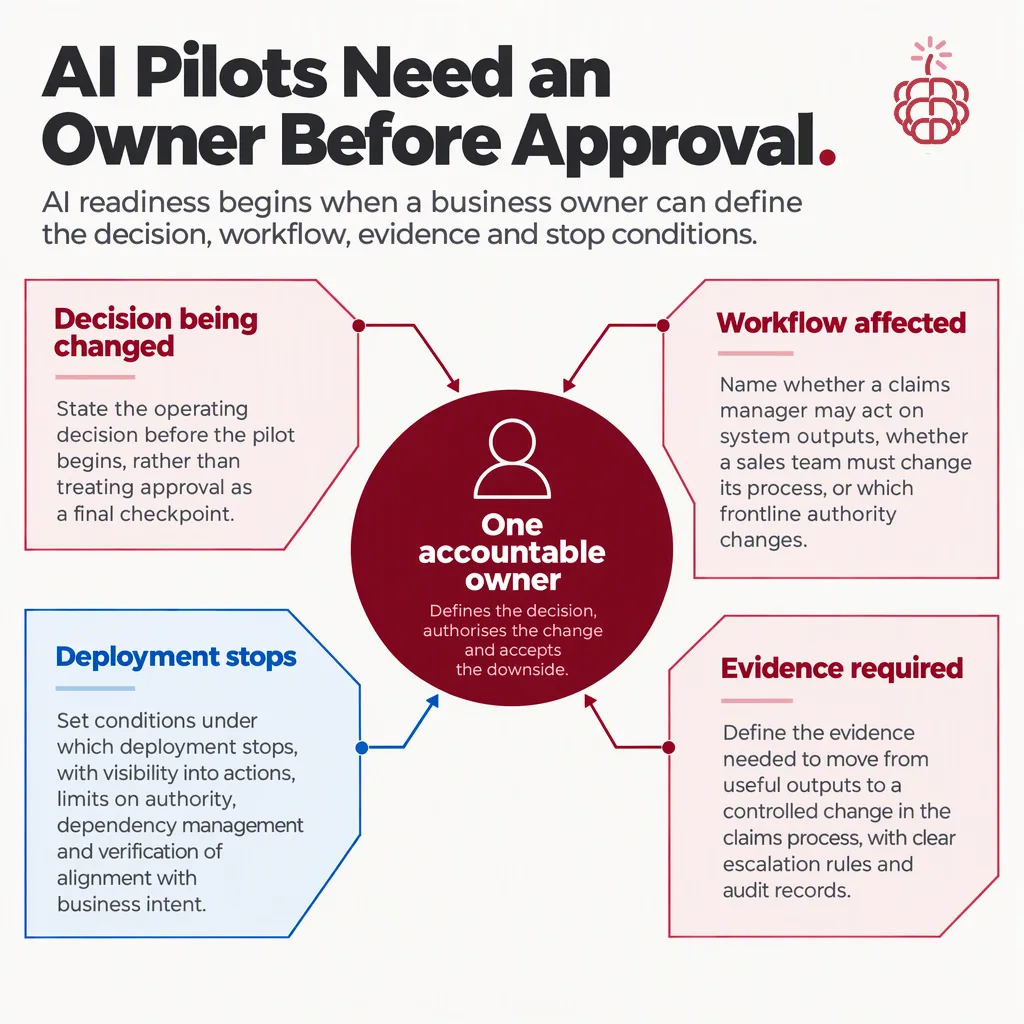
AI initiatives rarely fail because an organisation cannot find a capable model. They stall because the business cannot agree on what decision should change, who can authorize that change, or what risk the sponsor is willing to accept. The commercial decision is simple: stop treating approval as a final checkpoint and assign one accountable owner before the pilot begins.
The pattern we keep seeing is a project that receives positive feedback and no commitment. The board asks for more data, IT is asked for three options, legal requests a further review, and the business sponsor agrees to revisit the matter next quarter. Each request sounds prudent. Together, they create a project with activity but no decision.
That delay has a cost that rarely appears in the business case. Decision-making consumes management time through analysis, meetings, coordination and approval cycles. McKinsey describes this as one of the largest and least visible operating costs in a growing organisation, while arguing that AI’s economic value often comes from making better and faster decisions rather than simply reducing labour. A delayed AI initiative therefore does not just postpone software spend. It preserves the slow workflow the initiative was meant to change.
The mechanism is organisational. A pilot can demonstrate that a system produces useful outputs. It cannot, by itself, decide whether a claims manager may act on them, whether a sales team must change its process, or which executive owns the downside when the system is wrong. Those are operating choices. When they remain unresolved, technical progress makes little difference.
Consider an illustrative insurer. Its operations team tests an AI system that summarizes incoming claims and flags cases for specialist review. The demonstration works well enough to reduce manual sorting, but the project reaches the executive committee without a named decision owner. The chief information officer can explain security and integration. The chief operating officer can describe the workflow benefit. The risk officer can identify exceptions. Nobody can authorize the change in frontline authority.

The result is predictable. The insurer commissions another assessment, even though the next useful test is not a better model. It is a controlled change to the claims process, with clear escalation rules, audit records and a person accountable for outcomes. Until that decision is made, the organisation pays twice: once for the pilot and again for the manual process that continues beside it.
The strongest objection is valid. Boards should not approve systems they cannot observe, constrain or stop. Deloitte’s recent guidance on AI agents makes those controls explicit: leaders need visibility into actions, limits on authority, dependency management and a way to verify alignment with business intent. Caution is not the problem. Caution without a defined threshold for resolution is.
This changes the standard for readiness. A project is not ready because the model performs convincingly. It is ready when a business owner can state the decision being changed, the workflow affected, the evidence required, and the conditions under which deployment stops. IBM’s research reinforces the gap: many initiatives show technical promise but fail to deliver expected business value because processes, adoption and decision rights remain unresolved.
Our view is that the boardroom is not where AI projects should go to seek permission for an experiment. It is where executives should make the few operating decisions that experiments cannot make for them. The organisations that gain capacity from AI will not necessarily have the most ambitious pilots. They will be better at turning evidence into authority, and authority into a changed way of working.