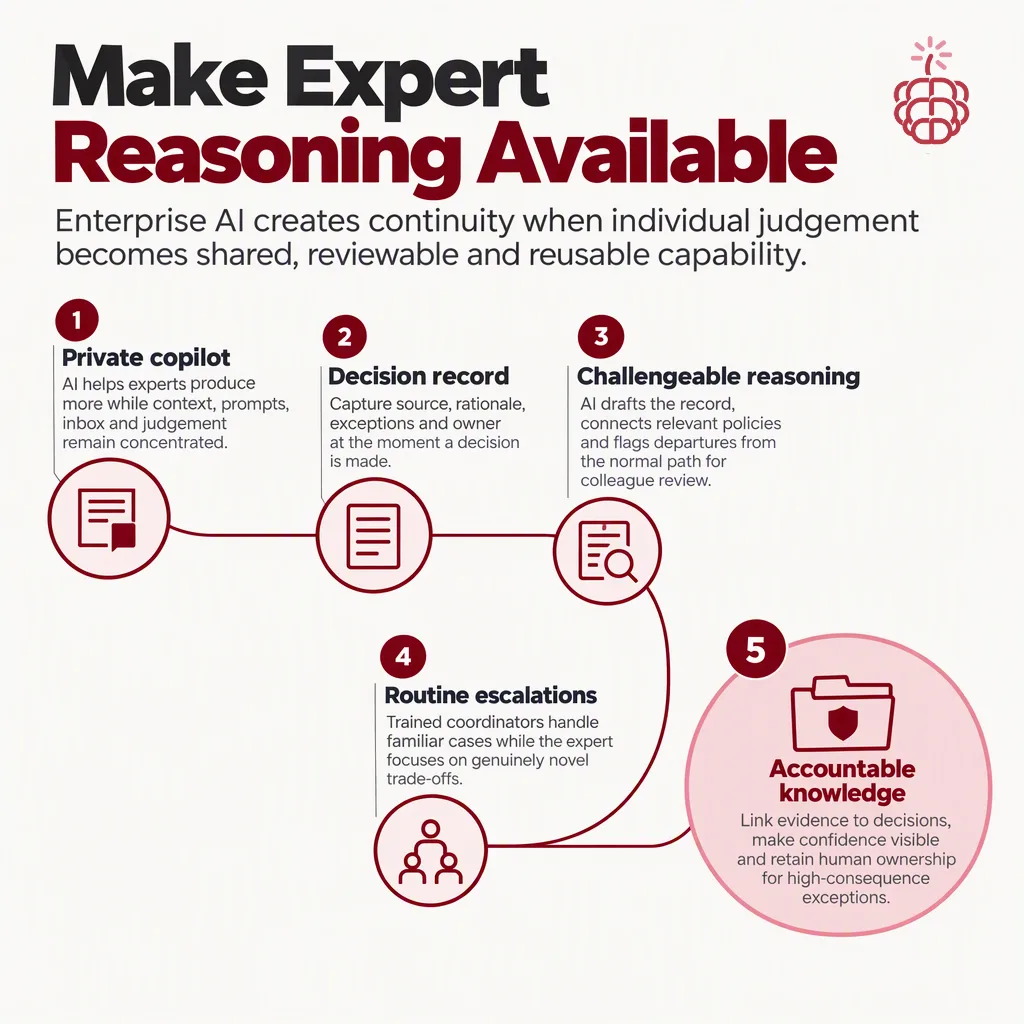
Knowledge concentration is a business continuity risk, not a productivity gap. AI becomes commercially useful when it turns individual judgement into a shared, reviewable operating capability, changing the decision leaders should make from “Who can work faster?” to “What capability remains when the expert is unavailable?”
The private copilot problem
The pattern we keep seeing is a subtle one: organizations introduce AI to help experts produce more, then leave the underlying expertise just as concentrated as before. The employee becomes faster, but the business remains dependent on the employee’s context, prompts, inbox and judgement.
That can make the risk harder to see. Performance improves while resilience does not. A key-person dependency may surface only when someone leaves, an audit requests evidence, a customer challenges a decision or a new team must take over the work. Knowledge concentration can complicate diligence, integration and scalability for precisely this reason: the business appears to have a process, but cannot reliably show how the process works without a particular person.
The mechanism for reducing that exposure is not a larger repository. It is capturing knowledge at the moment a decision is made, with its source, rationale, exceptions and owner attached. An AI assistant can draft the record, connect it to relevant policies and flag where the decision departed from the normal path. A colleague should be able to inspect and challenge it rather than accept an opaque answer.

Consider a regional industrial distributor whose senior procurement manager knows which suppliers can absorb an urgent order, when a quality warning is tolerable and which customers must be called before a substitution is made. A general-purpose copilot may help that manager write emails and compare quotes. A more useful system would also record the decision conditions behind each exception, link them to supplier and customer records, and make the reasoning searchable for the operations team.
The immediate effect is not that the manager becomes replaceable. It is that routine escalations move elsewhere. A trained coordinator can handle familiar cases, new staff can see how prior decisions were made, and the manager spends more time on genuinely novel trade-offs. The organization gains capacity without pretending that expertise has been reduced to a checklist.
The strongest objection is valid: some knowledge is tacit, contested or unsafe to encode automatically. AI-generated documentation can preserve errors with impressive fluency, and a shared answer is not necessarily a correct answer. That is why the target should not be total automation. It should be accountable knowledge: evidence linked to a decision, confidence made visible, and clear human ownership for high-consequence exceptions.
This changes the economics of departure and growth. Hiring remains necessary, but each hire does not have to recreate the organization’s memory from scratch. Onboarding can begin with decisions and patterns rather than scattered files. Continuity becomes a designed capability instead of an act of hope.
Our view is that enterprise AI should be judged partly by what it leaves behind. A demonstration that saves an expert ten minutes is useful. A workflow that makes the expert’s reasoning available, challengeable and reusable changes the organization. The real gain is not a faster individual. It is less dependence on any individual to keep the business moving.