Most organizations do not have an AI shortage. They have a decision-quality problem: too many promising demonstrations, too little evidence that a changed workflow will improve the business. The commercial decision should therefore change from “Which AI capability should we buy?” to “Which recurring decision or process can we improve, and how will we know?”
That distinction matters because demonstrations are designed to impress, while operating capabilities must survive permissions, exceptions, review, training and budget scrutiny. A polished assistant can summarize a document in seconds and still create no material value if employees must check every output, search across badly organized information or keep the old process running beside it.
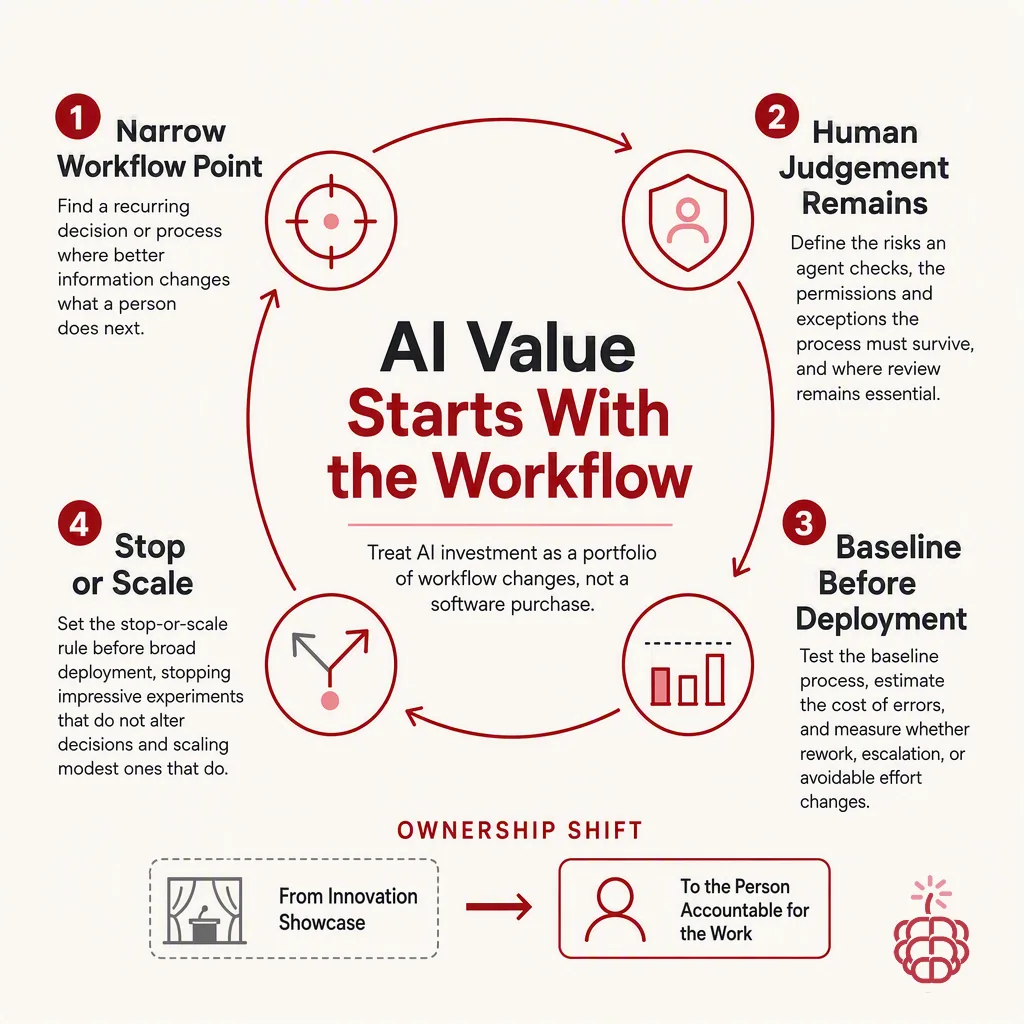
The pattern we keep seeing is that the difficult part is usually not selecting a model. It is finding a narrow point in the workflow where better information changes what a person does next. That might mean resolving a customer issue with less escalation, preparing a more complete account review or reducing the time a manager spends assembling evidence before approving work. The technology matters, but the value is created by the decision that becomes faster, cheaper or more consistent.
Independent research supports a more disciplined view of the opportunity. In a field study of more than 5,000 customer-support agents, generative AI increased productivity by about 14 percent on average, with larger gains among less experienced workers. That is useful evidence, but it is not a universal productivity promise. It suggests that assistance works best where the task is repeatable, the desired outcome is visible and good practice can be transferred through the system.
Consider a service team handling complex product questions. A Microsoft 365 assistant may find relevant material, draft a response and identify missing details. The compelling demonstration is the draft. The operating capability is the revised process: the system retrieves approved sources, the agent checks a defined set of risks, the final answer is recorded in the case system and supervisors can see whether rework or escalation has changed. The business result is not “employees used Copilot”. It is a better decision made with less avoidable effort.

This is also where investment validation earns its keep. A credible assessment should test the baseline process, identify where human judgement remains essential, estimate the cost of errors and define a stop-or-scale rule before broad deployment. Adoption metrics can show activity, but activity is not proof of value. A licence assigned, a prompt submitted or a generated summary accepted may all increase while the underlying work remains unchanged.
The strongest objection is that this approach can seem too slow when competitors are rapidly issuing licences and announcing pilots. That objection has force. Waiting for perfect measurement would waste opportunities. But speed without a bounded use case simply moves uncertainty from the pilot budget into operating costs, security exposure and employee distrust.
Our view is sharper: AI investment should be treated as a portfolio of workflow changes, not a software purchase. The organizations that gain durable capacity will be those willing to stop impressive experiments that do not alter decisions, while scaling modest ones that do. The important shift is therefore organizational. AI becomes commercially real when ownership moves from the innovation showcase to the person accountable for the work.