
The commercial case for an agentic software development lifecycle is not only faster code generation. It is the removal of recurring decisions and handoffs that consume engineering capacity without improving the product. Leaders should therefore judge these systems by the quality of the operating model around them, especially intake, gates and governance, rather than by the most impressive demonstration.
The pattern we keep seeing is simple: teams automate the visible task and leave the surrounding workflow untouched. An agent can draft a pull request in minutes, but that does not make a feature ready to build, safe to merge or valuable to customers. If the request is vague, the agent produces faster ambiguity. If approval rules are unclear, it produces faster risk.
The agentic SDLC matters because it moves AI from an individual tool into a standing business process. Agents can inspect incoming work, clarify requirements, identify dependencies, propose changes, review against defined standards and prepare evidence for a human decision. The gain is not that people disappear from the process. The gain is that their attention moves to the decisions that require context, judgement and accountability.
That shift changes where control must sit. Governance cannot be a final review document after the system is built. It has to be expressed in the workflow itself: which features are eligible, what information must accompany an intake, what an agent may read or change, which tests are mandatory, and where a person must approve the next step. Clear specifications become operational controls because agents, pipelines and reviewers can use the same statement of intent.
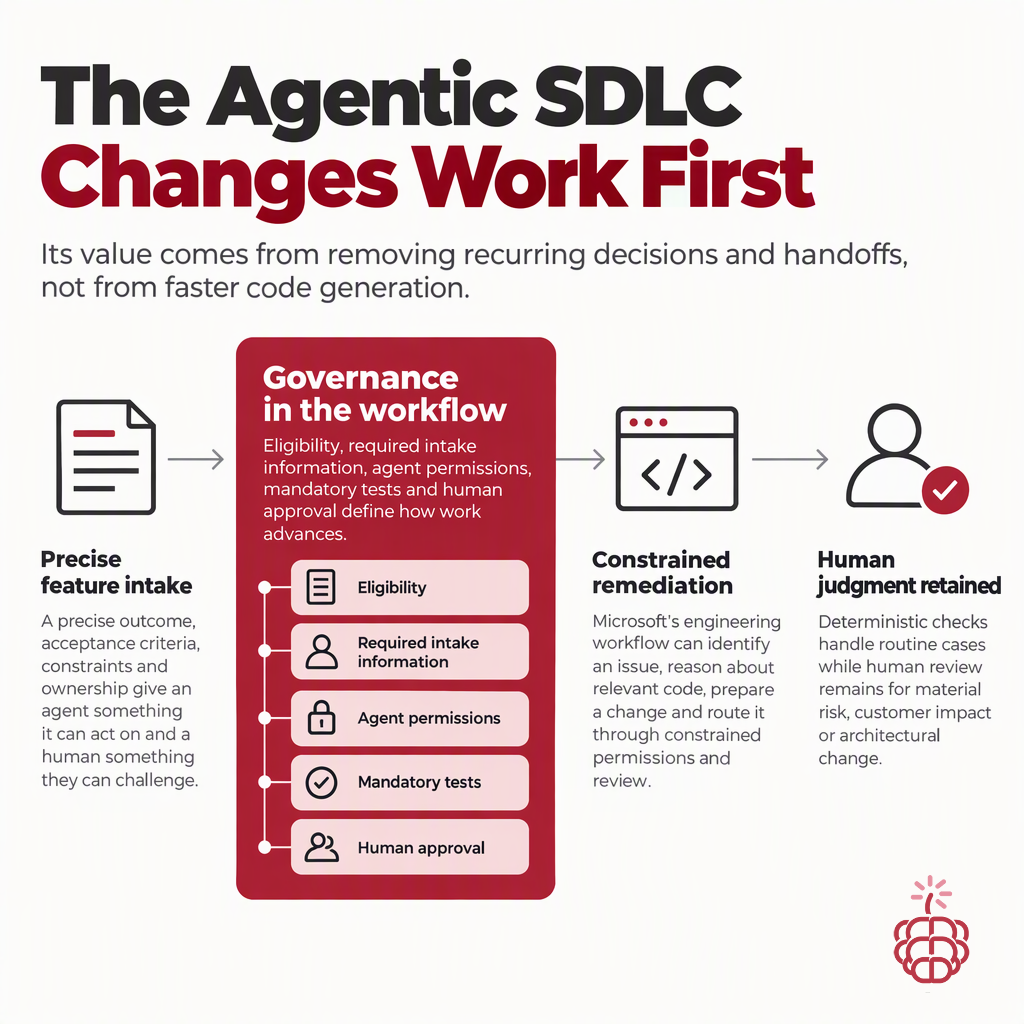
Consider Microsoft’s engineering work on security and compliance across its repositories. The useful outcome was not an agent that could suggest a remediation. It was a workflow that could identify the issue, reason about the relevant code, prepare a change and route it through constrained permissions and review. That distinction matters. The organization can reduce repetitive remediation work while retaining a deliberate point at which proposed changes are checked and accepted.
Our own move toward a fully agentic SDLC was not a single leap. It began in 2023 with AI suggestion, then iteratively evolving. The difficult part was not selecting a model. It was learning where to place gates. Early automation made it tempting to accept broad feature descriptions and let the system discover the work. In practice, better feature intake produced better downstream results. A precise outcome, acceptance criteria, constraints and ownership give an agent something it can act on and a human something they can challenge.
The strongest objection is that these controls can erase the speed advantage. They can, if governance means duplicating every manual approval around an automated task. The answer is not fewer controls by default. It is narrower, earlier controls, with deterministic checks handling routine cases and human review reserved for material risk, customer impact or architectural change. That is a design problem, not a reason to return to manual work.
This also changes the economics of delivery. More engineering capacity becomes available for product decisions and difficult technical work, while routine review, maintenance and triage become repeatable services. The uncertain part is how much capacity any organization will recover; it depends on process quality, system access and the proportion of work that is genuinely repeatable.
An agentic SDLC is therefore an organizational change disguised as a software feature. The companies that benefit will not be those that give agents the broadest authority. They will be those that make intent explicit, constrain execution and redesign ownership around faster, better-informed decisions.