
Enterprise AI creates value when it changes an operating decision, not when it produces an impressive demonstration. Steve Boey’s participation in the CIO Association of Canada’s Vancouver Chapter matters for that reason: it puts technical leadership closer to the executives who own service quality, risk, cost and capacity. The decision for technology leaders should change from “Which model should we test?” to “Which business decision should become better, faster or safer?”
The pattern we keep seeing is that AI pilots are often evaluated by the wrong audience. Technical teams can prove that a system generates a useful answer. The business still has to decide whether that answer can enter a real workflow, who is accountable for it, and what happens when it is wrong.
That gap is where many promising demonstrations stop. A model may summarize a case file, recommend a next action or identify an anomaly. None of that reduces cost or risk until someone changes how work is assigned, reviewed and approved. The difficult part is usually not model capability. It is fitting a new decision into an existing system of authority.
A CIO peer group is valuable because its members bring that authority into the discussion. CIOCAN describes its events as opportunities for technology executives to connect with peers and exchange insight on current industry issues. Its Vancouver chapter includes leaders responsible for enterprise systems, cybersecurity, education, financial services and technology operations, including Michael Fabri at the Justice Institute of British Columbia and Paul Taylor at the British Columbia Financial Services Authority. That is a more useful testing ground than a room focused only on software performance.
Consider a practical conversation between Steve and a CIO responsible for a regulated service. The attractive demonstration might be an AI assistant that drafts responses from internal records. The operating question is harder: can the assistant use the right records, show its sources, preserve sensitive information and route the draft to the person who remains accountable? If those conditions are absent, the tool may save keystrokes while adding review work and legal uncertainty.
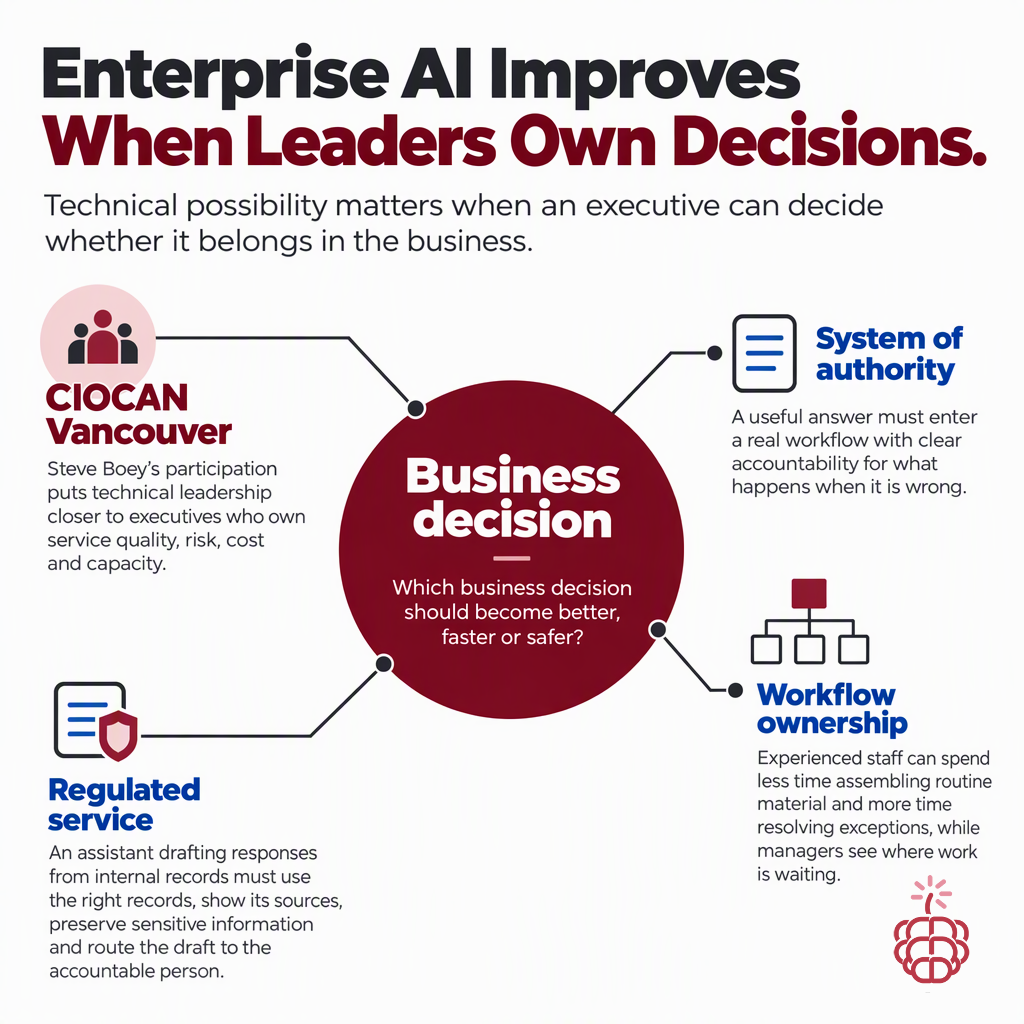
If the conditions are designed properly, the benefit is not simply faster drafting. Experienced staff spend less time assembling routine material and more time resolving exceptions. Managers gain a clearer view of where work is waiting. The organization can handle more demand without treating every increase in volume as a hiring problem. Those effects are possible, not guaranteed, and they depend on workflow ownership more than on a compelling interface.
The strongest objection is that professional associations can become conversation without execution. That risk is real. Peer access does not validate a use case, improve data quality or settle responsibility. It can, however, expose weak assumptions earlier, especially when leaders compare the same technology against different operating constraints.
Our view is that the most useful role for an enterprise AI practitioner is therefore not to bring more novelty into the room. It is to make the room more honest about decisions, evidence and consequences. CIOCAN’s national network represents more than 675 technology executives, according to independent reporting on the association’s 2026 awards. The strategic value of that proximity is not visibility for its own sake. It is a shorter path between a technical possibility and the executive who can determine whether it deserves to become part of the business.