
Most executive reporting fails for a simple reason: it measures the organisation’s appetite for information, not its ability to decide. The commercial cost is delayed action, duplicated analysis and risks that remain invisible until they become expensive. Leaders should judge reporting by the unknowns it removes and the decisions it improves, not by the volume of pages or dashboards produced.
The recurring pattern is familiar. A board pack grows because every function wants its context preserved. Each dashboard is defensible on its own. Together, they force executives to perform the synthesis that the reporting process was meant to provide. A green status can mean healthy performance, stale data, an offsetting metric or an owner who has not yet escalated a concern.
This is why adding another summary layer rarely fixes the problem. An executive dashboard is useful when it connects a small number of measures to strategic outcomes and decisions, rather than displaying every available measure. Independent guidance on dashboard design makes the same distinction: the aim is not to show all data, but to focus on information tied to business priorities and leadership action.
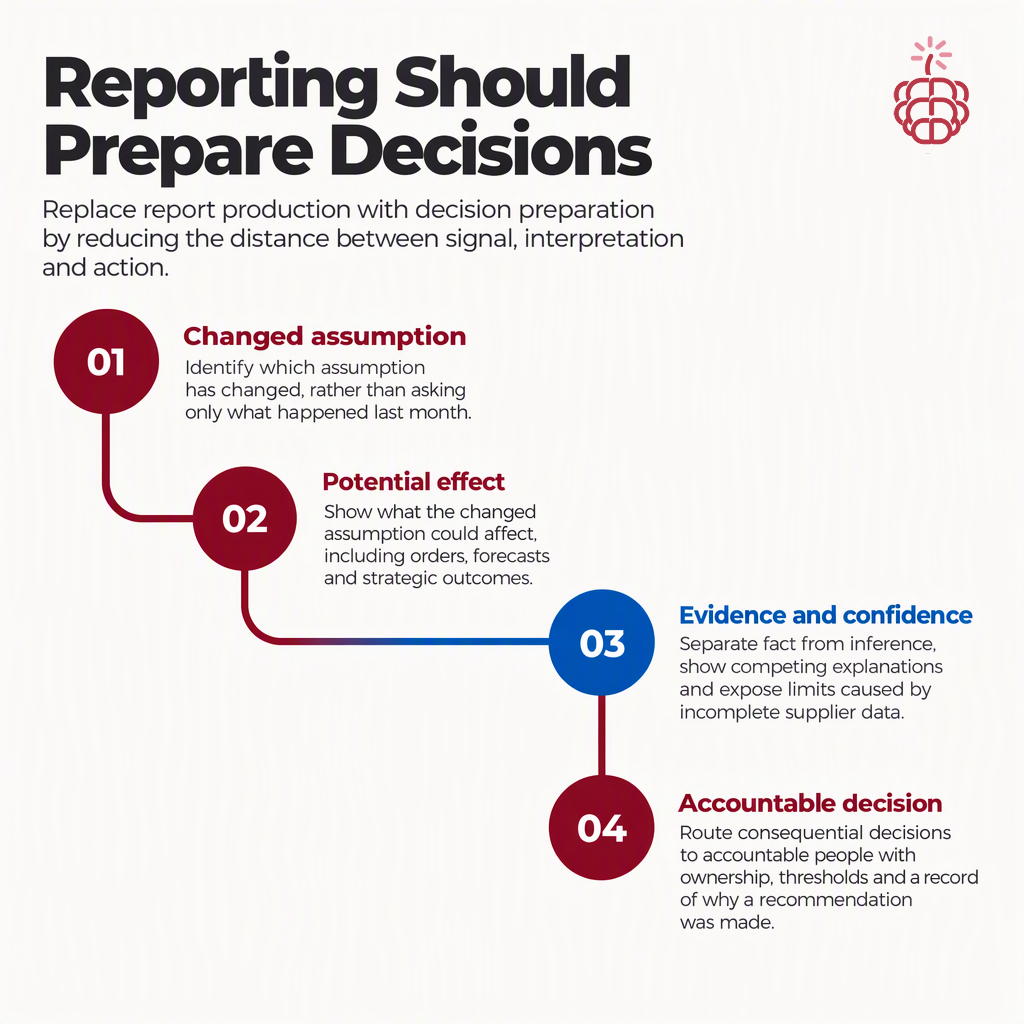
The mechanism that matters is a change from report production to decision preparation. Instead of asking, “What happened last month?” the system should ask, “Which assumption has changed, what could it affect, and who needs to decide?” That requires more than a language model. It requires reliable data definitions, time stamps, ownership, thresholds and a clear record of why a recommendation was made.
Consider a finance director reviewing a manufacturing company’s monthly pack. Revenue is on plan, so the headline remains green. An AI-supported review notices that two large orders depend on a supplier whose delivery performance has deteriorated, while the sales forecast still assumes the original arrival dates. The useful output is not another chart. It is a bounded alert: the forecast is exposed, the affected orders are identified, the confidence is limited by incomplete supplier data, and procurement and sales must resolve the conflict before the next planning cycle.
That changes the work. The finance director spends less time locating the relevant pages. The operating teams spend less time reconciling competing versions of the truth. More importantly, the organisation can decide while the issue is still manageable, rather than explaining a miss after the fact.
The strongest objection is that executives may not trust automated interpretation, and rightly so. A system that confidently invents causality creates a more dangerous unknown than a long report. The answer is not to remove human judgement. It is to make the system show its evidence, distinguish fact from inference, surface competing explanations and route consequential decisions to accountable people. Automation should narrow the field of attention, not quietly take responsibility for the outcome.
Our view is that reporting is becoming an operating capability, not a publishing task. Its value lies in reducing the distance between signal, interpretation and action. That shift also changes ownership: executives must define the decisions that matter, while functions must maintain the data and assumptions those decisions depend on.
The measure of a mature reporting system is therefore not how quickly it produces a forty-page pack. It is whether a leader can see what has changed, understand why it matters and act before uncertainty hardens into cost.