Most enterprises do not have an AI shortage. They have a work-design problem. Adding another assistant may improve an individual task, but commercial value appears only when AI changes how a decision, handoff or customer outcome moves through the organisation. The decision for leaders is therefore not which tool to buy next, but which workflow should be redesigned around accountable machine and human work.
The pattern we keep seeing is an uncomfortable one: the more successful an AI demonstration looks, the easier it is to mistake it for an operating capability. A chatbot that drafts a response in seconds is useful. It does not, by itself, ensure that the right customer record was checked, the approval threshold was respected, the action was logged or the next team received the work. The demonstration improves an interaction. The system must improve the process.
That distinction helps explain why enterprise adoption can coexist with disappointing results. A 2025 MIT estimate found that roughly 95 percent of task-specific generative AI initiatives had not delivered measurable business returns. The researchers pointed to poor fit with existing workflows and weak feedback loops as major barriers, rather than treating model quality as the whole problem. The finding has methodological limitations and should not be read as a universal benchmark. Its direction is nevertheless useful. More experiments do not solve a process that nobody owns.
Consider a hypothetical insurer handling commercial claims. A claims adjuster uses one assistant to summarize emails, another to search policy language and a third to draft a customer update. Each tool saves time in isolation. Yet the adjuster still decides when evidence is complete, re-enters information into the claims platform and asks a supervisor to confirm exceptions. The organisation has purchased acceleration without changing the queue.

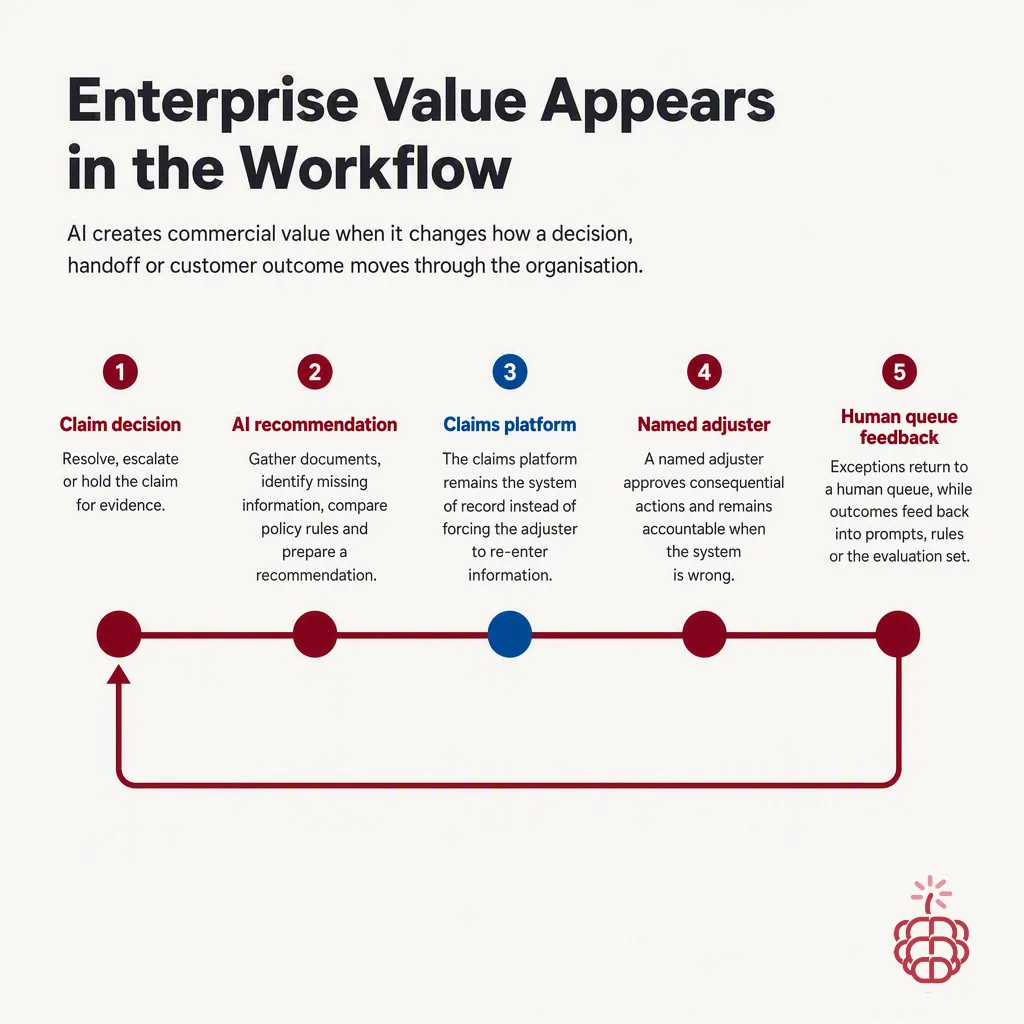
A system would begin with the business decision: can this claim be resolved, escalated or held for evidence? AI could gather relevant documents, identify missing information, compare the case with policy rules and prepare a recommendation. The claims platform would remain the system of record. A named adjuster would approve consequential actions. Exceptions would return to a human queue, and the outcome would feed back into the prompts, rules or evaluation set.
That design changes more than the speed of drafting. It can reduce duplicate handling, make escalation more consistent and give experienced adjusters capacity for ambiguous cases. It also exposes the difficult work that a collection of tools hides: data access, permissions, audit trails, ownership and a clear definition of a good decision.
The strongest objection is that systems cost more to build and govern than lightweight assistants. That is true. Not every workflow deserves orchestration. If a task is low-risk, infrequent and already well controlled, a simple tool may be the rational choice. The point is not to replace tools with elaborate platforms. It is to reserve system-level investment for work where handoffs, risk or volume determine the economics.
Deloitte’s research reaches a similar conclusion from the operating-model side: scaling AI requires changes to decision-making, capital allocation, risk governance and the way work gets done, not just broader deployment. Our view is sharper: AI maturity is less about the number of copilots in use than the number of important workflows with explicit machine participation, human accountability and measurable feedback.
The organisational consequence is larger than a technology refresh. Once AI becomes part of how work moves, ownership cannot remain split between an innovation team, IT and uncoordinated business users. The enterprise must decide which decisions it is willing to automate, which it wants to augment and who remains answerable when the system is wrong. That is where a collection of tools becomes a business capability.