
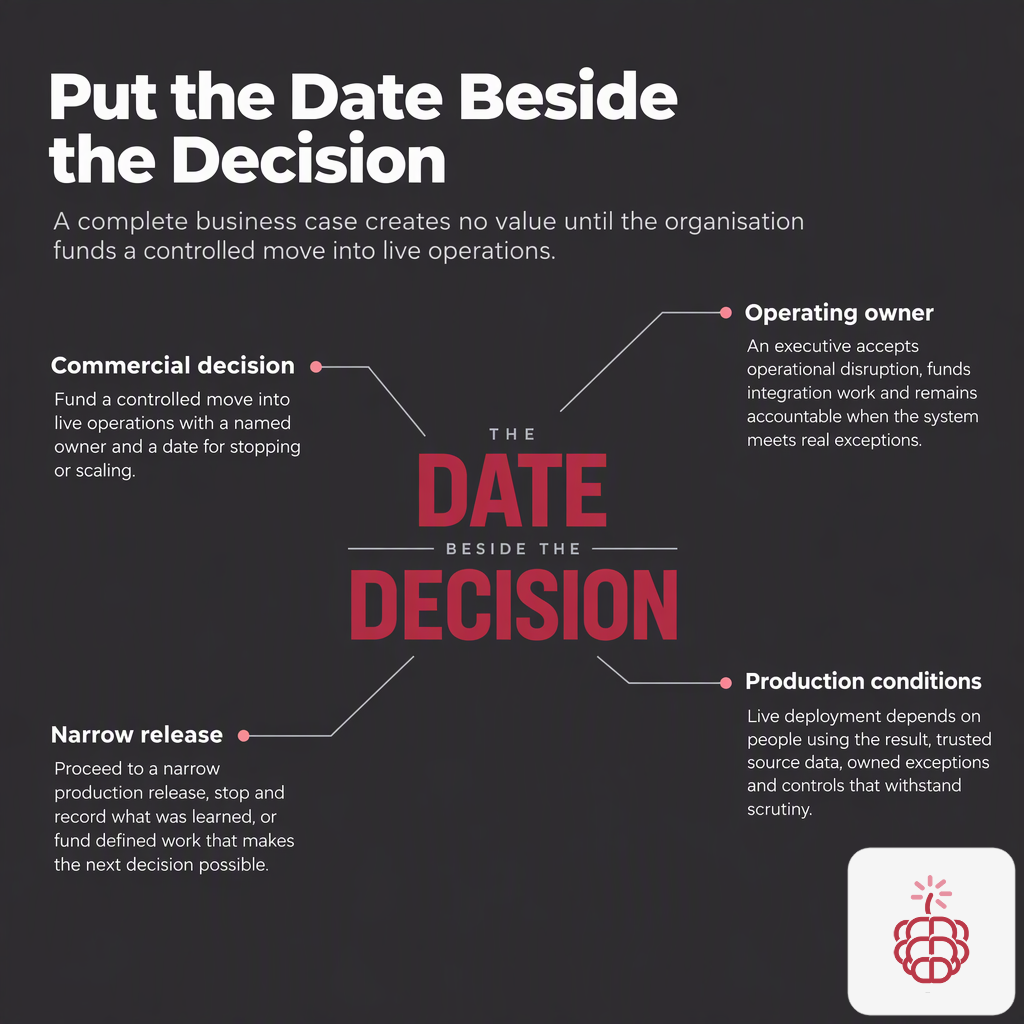
An AI business case can be complete and still produce no business value. The commercial decision is whether the organisation will fund a controlled move into live operations, with a named owner and a date for stopping or scaling. Treating more analysis as progress turns a decision into a permanent pilot.
The pattern we keep seeing is not failure in the usual sense. Nobody rejects the project. Nobody proves it useless. The proposal remains in committee while each review asks for another scenario, another risk assessment or another refinement to the forecast. Meanwhile, the business continues paying the cost the project was meant to reduce, or leaves capacity trapped in a manual process.
That delay is often described as caution. Sometimes it is. More often, it is an ownership problem disguised as an evidence problem. A business case can estimate value, but it cannot choose the executive who will accept the operational disruption, fund the integration work and be accountable when the system meets real exceptions. Those are decisions, not research tasks.
This distinction matters because a demonstration and an operating capability answer different questions. A demonstration asks whether a model can produce a plausible result under controlled conditions. Production asks whether people will use that result, whether source data can be trusted, whether exceptions have an owner and whether the control environment can withstand scrutiny. Independent analysis of enterprise pilots describes the same gap: projects commonly stall on data readiness, governance, integration and ownership rather than model quality.
Consider a manufacturer whose procurement team has shown that an AI assistant can summarize supplier correspondence and flag orders at risk. The business case estimates less analyst time spent searching email and faster escalation of late components. The committee asks for better accuracy evidence, so the team runs another test. What remains undecided is more consequential: will procurement change its workflow, who will approve an escalation, and which system becomes the record when the assistant is wrong?
Until those questions have owners, another test mostly produces better material for the next meeting. The project is not reducing work. It is adding work for the team that built it, while the old process stays in place. The expected saving is therefore not false, but it is not yet earned.
The strongest objection is legitimate. Committing too early can scale an unsafe or uneconomic system. A date should not force a launch. It should force a decision with explicit conditions: proceed to a narrow production release, stop and record what was learned, or fund a defined piece of work that makes the next decision possible. Governance belongs in that decision, not after it. Research on the pilot to production gap similarly emphasizes that live deployment requires operational controls and a business owner, not just a successful proof of concept.
Our view is that the date belongs beside the decision because uncertainty is not removed by extending a pilot indefinitely. It is reduced by exposing the system to the specific workflow, controls and accountability that determine value. A short, bounded release can reveal more than another polished demonstration, provided the organisation is prepared to act on what it learns.
The larger implication is uncomfortable: enterprise AI adoption is less a race to build models than a test of whether leaders can make accountable choices under incomplete information. The stalled business case is not waiting for technology. It is waiting for permission to become an operating commitment.