
Microsoft’s move to place agents inside Dynamics 365, Outlook and Teams changes the commercial question. The opportunity is not faster drafting; it is faster, better-informed decisions inside the work people already do. The decision for leaders is whether to prepare the information estate before asking agents to act on it.
The pattern we keep seeing is simple: companies buy an intelligent interface, then discover that the underlying information is scattered, duplicated, stale or shared too broadly. An Outlook agent can find a contract, summarize a customer relationship and suggest a next step. That does not make the contract current, the relationship complete or the recommendation safe.
This matters because an agent changes the cost of using information. Employees no longer need to know which folder, mailbox or system contains an answer. They can ask for it in the flow of work. That convenience is valuable only when the information is both relevant and permissioned. Otherwise, the organization has made bad knowledge easier to retrieve and potentially sensitive knowledge easier to expose.
Microsoft’s own guidance treats oversharing as a central Copilot and agent risk. It recommends identifying excessive access across Microsoft 365, reviewing site permissions, restricting discovery where necessary, and archiving or deleting content that is no longer needed. This is not housekeeping before the real project. It is part of the operating capability.
Consider a regional sales director preparing for a renewal in Outlook. An agent can assemble recent correspondence from Outlook, account records from Dynamics 365 and service information from connected systems. But a shared drive may contain an old pricing sheet, an unsigned amendment and an internal note with restricted commercial terms. If those files are poorly labelled or accessible to the wrong group, the agent may produce a polished answer that is incomplete, misleading or inappropriate to share.
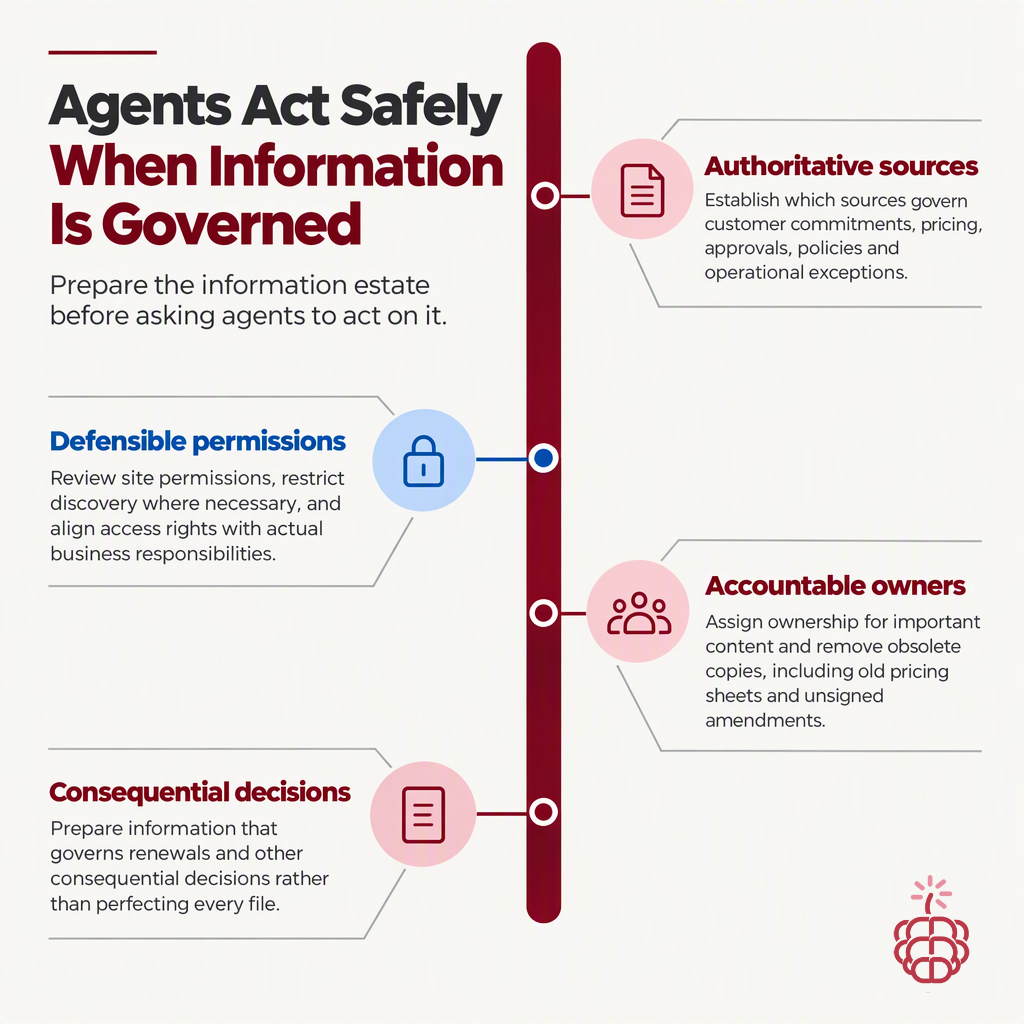
The immediate fix is not to make the agent more eloquent. It is to establish which sources are authoritative, assign ownership for important content, remove obsolete copies and align access rights with actual business responsibilities. That work also improves ordinary search, onboarding and manual decision-making, so its value does not depend on agent adoption.
The strongest objection is that modern agents can reason across business context rather than simply search documents. Microsoft describes Work IQ as a way to connect business data, relationships and rules so agents can support decisions across systems, rather than return isolated records. That makes the data problem more consequential, not less. Better reasoning can amplify a sound operating model, but it can also connect inconsistent records at greater speed.
Our view is therefore narrower than “clean your data before AI.” Companies should prepare the information that governs consequential decisions: customer commitments, pricing, approvals, policies and operational exceptions. Perfecting every file is neither necessary nor realistic. Establishing trustworthy sources, defensible permissions and accountable owners is.
The organizational change is easy to miss. When agents move into everyday applications, information management stops being an IT background task and becomes part of how work is controlled. The firms that gain capacity will not necessarily have the most impressive demonstrations. They will be the ones that can let an agent act because the business knows what the information means, who may use it and when it can be trusted.