The commercial risk in enterprise AI is shifting from choosing a capable model to controlling what that capability can do. Organizations that build their own control layer will be better able to increase AI’s reach without surrendering authority over data, decisions, execution or evidence.
The pattern we keep seeing is simple: a convincing demonstration can hide an operating problem. A model may summarize a contract well in a test, but an enterprise must also decide which contracts it can read, which recommendations require approval, what systems it may change and how its actions can later be reconstructed. Capability creates value only when the surrounding workflow can contain it.
That is why governance cannot remain a policy document or a model-by-model review. Frontier systems are increasingly used as components in workflows, where employees, software agents and connected services may all act on corporate assets. The relevant unit of control is therefore the intelligence layer: the models, prompts, tools, data, permissions and decisions that work together.
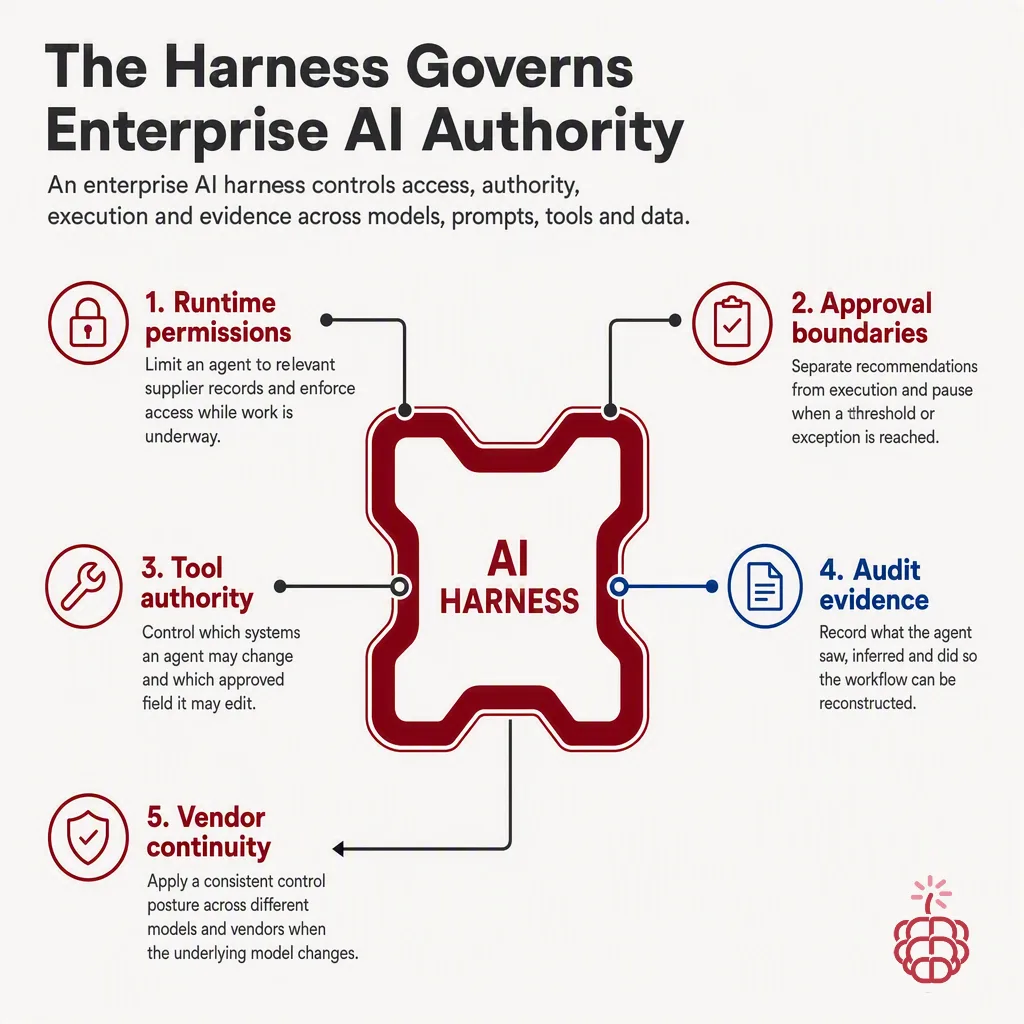
Consider a procurement team giving an AI agent access to supplier records and an enterprise resource planning system. The agent might identify a cheaper renewal and prepare the purchase order. The useful question is not whether the model is accurate in general. It is whether the agent can access only the relevant records, change only an approved field, pause when a threshold or exception is reached, and leave an audit trail that shows what it saw, inferred and did. Those controls determine whether the workflow reduces administrative work or creates an unpriced liability.
An enterprise AI harness makes those boundaries operational. It can enforce permissions at runtime, separate recommendations from execution, record activity, test behaviour against defined risks and apply the organization’s compliance requirements across different models and vendors. This does not make the system safe by default. It makes safety and accountability inspectable, adjustable and enforceable where the work occurs.

The strongest objection is that model providers already supply guardrails. Those controls are useful, and organizations should use them. They cannot, however, know every internal approval rule, data classification, segregation of duties requirement or business exception. Vendor safeguards also do not remove the need to compare model behaviour, investigate incidents or preserve a consistent control posture when the underlying model changes.
Owning the harness does not mean owning every model or rebuilding every control. It means owning the decisions about access, authority, monitoring and evidence. That distinction preserves flexibility while reducing the chance that a vendor change silently changes the organization’s risk.
The difficult part is usually not writing the policy. It is deciding where AI authority ends and human or system authority begins, then enforcing that boundary under real operating conditions. Governance is consequently an engineering discipline as much as a compliance function.
The larger shift is organizational. As intelligence becomes easier to add to workflows, competitive advantage will depend less on finding a permanently superior model and more on expanding useful capacity without losing control of the business. The AI harness becomes the institution’s way of governing intelligence, not just deploying software.