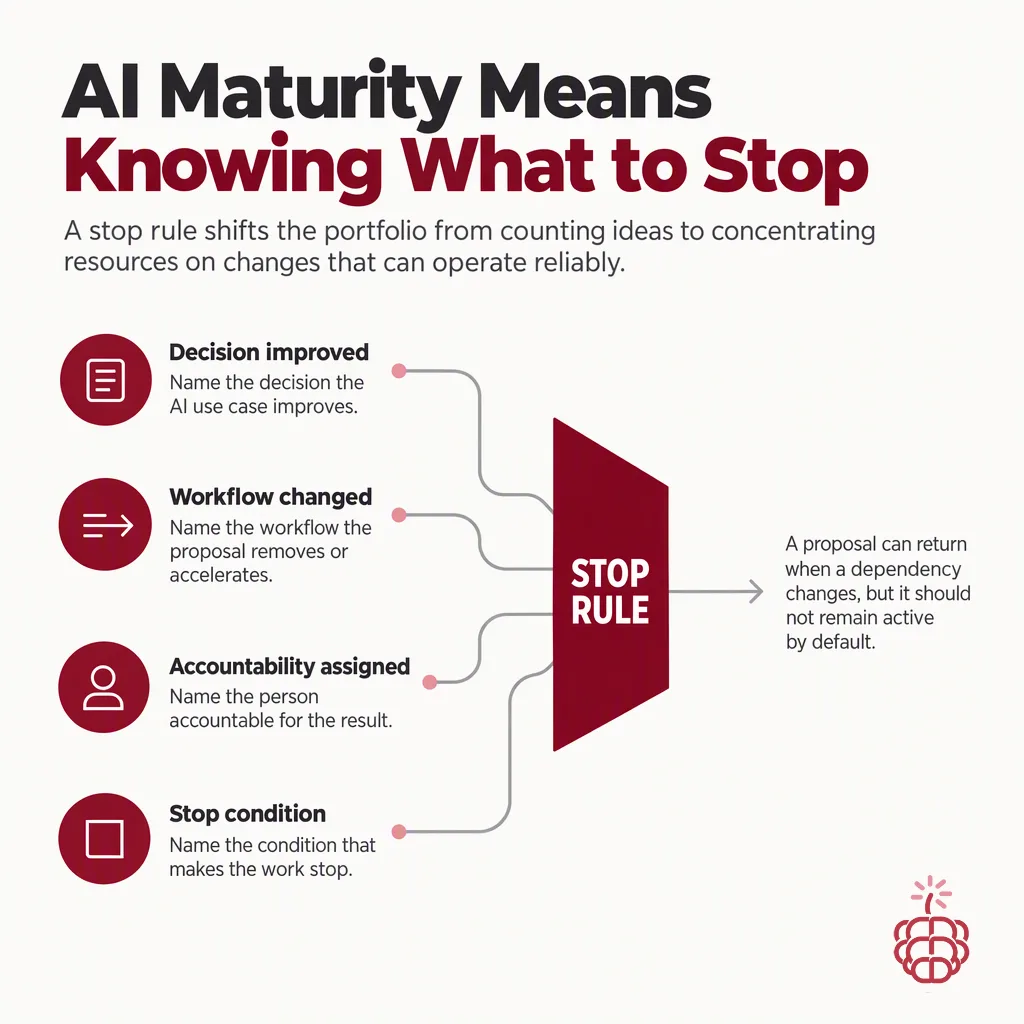
Most companies do not have an AI pipeline problem. They have a decision problem. When every department can propose a use case but no one must retire one, experimentation becomes a queue of unpaid commitments. The commercial decision should change: stop treating the number of ideas as evidence of progress, and start measuring how quickly the organisation can reject weak work and concentrate resources on the few changes that can operate reliably.
The pattern we keep seeing is simple. A use-case register creates the appearance of control, while ownership remains distributed across committees, innovation teams and business functions. Each proposal looks inexpensive in isolation. Together, they consume architecture time, security reviews, data work and scarce people who could be taking a promising capability into production.
This matters because a demonstration and an operating capability are different investments. A pilot can show that a model produces a plausible answer. Production requires a business owner, acceptable error, access controls, monitoring, integration with existing systems and a response when the system is wrong. Independent reporting on enterprise AI implementation identifies the same gap: many organisations use AI in at least one function, yet a much smaller share has begun scaling it across the enterprise. Clear ownership and measurable outcomes are among the conditions that separate a pilot from a deployable system.
A stop rule changes the economics before a team writes more code. An idea should leave the portfolio when it cannot name the decision it improves, the workflow it removes or accelerates, the person accountable for the result, and the condition that would make the work stop. This is not bureaucracy added to innovation. It is a way to prevent technical enthusiasm from becoming an indefinite claim on operating capacity.

Consider a retail bank's lending operations team proposing an assistant for credit analysts. In a workshop, the prototype summarizes application documents convincingly. That is useful evidence, but not yet a business case. The accountable executive must still decide whether the assistant will shorten review time, improve consistency or simply add another screen. The team must define who checks its output, what happens when documents conflict, and whether the existing workflow can record the reasoning. If those answers remain vague after a short discovery period, stopping the proposal protects the bank from funding a polished detour.
The strongest objection is that early ideas are hard to assess. A rigid filter can reject learning before the value is visible, especially where the benefit is strategic or the data is immature. That objection is valid. Stop rules should therefore end a stage, not necessarily erase the idea. A proposal can return when a dependency changes, but it should not remain active by default. Preservation is cheap; active sponsorship is not.
The difficult part is usually not ranking forty ideas. It is making senior leaders accept that choosing one means withholding attention from the other thirty-nine. That choice exposes duplicated work, weak data ownership and processes no one wants to redesign. It also reveals where AI is being used to avoid a harder operational decision.
Our view is that AI maturity will show less in the size of an organisation's use-case catalogue than in its ability to close work cleanly. The winning capability is not endless invention. It is disciplined allocation of decision rights, engineering time and change capacity. A company that knows what to stop can give a viable AI system somewhere to go.