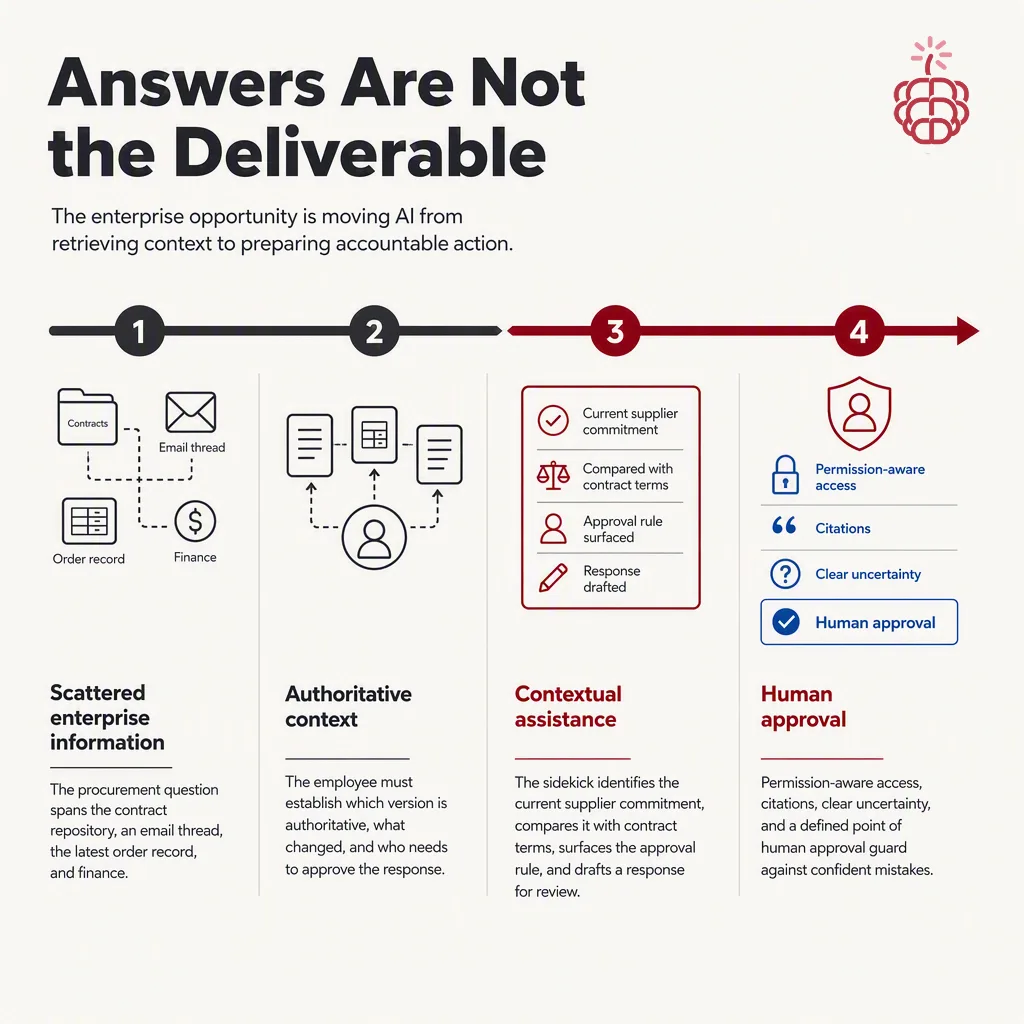
Most companies treat workplace questions as a search problem. Our view is that the commercial loss happens after retrieval: people must rebuild context, judge conflicting information, and decide what to do next. An effective AI sidekick should therefore reduce the distance from question to sound action, not simply return a faster answer.
That distinction matters because finding information is only one interruption in a longer chain. A procurement manager asking whether a supplier can meet a revised delivery date may search the contract repository, scan an email thread, check the latest order record, and ask finance about an exception. The answer may be available in minutes. The work of establishing which version is authoritative, what changed, and who needs to approve the response can consume the rest of the hour.

This is why conventional enterprise search often disappoints despite improving retrieval. It returns documents into the employee’s workflow and leaves the employee to perform the reasoning. Research cited by Kore.ai describes enterprise information as spread across structured and unstructured sources including databases, email, customer relationship management systems, PDFs, chat threads, and policy documents. The fragmentation is not a minor usability flaw. It makes every decision depend on a person’s ability to reconstruct a reliable picture from partial records.
The more useful pattern is contextual assistance. In the procurement case, a sidekick would identify the current supplier commitment, compare it with the contract terms, surface the relevant approval rule, and draft a response for review. It would show the sources and flag that the order record is newer than the email thread. The manager still owns the decision, but no longer spends the first part of the job acting as a human integration layer.
That changes the economics in a more meaningful way than shaving seconds off a search. The gain is fewer duplicated questions, fewer avoidable handoffs, and more consistent decisions when experienced employees are unavailable. It also increases organisational capacity: a specialist can handle more exceptions because the routine work of assembling evidence has been compressed.
The strongest objection is valid. An assistant connected to bad permissions, stale records, or ambiguous policies can make a confident mistake faster. Direct answers without traceable evidence may be more dangerous than a slow search. Any credible deployment therefore needs permission-aware access, citations, clear uncertainty, and a defined point of human approval. The tool must be judged by the decisions it supports, not by how impressive its responses look.
There is a second complication. A personal sidekick can make each employee more productive while leaving the organisation’s knowledge fragmented. If useful prompts, decisions, and exceptions remain private, the company creates a collection of clever individual workarounds rather than a better operating system. The capability becomes more valuable when approved outputs can improve shared procedures without turning every interaction into a documentation task.
The answer was never the slow part because answers are rarely the deliverable. Decisions are. The enterprise opportunity is to move AI from retrieving context to preparing accountable action. That is an organisational change: less time spent navigating the company, and more capacity spent choosing what the company should do.