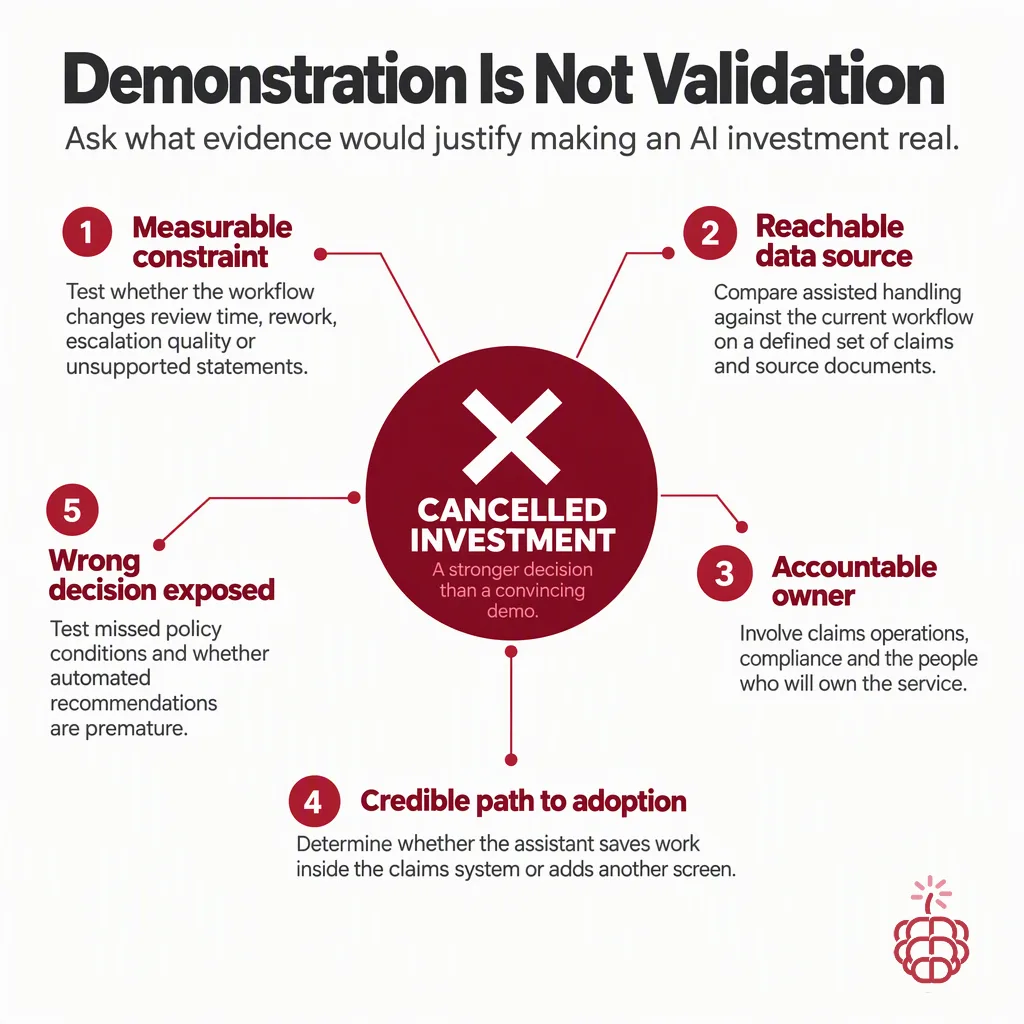
The most valuable AI decision is often made before a model is chosen: deciding which problem deserves investment. Early validation reduces the risk of funding a convincing demonstration that cannot improve a customer outcome, operating cost or management decision. Leaders should change the approval question from “Can this work?” to “What evidence would justify making it real?”
The pattern we keep seeing is simple. An AI pilot can look successful while the business case remains untested. A polished prototype proves that software can produce an output under controlled conditions. It does not prove that employees will use it, that the underlying process is ready, or that the result changes economics once controls, exceptions and ownership are included.
That gap explains why pilot success is a weak investment signal. A reported MIT NANDA analysis of more than 300 enterprise deployments found that most generative AI pilots produced no measurable profit-and-loss impact, attributing the problem less to model capability than to how the work was integrated into the business. Gartner has likewise been reported as finding that many generative AI projects are abandoned after proof of concept because organizations underestimate data, governance and implementation costs. These findings are directional rather than a universal failure rate, but the commercial lesson is sound: demonstration is not validation.
Validation is a smaller, more disciplined activity. It tests whether a specific workflow has a measurable constraint, a reachable data source, an accountable owner and a credible path to adoption. It should also expose what happens when the system is wrong. The aim is not to make the model look good. It is to make the investment decision less ambiguous.
Consider a hypothetical insurance company exploring an AI assistant for claims handlers. A demo can summarize a claim in seconds. That may impress executives, but it leaves the expensive questions unanswered: does the summary reduce handling time, or do handlers reread the source documents? Can it distinguish evidence from speculation? Who approves a claim when the assistant misses a policy condition? If the tool sits outside the claims system, does it save work or add another screen?

A short validation could compare the current workflow with assisted handling on a defined set of claims. It could measure review time, rework, escalation quality and the rate of unsupported statements, while involving claims operations, compliance and the people who will own the service. The likely result is not always a green light. It may show that summarization is useful, but automated recommendations are premature. That is a productive finding: capital can move toward the narrower use case before the organization pays to automate the wrong decision.
The strongest objection is that validation can become another committee process that delays learning. That risk is real. A six-month assessment is not prudence; it is avoidance. Validation earns its place when it is time-boxed, tied to a decision and designed to kill weak ideas quickly. It should be cheaper than implementation and specific enough to produce a clear next step.
Our view is that AI portfolio discipline will matter more than access to better models. The scarce resource is not experimentation. It is the organizational capacity to absorb a new decision into a live workflow. The best leaders will therefore treat cancellation as evidence of progress when it prevents a system from becoming an expensive obligation. In that sense, the first AI capability a company needs may be a reliable way to decide what not to build.