
A model that wins a benchmark can still be the wrong choice for the work that pays the bills. Enterprises should evaluate models against complete decisions and workflows, not isolated answers, because the result changes what can be automated, what still needs review, and what the work costs to operate.
The recurring mistake is treating model selection as a leaderboard exercise. A benchmark usually asks which system produces the strongest response to a defined prompt. Real work asks a less tidy question: can this system handle incomplete information, follow the organisation’s rules, expose uncertainty, and produce an output someone can safely act on?
That difference matters more than a small gap in answer quality. A model may write an impressive response yet create extra work if employees must check every claim, correct its format, or move information between systems. Another model may appear less capable in a demonstration but fit the workflow better because it is more predictable, easier to constrain, or cheaper to run at the required volume. The useful unit of evaluation is therefore not the response. It is the completed job.
Consider a procurement team reviewing supplier contracts. A model is asked to identify renewal dates, unusual terms, and missing information. In a demonstration, reviewers may prefer the model that produces the most polished summary. In practice, the team needs fields extracted consistently, unsupported conclusions marked clearly, exceptions routed to the right person, and results recorded in its existing process. If the model’s elegant summaries hide uncertainty, the team gains reading material rather than capacity.
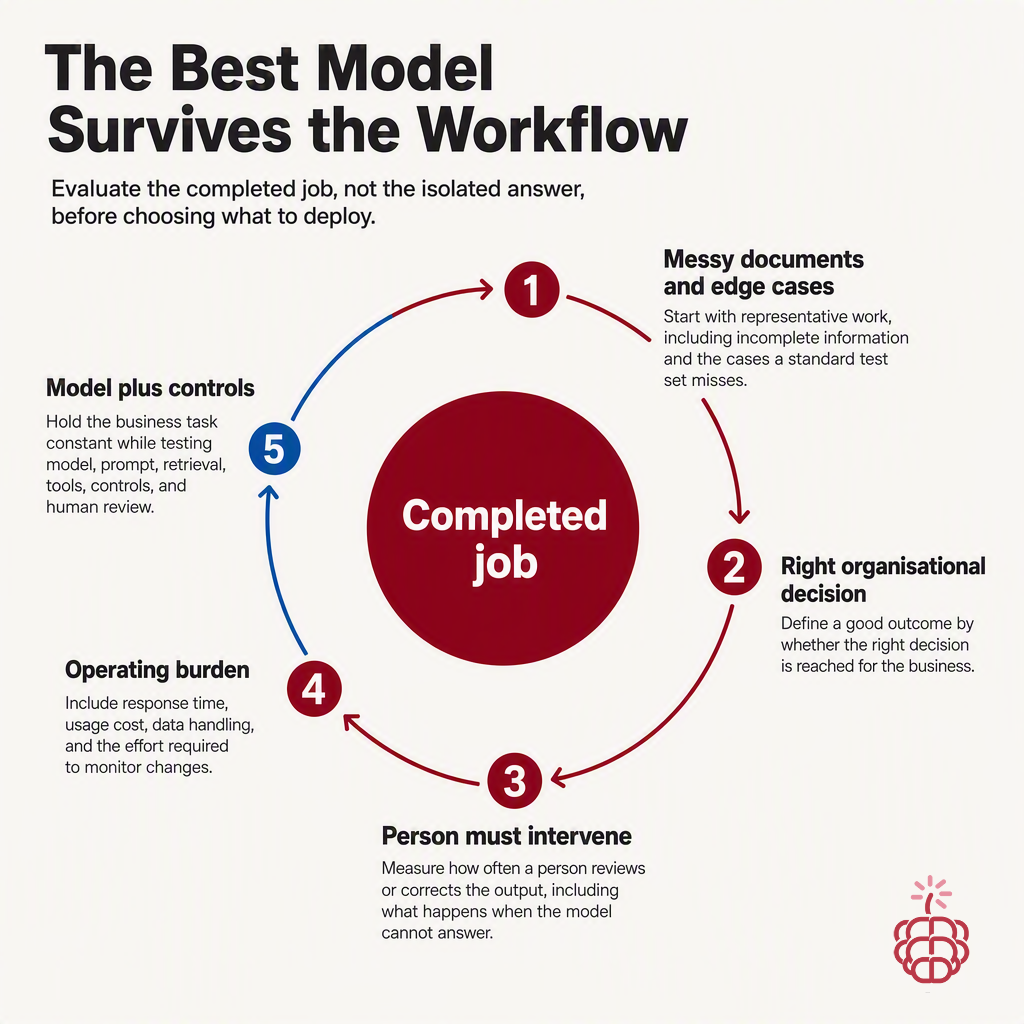
The evaluation should follow that chain. Start with representative work, including messy documents and edge cases, then define what a good outcome means for the business. Measure whether the right decision is reached, how often a person must intervene, how much correction is required, and what happens when the model cannot answer. Include operating factors such as response time, usage cost, data handling, and the effort required to monitor changes. These are not secondary technical details. They determine whether a promising test becomes a dependable service.
This is also why thinking beyond Claude, or any single familiar model, is the wrong framing. The choice is rarely between brand names in the abstract. It is between combinations of model, prompt, retrieval, tools, controls, and human review. A model’s performance can change when the surrounding workflow changes, so a fair comparison must hold the business task constant while testing the configurations that might actually be deployed.
The strongest objection is that this approach takes more time than running a standard test set. It does. But a quick benchmark can create false confidence, especially when failure is expensive or difficult to detect. The answer is not to build an enormous evaluation programme. It is to test the few workflows where quality, volume, and risk make the decision consequential, and to record failures as carefully as successes.
Our view is that model evaluation is becoming an operating discipline rather than a procurement event. The winning system will not always be the one with the highest general score. It will be the one that makes a specific organisational decision faster or safer without moving hidden effort onto employees. That shifts the question from “Which model is best?” to “Which arrangement of capability and control gives this work a better outcome?”