
The strongest AI model is not the one that wins an isolated test; it is the one that improves a real business process without creating more work around it. Leaders should therefore change the buying decision from “Which model performs best?” to “Which model can be governed, adopted and maintained inside the workflow that matters?”
The pattern we keep seeing is a mismatch between demonstration quality and operating value. A model can produce an impressive answer in a controlled prompt, yet fail when the request is incomplete, the source data is messy, a decision needs approval, or the result must enter another system. The gap is not a minor implementation detail. It is where much of the expected benefit disappears.
A production workflow is a chain of decisions, handoffs and exceptions. The model is one link in that chain. Its useful performance depends on whether it receives the right context, produces an output a person can assess, respects the organization’s controls and leaves a clear path when confidence is low. Testing the model alone measures only part of the capability the business is buying.
Consider a procurement team reviewing supplier contracts. A demonstration might ask a model to identify a renewal clause in a clean document and return a correct answer. In practice, the team may receive scanned files, amendments stored elsewhere and agreements that use different terminology. The output must then be checked by a procurement manager, recorded in the contract system and routed to legal when the clause creates an unusual obligation.
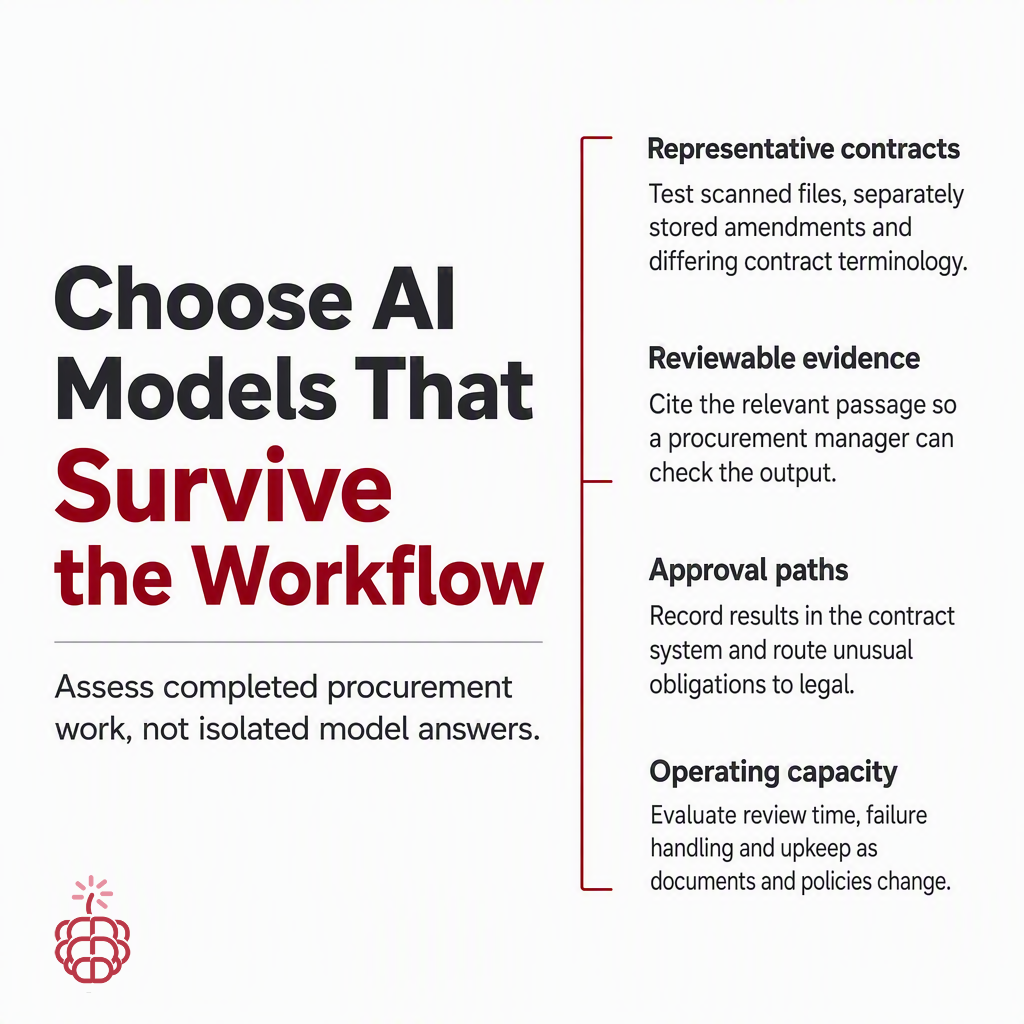
A model that is slightly less capable on a benchmark may be the better choice if it handles those conditions predictably, cites the relevant passage for review and fits the team’s existing approval path. A more capable model can still be the wrong operating decision if its errors are difficult to detect, its responses vary without a useful signal, or its output forces staff to reconstruct the evidence manually.
This changes what evaluation should include. Teams need to test representative tasks, not just ideal prompts. They need to observe failure handling, review time, escalation rates, data access and the effort required to keep the workflow accurate as documents and policies change. The unit of assessment is not an answer. It is a completed piece of work.
That approach also exposes a harder cost. If every output requires a specialist to verify the model line by line, the system may reduce drafting time while preserving the bottleneck that determines throughput. In some cases it can add a new control burden, because staff must monitor both the original process and the AI’s behaviour. A compelling pilot can therefore show that the model is capable without showing that the organisation has gained capacity.
The strongest objection is that workflow evaluation can slow experimentation. That is true. A narrow model comparison is cheaper at the start. But speed at selection is not the same as speed to value. If the surrounding process is ignored, the organisation learns late that its data, approvals or ownership model cannot support the chosen system.
Our view is that model choice should remain flexible, while workflow requirements should become firm. Models will change. The business question should endure: does this system make a consequential decision faster, safer or less costly, and can the organisation tell when it should not be trusted? The competitive advantage will belong less to the company with the most impressive model than to the one that can turn model capability into dependable operating capacity.