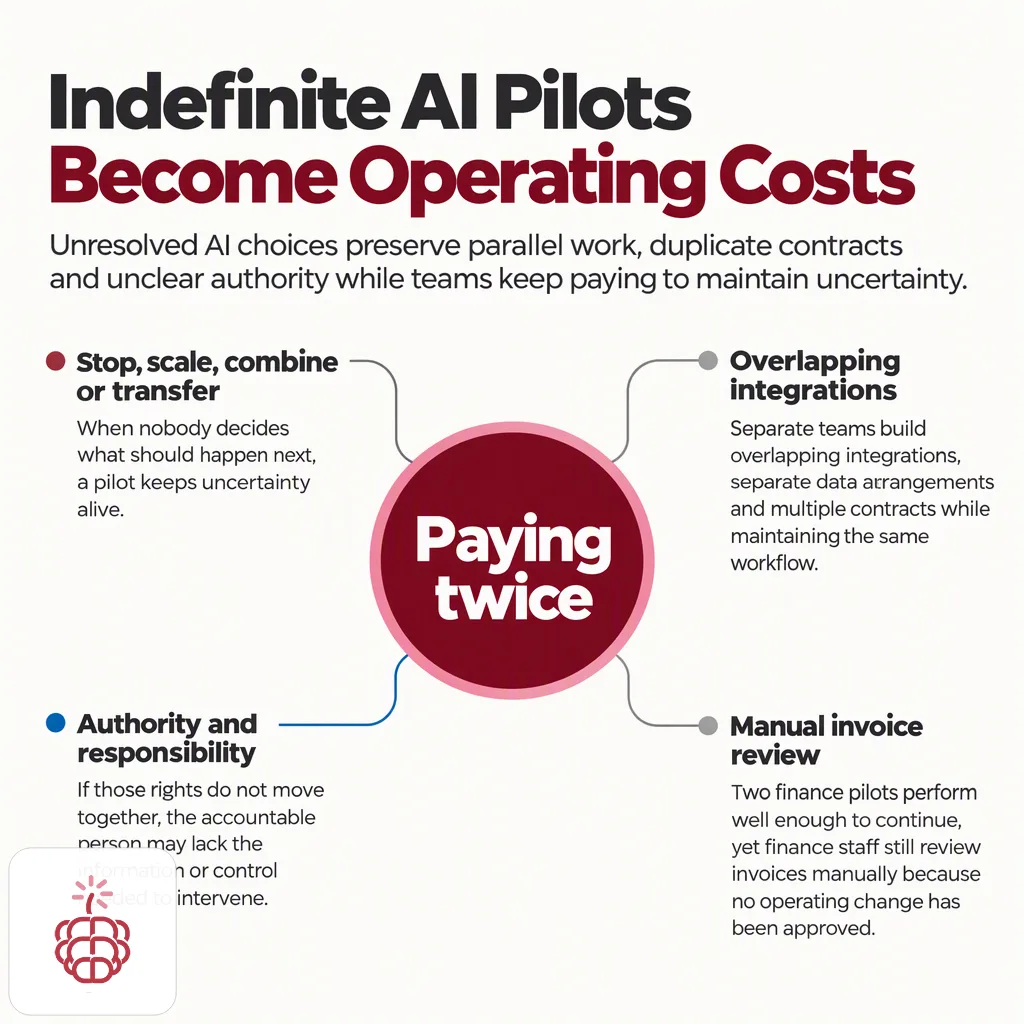
The most expensive AI decision is often the one an organization keeps postponing. Delay leaves pilots funded, teams duplicated and accountability unclear, so executives should treat unresolved decisions as operating costs rather than neutral caution.
The contradiction is familiar: companies describe pilots as experiments, yet allow them to run indefinitely without deciding what should happen next. A pilot is meant to reduce uncertainty. When nobody decides whether to stop, scale, combine or transfer ownership, it creates a second problem: the organization starts paying to preserve uncertainty.
That cost is easy to miss because waiting feels responsible. No executive has visibly approved the wrong platform. No team has to defend a failed investment. But the business still carries several versions of the same workflow, separate data arrangements, fragmented learning and staff time spent maintaining options that may never be chosen.
The mechanism is organizational, not technical. An AI system changes who recommends, approves, executes and escalates work. If those rights are not assigned, the technology may produce useful output while the workflow remains stuck. Recent research on enterprise AI governance makes the same distinction: authority and responsibility need to move together, or the person held accountable may lack the information or control needed to intervene.
Consider a finance department testing two tools to review supplier invoices. One team focuses on extraction accuracy. Another tests whether the system can flag unusual payment terms. Both pilots perform well enough to continue, but nobody decides whether the goal is faster processing, stronger controls or fewer manual reviews. After a quarter, both teams have built overlapping integrations, procurement is negotiating two contracts and finance staff are still reviewing invoices manually because no one has approved the operating change.

The missed decision is not “which model is best?” It is “what work are we prepared to remove, who owns the result and what evidence is sufficient to proceed?” Answering that can end one pilot, combine the useful parts of both or expose that the expected benefit does not justify the control burden. Each outcome is more valuable than another month of ambiguous progress.
The strongest objection is that some decisions genuinely require more evidence. That is true. A high-risk workflow should not be rushed to production because a deadline has arrived. But caution is not the same as indefinite evaluation. A disciplined decision can preserve a review point, define a failure threshold and limit the system's authority while evidence improves. The decision is then reversible by design, rather than absent by default.
This matters more as AI moves from analysis into action. External research on stalled AI programmes identifies success measures, stakeholder alignment, integration and governance as decisions that become more expensive when left until later, after teams and systems are already committed. The longer ownership remains unclear, the more expensive it becomes to change the workflow without reopening budgets, architecture and trust.
Our view is simple: an AI portfolio should be managed partly as a queue of decisions, not just a catalogue of experiments. The useful question is not how many pilots are active. It is which unresolved choice is currently consuming the most capacity.
That reframes AI governance. Its purpose is not only to prevent bad deployment. It is also to prevent an organization from hiding behind experimentation when the real need is a decision. Inaction can look prudent for a quarter. Over time, it becomes a business model for paying twice.