The commercial problem in enterprise AI is often not whether a model can work. It is whether the organization can make a bounded decision, assign ownership and put a useful capability into daily work before the opportunity disappears. Leaders should treat approval time as a business cost, not as neutral administration.
The pattern we keep seeing is uncomfortable: companies ask the build team to prove more, while the real uncertainty sits elsewhere. A demonstration can show that a model produces a plausible answer. Production requires a decision about data access, escalation, accountability, workflow design and what happens when the answer is wrong. Those are management decisions, and they cannot be resolved by improving the prompt.
That is why the build is often blamed for a delay it did not create. Research and industry reporting point to the same gap. Presidio describes pilots that stall at budget review, governance, integration and change management, even after the technology has worked in a controlled setting. A separate enterprise survey reported that 48 percent of AI projects reached production, with many taking eight months to move from prototype to production. The exact rates will vary by sample and definition. The direction is more useful than the number: experimentation is faster than institutional commitment.
Consider the manufacturer described in the supplied LinkedIn post. It reportedly spent $50,000 to put an AI capability into operation and received $290,000 a year in benefit, a return of roughly five to six times the investment. That result is not independently verified here, so it should not be treated as a benchmark. The more revealing fact is the claim that the opportunity sat in committee first.

If the example is representative, the delay did not protect the company from risk. It postponed a controlled way to learn whether the benefit was real. During that time, the organization continued paying the existing cost, while the proposed system generated no benefit and no operating evidence. Approval became more expensive than implementation.
There is a serious objection. Moving faster can turn a promising prototype into an expensive liability. In production, data is incomplete, permissions are consequential, and a wrong recommendation can create regulatory, financial or customer harm. Reports on AI adoption also identify poor data quality, weak risk controls, rising costs and unclear value as reasons projects are abandoned after proof of concept. Speed without controls is not discipline.
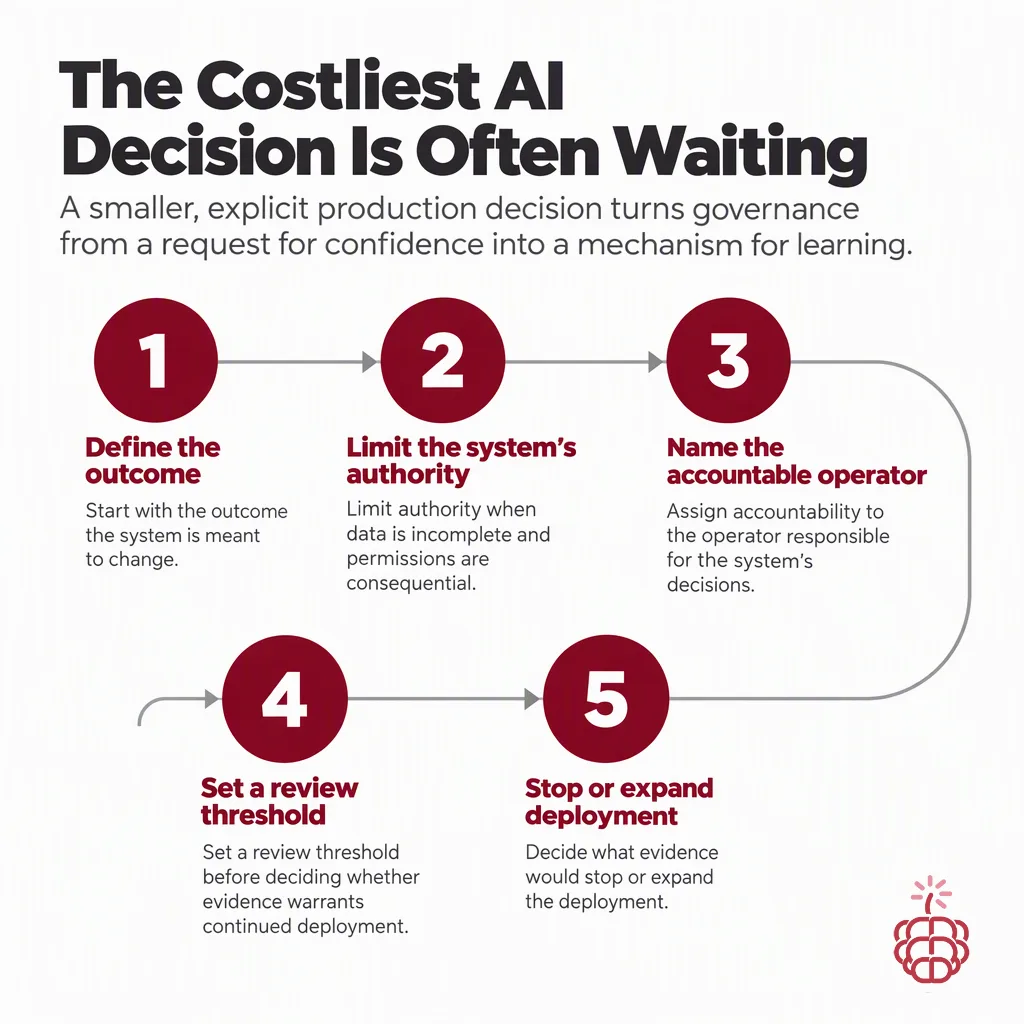
But the answer is not an indefinite committee. It is a smaller, explicit production decision: define the outcome, limit the system’s authority, name the accountable operator, set a review threshold and decide what evidence would stop or expand the deployment. That converts governance from a request for confidence into a mechanism for learning.
Production itself is not the finish line. One 2026 enterprise report found that organizations can improve production capability while still failing to make returns exceed investment, because business users cannot consistently act on what systems produce. The sharper lesson is this: AI value is released when a decision changes, not when a model is deployed.
The organizational advantage will therefore belong less to companies that run the most pilots than to those that can make safe, reversible decisions quickly. The scarce capability is not model access. It is an operating system for deciding what deserves to become work.