
Most AI pilots do not stall because the model fails. They stall because nobody has clear authority to turn a promising result into a change in daily work. That makes decision rights a commercial concern: before building, leaders should identify who can approve the workflow, accept the risk and fund the operating capability.
The pattern we keep seeing is simple. A team can demonstrate that AI will classify requests, draft responses or recommend an action, yet the demonstration has no path to adoption. The people who like the result are not the people who own the process. The people who own the process are not sure who can accept a new risk. Procurement, security, legal and operations then become late-stage veto points rather than participants in a defined decision.
That is why “what should we build?” is often the wrong opening question. The more useful question is: “Who gets to say yes when this changes the work?” If the answer is unclear, technical progress increases the stock of impressive pilots without increasing the organisation’s capacity.
The mechanism is not mysterious. A pilot usually benefits from exceptional conditions: selected data, close access to its builders, manual fixes and a small group of willing users. Production removes those advantages. The system must work with ordinary data, normal approvals, existing controls and a named owner when the original project team has moved on. MIT Technology Review Insights makes a similar point about scaling AI agents: business objectives, connected workflows, governance and change management matter alongside the technology.
Consider a customer service operation testing an assistant that drafts replies for complex cases. The prototype may save an agent time, but deployment still requires someone to decide whether the assistant can use customer records, who reviews errors, which cases must remain human-led and whether the service leader owns the outcome. If those decisions are left implicit, the pilot becomes a showcase. If they are assigned early, the same build becomes a controlled change to the queue, the review process and the staffing model.
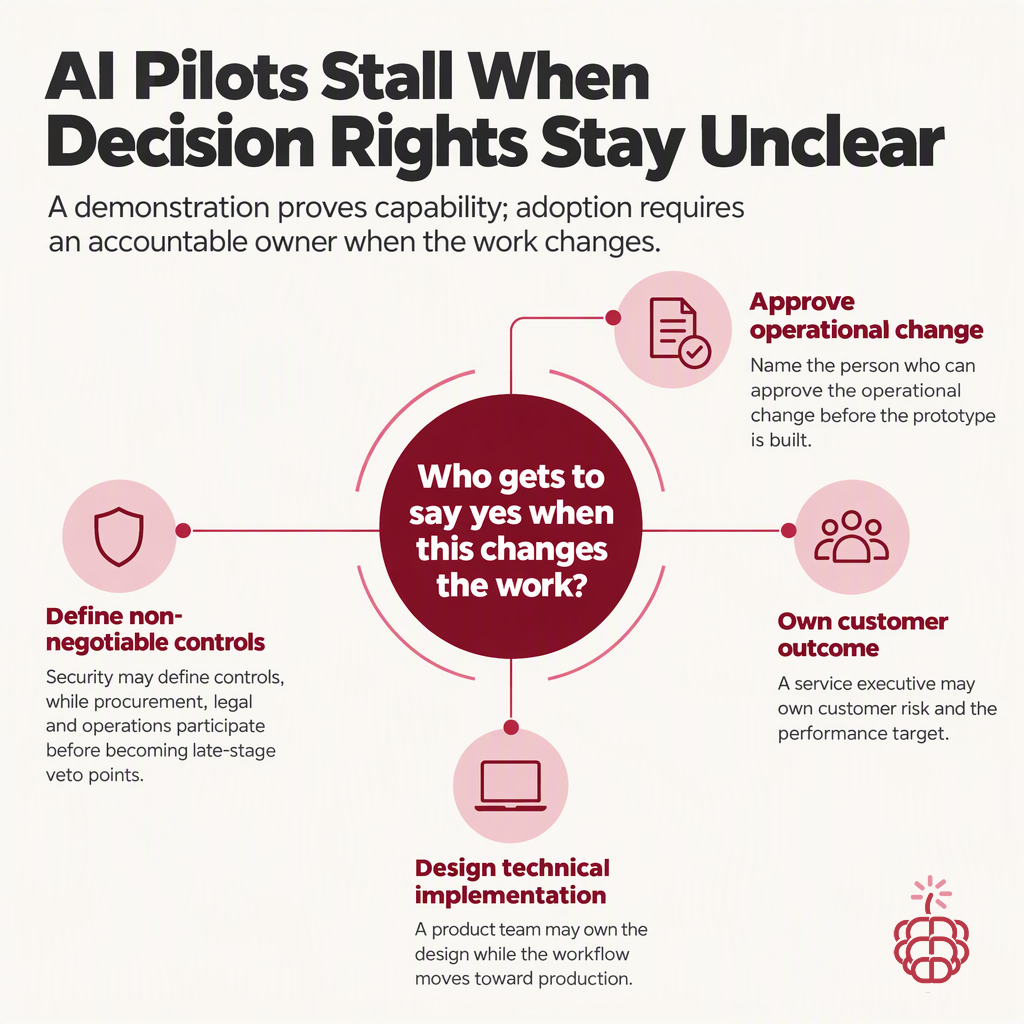
This does not mean every decision should be centralized. Central approval for every use case would create a different bottleneck. The practical distinction is between authority over the business outcome and authority over the technical implementation. A service executive may own the customer risk and performance target; a product team may own the design; security may define non-negotiable controls. Those roles can move quickly when their boundaries are explicit.
The strongest objection is that early governance can slow experimentation. It can, if governance means a committee reviewing unfinished ideas. But decision rights are not the same as permission for every detail. They are a way to expose the decisions that would otherwise arrive late, when the cost of changing the design is highest. BCG’s analysis similarly points to enterprise-wide ownership and consistent controls as conditions for scaling AI agents without multiplying risk or cost.
Our view is therefore narrower than “govern AI everywhere.” Name the person who can approve the operational change before the prototype is built, then involve the people who can block it for legitimate reasons. A compelling demonstration answers whether the capability can work. A useful operating capability also answers who is accountable when it does.