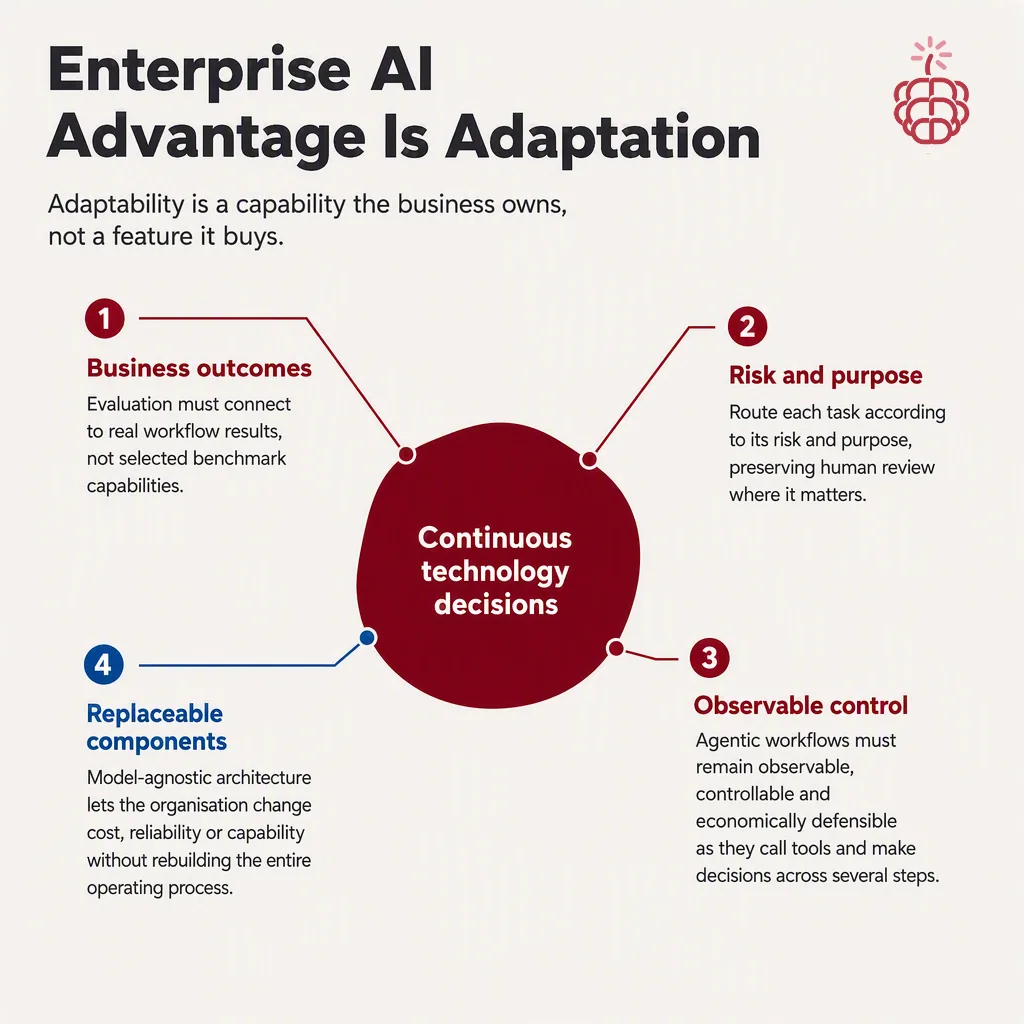
More AI models have made enterprise decisions harder, not easier. The commercial issue is no longer access to capable systems, but choosing an approach that improves a real workflow while controlling cost, reliability, governance and operational risk. That should change the decision from “Which model should we standardize on?” to “How will we continuously decide what works for each task?”
The pattern we keep seeing is a mismatch between technical excitement and business usefulness. A model can lead a public benchmark and still fail in production because it is expensive at the required volume, unreliable with the company’s data, difficult to monitor, or poorly suited to the surrounding workflow. Benchmark scores test selected capabilities. They rarely test approval rules, data access, escalation paths, integration effort or the cost of a wrong action.
That gap becomes wider when systems move beyond generating answers and begin planning work, calling tools or making decisions across several steps. A small error in one response is contained. An error in an agentic workflow can trigger the wrong search, update the wrong record and consume substantial compute before anyone notices. The useful question is therefore not whether a model appears intelligent, but whether the whole workflow remains observable, controllable and economically defensible.
Consider an enterprise customer-service team deciding how to automate incoming requests. One model may be strongest at interpreting long, ambiguous messages. Another may be cheaper and more consistent for classification. A third may work better with the company’s approved tools. Sending every request to the most capable model would simplify procurement, but it could raise costs and still leave the team with weak handling of exceptions. Routing each step according to its risk and purpose is more complex to build, yet it can preserve human review where it matters and reduce unnecessary model use elsewhere.

This is why model-agnostic architecture is becoming a practical business choice. It is not a demand to support every provider or chase every release. It is a way to keep the workflow, evaluation process and governance controls from being tied too closely to one model. The value lies in being able to change a component when its cost, reliability or capability changes, without rebuilding the entire operating process.
There is a serious objection: abstraction can add engineering work, latency and another layer of management. That is true. For a narrow, stable use case, a single provider may be the better choice. Flexibility is not automatically efficient. It earns its keep only when the workload changes, the economics matter at scale, or the risk of dependency exceeds the cost of orchestration.
The strategic shift is therefore larger than model choice. Enterprises need evaluation tied to business outcomes, clear ownership of agentic behaviour, and operating processes that can absorb new evidence without restarting the programme. Expertise matters because the landscape changes quickly, but its purpose is not to identify a permanent winner. It is to help the organisation make better technology decisions repeatedly. In enterprise AI, adaptability is becoming a capability the business owns, not a feature it buys.