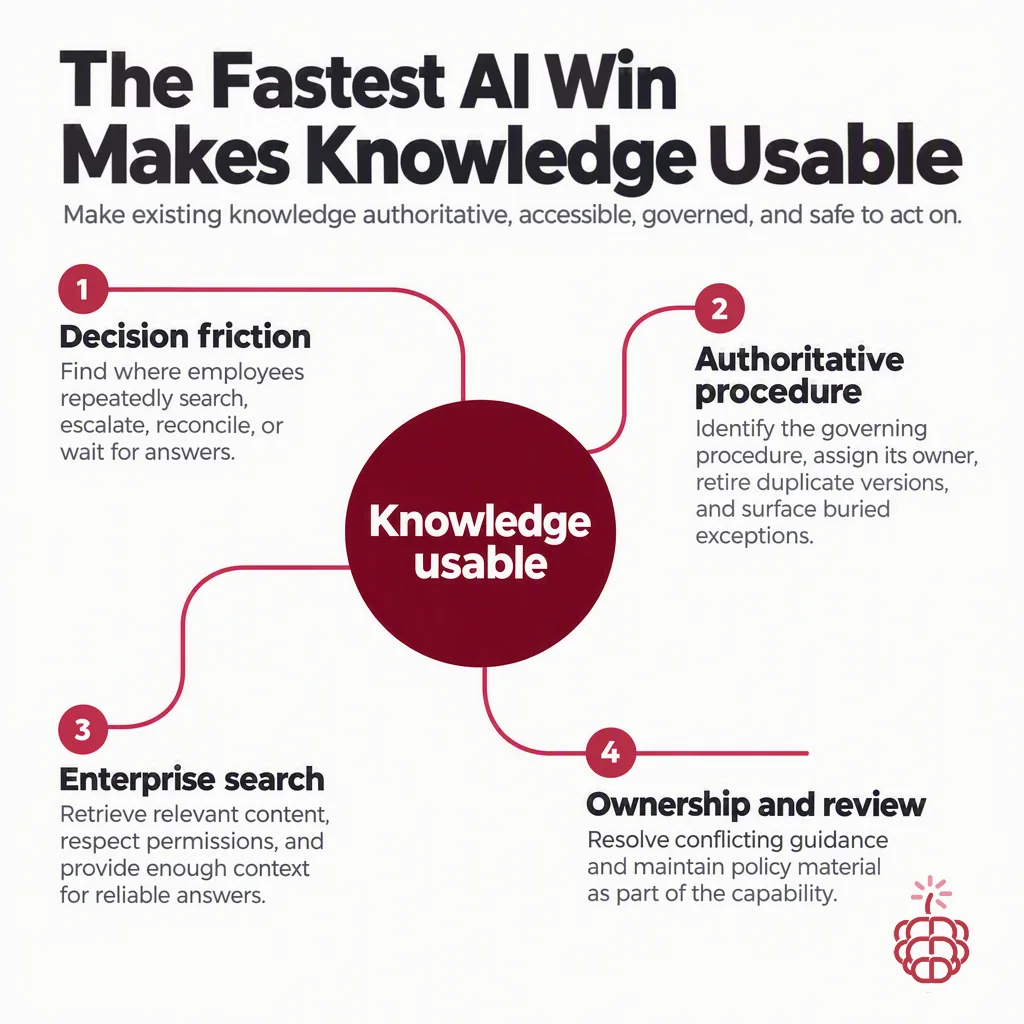
The quickest route to business value from AI is often not a new model or application. It is reducing the time and risk involved in finding information the organisation has already paid to create, which should change the first decision from “Which AI tool should we buy?” to “Can people and systems reliably access the right knowledge?”
The recurring mistake is to treat poor information access as a technology gap. In practice, it is usually an operating problem: unclear ownership, inconsistent naming, duplicate documents, weak permissions, and no agreement on what counts as current. Research on enterprise findability reaches the same conclusion: search failure exposes deeper weaknesses in governance, structure, context, and trust rather than a simple usability defect.
That distinction matters because AI changes the cost of bad information. A person who cannot find a policy may ask a colleague, spend an hour checking files, or make a cautious decision. An AI assistant can produce an answer quickly, but speed does not make an outdated or unauthorised source safe. Enterprise search is increasingly treated as the retrieval layer for AI because a useful answer depends on finding relevant content, respecting permissions, and providing enough context for the model to respond reliably.
Consider a claims manager looking for the procedure governing an unusual customer case. The procedure exists in SharePoint, but three versions sit in different sites, one is marked “final”, and a related exception is buried in a meeting document. The obvious AI project would add a conversational interface. The more valuable first move is to identify the authoritative procedure, assign its owner, retire the duplicates, and make the exception discoverable.

That work may appear less impressive in a demonstration. It can nevertheless change the workflow more substantially. The claims manager spends less time asking a specialist to interpret a document, the specialist handles fewer repetitive questions, and the customer receives a decision based on a known source rather than institutional memory. The benefit is not that AI has replaced judgement. It has reserved judgement for the cases that actually need it.
The strongest objection is that content clean-up can become a long, expensive programme with no clear end. That risk is real. Organisations should not attempt to catalogue every file before testing an AI use case. They should narrow the scope to a decision-heavy workflow, establish the minimum content standard required for that decision, and measure whether people can find and trust the answer. A small, governed knowledge set is more useful than a large, vaguely indexed estate.
There is also a limit to what better access can solve. If policy owners do not maintain their material, if permissions are wrong, or if the business cannot resolve conflicting guidance, AI will expose those failures rather than remove them. That is not a reason to delay. It is a reason to make ownership and review part of the capability, not an afterthought.
Our view is that the first AI question should be about decision friction. Where are employees repeatedly searching, escalating, reconciling, or waiting for answers? If the required knowledge already exists, improving its authority and access may deliver value faster than introducing another system.
The broader implication is easy to miss: many early AI projects are information-management projects with a conversational interface. The organisations that gain durable capacity will not simply ask models to know more. They will make more of their own knowledge usable, governed, and safe to act on.