Most organizations do not have an AI adoption problem. They have a prioritization problem. The commercial decision is not which tool to buy, but which recurring decision or bottleneck is valuable enough to redesign first. That choice determines whether AI becomes operating capacity or another isolated demonstration.
The pattern we keep seeing is a mismatch between the way companies discuss AI and the way value appears. Leaders compare models, licences and features, while the business absorbs delays in approvals, inconsistent service, avoidable rework and decisions made without the right context. Those costs rarely belong to one technology team. They sit inside workflows owned by operations, finance, sales or customer service.
That is why a technically impressive pilot can produce little business value. A model may summarize documents accurately, but accuracy is not the outcome. The outcome is a decision made sooner, a case resolved with fewer handoffs, or a scarce specialist freed for work that requires judgement.
External evidence points in the same direction. McKinsey’s study of 20 companies that created significant economic value from AI found that two-thirds concentrated their efforts on three business domains or fewer, and those domains were tied to important economic leverage points. The technology was broadly available. The advantage came from applying it quickly and repeatedly to material business problems.
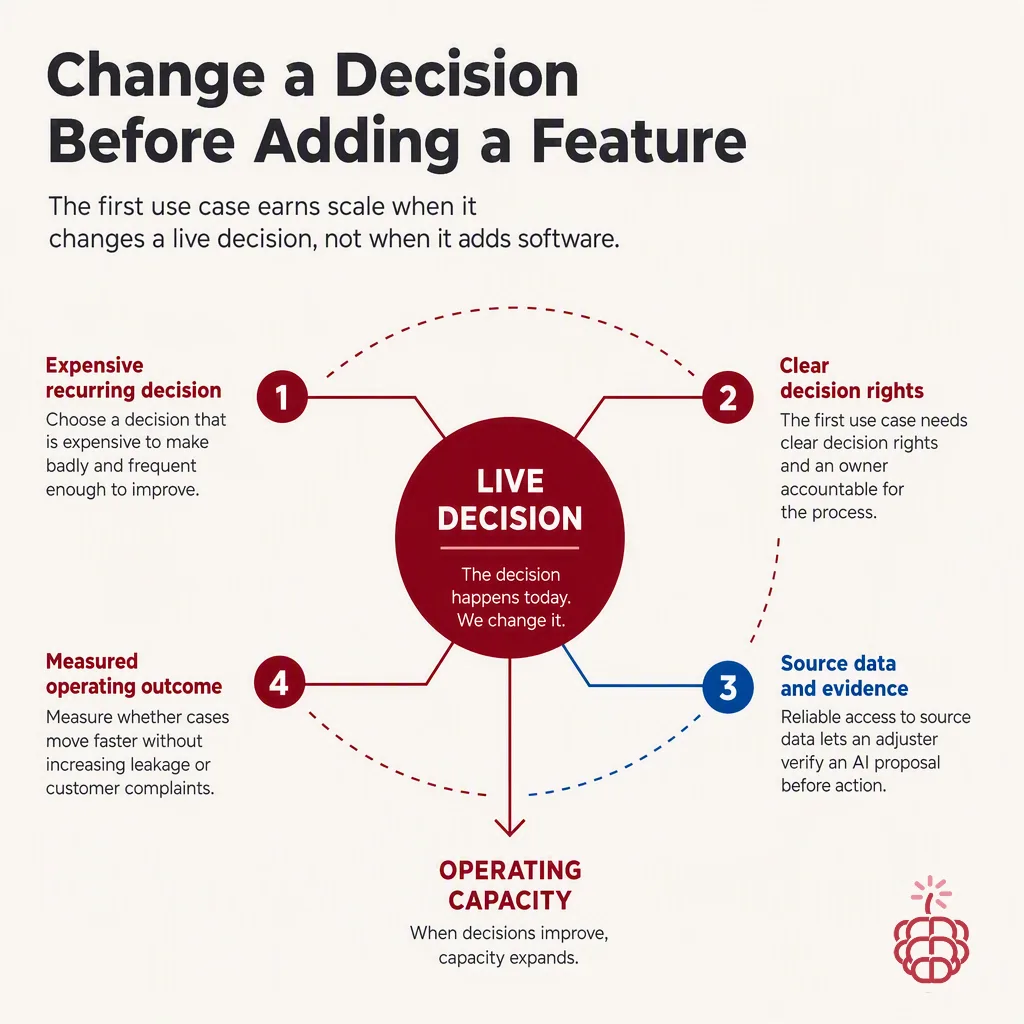
Consider a claims operation. A claims manager may begin with an AI assistant that extracts information from incoming documents and proposes the next action. That is a useful demonstration, but it is not yet an operating capability. The value appears only when the proposal enters the claims workflow, the adjuster can verify its evidence, exceptions are routed to the right specialist, and the organization measures whether cases move faster without increasing leakage or customer complaints.

This example also shows why “start with one use case” is not the same as “start small and stay isolated.” The first use case should expose the conditions needed for the second: reliable access to source data, clear decision rights, an owner accountable for the process, and a way to evaluate errors. Without those conditions, each pilot recreates the same integration and governance work. Speed at the beginning becomes delay later.
The strongest objection is reasonable. Choosing one process can narrow attention too early, especially when senior leaders suspect that AI will alter whole functions. But broad ambition does not require broad deployment. In practice, a narrow workflow is often the best test of whether the organization can change work rather than merely add software. It creates evidence about risk, adoption and economics before those questions become enterprise-wide problems.
The difficult part is usually not finding a possible use case. It is agreeing what result makes the use case worth doing, who owns that result, and what must change around the tool. AI should therefore be judged less by whether it works in a controlled demonstration than by whether the business is prepared to let it alter a live decision.
That changes the question leaders should ask. Not “Where can we use AI?” but “Which decision is expensive to make badly, frequent enough to improve, and owned clearly enough to change?” The answer will not produce the broadest showcase. It may produce something more useful: a repeatable way for the organization to turn better decisions into capacity.