
Most organisations do not have a data shortage. They have a decision delay caused by information trapped in systems that were never designed to work together. The commercial decision should therefore change: before buying another platform or launching a large data lake programme, test whether a focused connection between existing systems can improve one important workflow.
The model is not the bottleneck
The recurring pattern is straightforward. Sales has customer commitments in the CRM, finance has credit and payment status in the enterprise resource planning system, service has unresolved issues in the ticketing platform, and the relevant context may be buried in documents. Each system can be useful on its own. The business problem appears when a decision requires all four.
Disconnected records slow daily work and weaken confidence in reports. Teams spend time reconciling versions, checking spreadsheets and asking colleagues for information that already exists elsewhere. Independent reporting on enterprise systems integration describes the same effect: conflicting records and isolated systems make people validate information instead of acting on it.
The answer is not to pretend the data is clean. It is to make the mess usable for a defined decision. That means identifying which systems contain the required evidence, linking records through stable business identifiers, setting rules for conflicting values, and exposing the result inside the workflow where someone must act. A useful connection is often more valuable than a perfect repository that arrives after the decision has passed.
Consider a manufacturer reviewing a large customer renewal. The account executive sees the contract and relationship history in the CRM. Finance can see overdue invoices in the ERP. Customer service can see a recurring equipment problem in its ticketing system. Today, the executive may assemble that picture manually, or recommend renewal without it. A connected workflow could present the commercial, financial and service context before the approval meeting, with links back to each source.
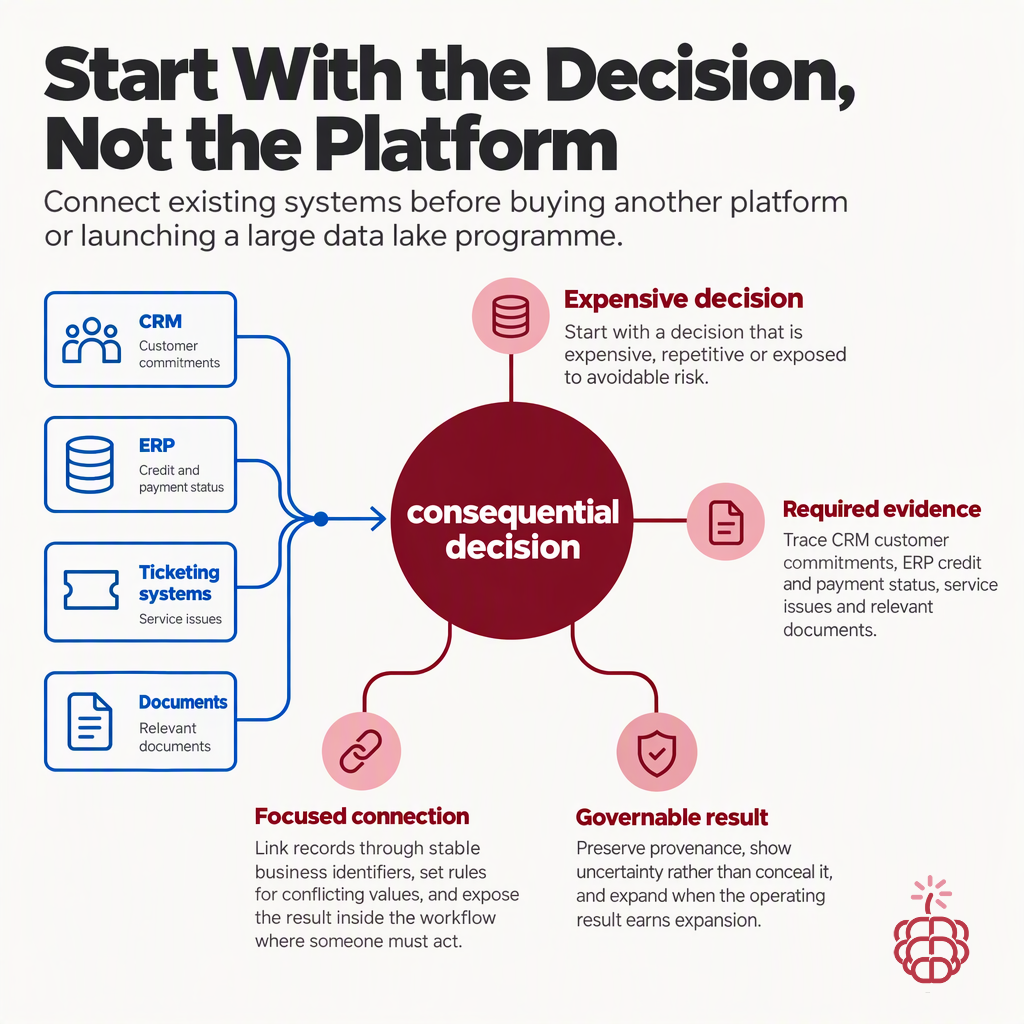
The immediate gain is not a clever answer generated by AI. It is a better-timed decision with less administrative work around it. The same connection could route an exception to finance, prompt service to resolve a known issue, or prevent a renewal conversation from ignoring payment risk. AI may summarize the evidence or identify a pattern, but the operating value comes from placing trusted context where responsibility already sits.
The strongest objection is valid: connecting bad data can spread bad decisions faster. A CRM may contain duplicate accounts, an ERP may use a different customer identifier, and a document may be outdated. Integration does not remove those risks. It makes them visible and therefore governable. The difficult part is usually not moving fields between applications. It is agreeing which record governs which decision, who can override it, and when uncertainty must be shown rather than concealed.
That changes the order of work. Start with a decision that is expensive, repetitive or exposed to avoidable risk. Trace the evidence required to make it. Connect only the systems that supply that evidence, preserve provenance, and measure whether the workflow becomes faster or more reliable. Expand when the operating result earns expansion, not because a larger platform has been purchased.
The larger implication is organisational. Data becomes valuable when accountability can move through it. The winning architecture may still include a lake, warehouse or new platform, but those are means, not evidence of progress. The real test is whether people can make a consequential decision with information the organisation already owns, without waiting for another system to become the centre of everything.