
Most AI application failures are not caused by a model lacking fluent language. They happen because the application cannot retrieve the right business context at the moment a decision is made. Vector databases matter commercially because they turn scattered documents, records and product knowledge into searchable evidence. The decision for technology leaders is therefore not whether to add one, but whether a proposed AI workflow depends on reliable retrieval strongly enough to justify a new operating capability.
The pattern we keep seeing is a mismatch between a convincing demonstration and a useful system. A model can answer a carefully prepared question well, yet fail when a user uses different wording, when relevant information is spread across several files, or when the source changes. Keyword search is often too literal for this work. A vector database supports search based on meaning by representing content as numerical vectors and finding items that are similar in context, even when the wording differs.
That mechanism changes the application’s job. Instead of asking the model to know everything, the system can retrieve a smaller set of relevant material and give the model a bounded basis for its response. This can make answers more useful and reduce the need to place an entire knowledge base inside every prompt. The gain is not abstract intelligence. It is less time spent searching, fewer handoffs for routine questions and a clearer path for checking where an answer came from.
Consider a manufacturer’s service agent handling a failed machine. The agent may search a maintenance guide using the customer’s description, which does not match the guide’s terminology. A vector search can surface the relevant repair procedure, while filters can narrow results to the machine model, region and current document version. The agent still decides what to recommend, but the workflow changes from reconstructing an answer from memory to reviewing relevant evidence. The customer may receive help sooner, while the organisation retains more of the specialist’s capacity for difficult cases.
That example also shows why the database is only part of the capability. Retrieval quality depends on how content is divided, labelled, updated and governed. A technically strong search can still return obsolete procedures, duplicate passages or material the user should not see. Those failures are operational failures, not simply model failures. Ownership of the source content, update rules and access permissions must sit with the business process that depends on the answer.
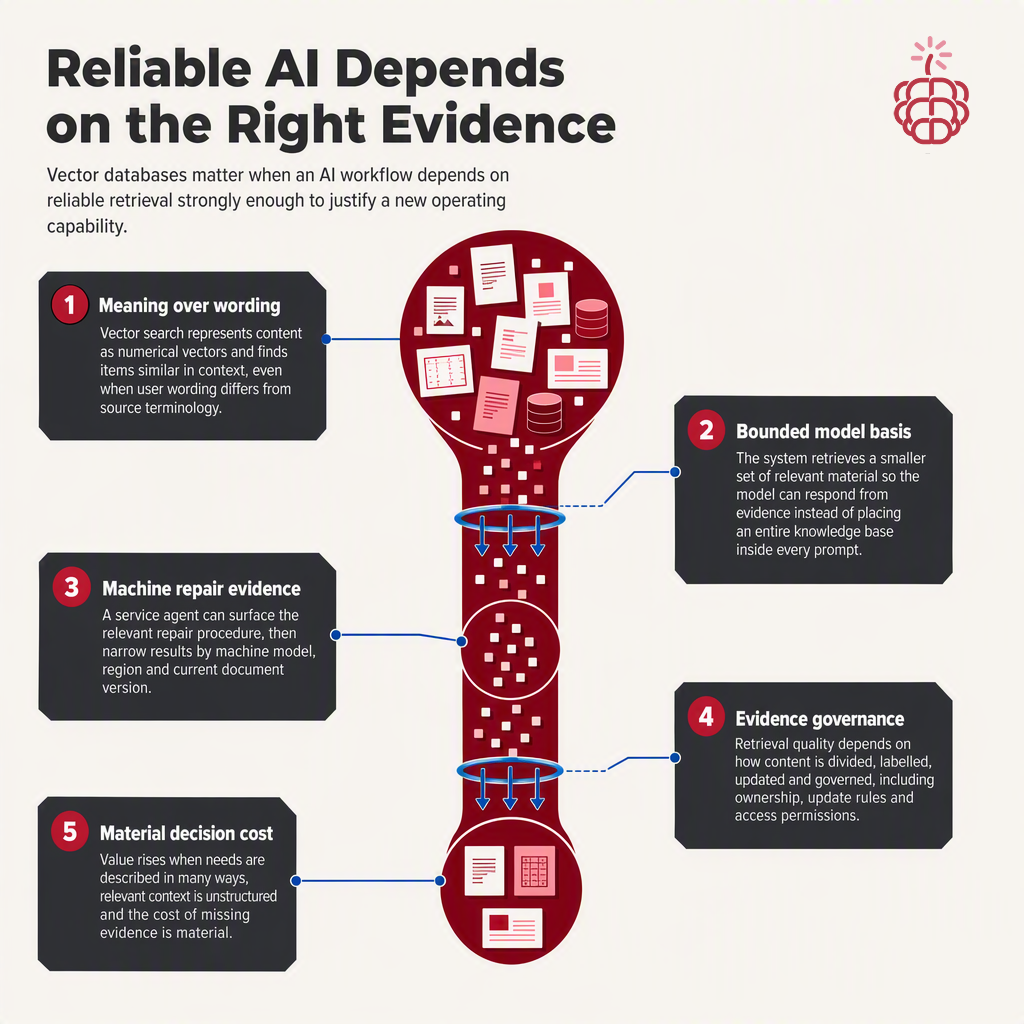
The strongest objection is that conventional search, databases or carefully written prompts may solve some use cases more simply. That is true. A vector database is unnecessary when the information is structured, terminology is stable and the required lookup is exact. Adding one to every AI project creates cost and another component to maintain. Its value rises when users describe the same need in many ways, relevant context is unstructured, and the cost of missing evidence is material.
Our view is that vector databases should be judged as retrieval infrastructure, not as a badge of modernity. The useful question is whether they improve a decision or workflow that already matters, and whether the organisation can maintain the evidence behind the result. Once retrieval becomes part of an AI application, knowledge management, security and process ownership become part of its performance. The technology shift is therefore also an organisational one: reliable AI depends less on making the model sound confident than on making the right evidence available, current and accountable.