
Many AI applications fail for a reason that has little to do with the model: they cannot find the right business context at the moment a decision is made. A vector database can change that by making meaning, rather than exact wording, usable for retrieval. The commercial decision is not whether every AI project needs one. It is whether the application depends on finding relevant internal knowledge quickly and consistently enough to justify a dedicated retrieval capability.
The pattern we keep seeing is a mismatch between how people ask questions and how enterprise information is stored. A service employee may ask which remedy applies when a shipment is delayed and damaged. The answer may be spread across policy documents, exception rules and regional guidance, using language that does not match the question. A keyword search can miss relevant material because the terms differ. A vector database is designed to compare the meaning of the question with the meaning of stored content, then return nearby material for the application to use.
That changes the role of the AI system. The model is no longer expected to produce an answer from general training alone. It can work from selected company information, which can make responses more relevant and give the workflow a clearer basis for review. The benefit is not a more impressive demonstration. It is less time spent searching, fewer avoidable escalations and a better chance that an employee acts on the current rule rather than a remembered one.
Consider a claims team using an internal assistant. A claims specialist enters a plain-language description of a case. The system retrieves related coverage clauses and handling guidance, then presents a draft response with the relevant material available for checking. The important change is not that the assistant writes faster. It moves the specialist's effort from locating documents to judging the case. That can increase the team's capacity without pretending that the model should own the decision.
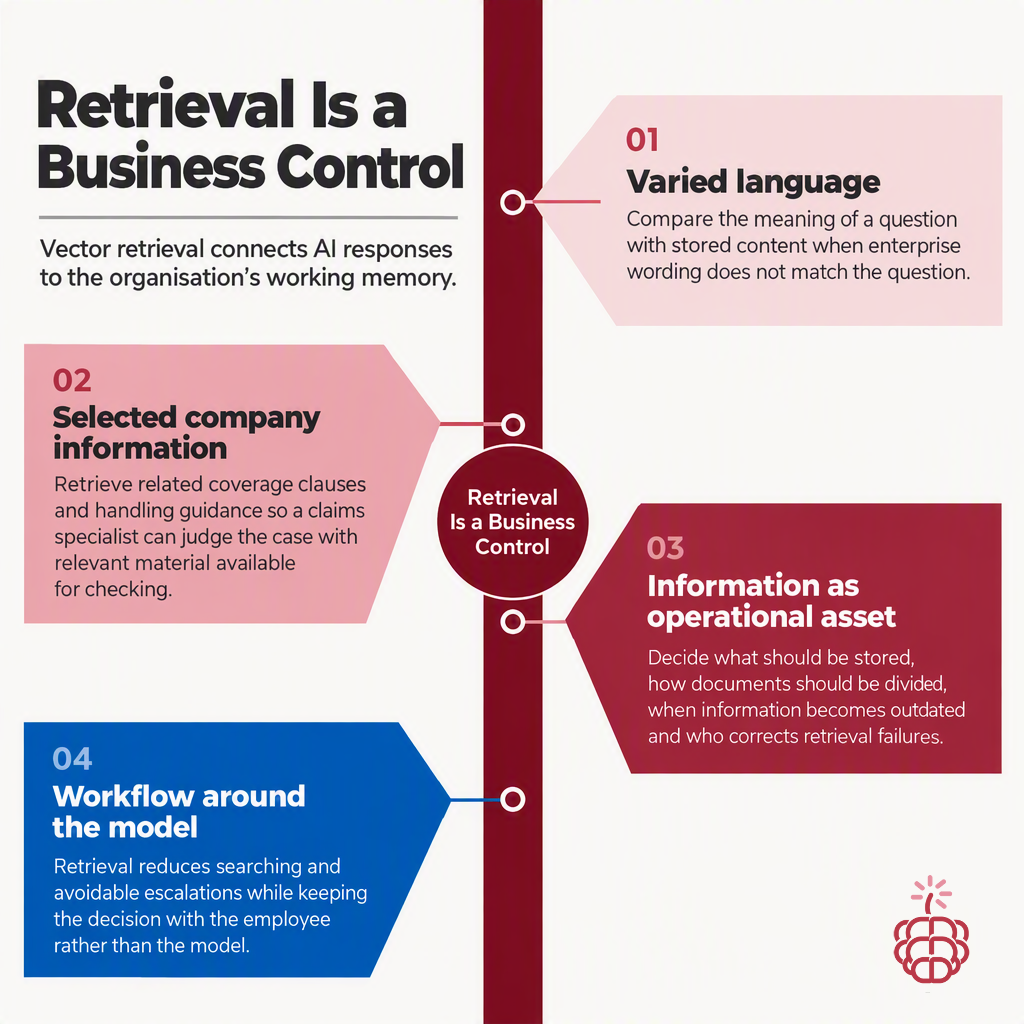
The difficult part is usually not storing vectors. It is deciding what should be stored, how documents should be divided, when information becomes outdated and who is responsible for correcting retrieval failures. Poor source content will still produce poor support. A technically sound search can return an obsolete policy with high confidence if the organisation has not managed its information as an operational asset.
There is also a reasonable objection: a vector database can add cost and complexity where ordinary search is sufficient. That objection should change the claim. Vector retrieval is not a default layer for every application. It becomes critical when users describe needs in varied language, the relevant knowledge is dispersed, and the cost of a missed or stale answer is material. In simpler workflows, conventional search may be easier to govern.
The larger shift is organisational. Once AI depends on retrieving enterprise knowledge, information ownership, content quality and update processes become part of the product. The database matters because it connects an AI response to the organisation's working memory. That makes retrieval a business control, not just a technical feature, and places the lasting advantage in the workflow around the model rather than in the model alone.