
Most companies do not have an information shortage. They have a decision shortage: the relevant answer exists, but it cannot be found, trusted, or applied at the moment of work. That makes knowledge retrieval a commercial problem, because every unanswered question becomes slower service, duplicated effort, or avoidable dependence on a few experienced employees.
The pattern we keep seeing is that people ask colleagues before they search. This is often treated as a user-adoption problem. It is usually a system-design problem. A colleague does more than retrieve a document. They interpret the question, judge which version is current, explain the exception, and take responsibility for the answer. A search box that returns twenty documents cannot compete with that experience.
The answer must carry its context
AI can improve the economics of internal knowledge, but only when it changes the interaction from “find a file” to “resolve a decision”. That requires more than indexing. Enterprise knowledge systems need connected sources, clear ownership, version control, access rules, and a way to expose uncertainty. These are not administrative extras. They determine whether an answer can safely enter a workflow. Independent knowledge-management guidance identifies the same failure pattern: fragmented tools, weak content ownership, and AI built on outdated material undermine adoption and reliability.
Consider a procurement analyst preparing a supplier renewal. She asks an internal assistant whether the supplier must provide updated insurance certificates. The system finds the current procurement policy, a recent exception approved by legal, and the owner responsible for confirming the exception. It cites the sources and says when they conflict. The analyst does not spend half an hour searching shared drives or interrupting a procurement manager. More importantly, the workflow now has a visible decision trail.
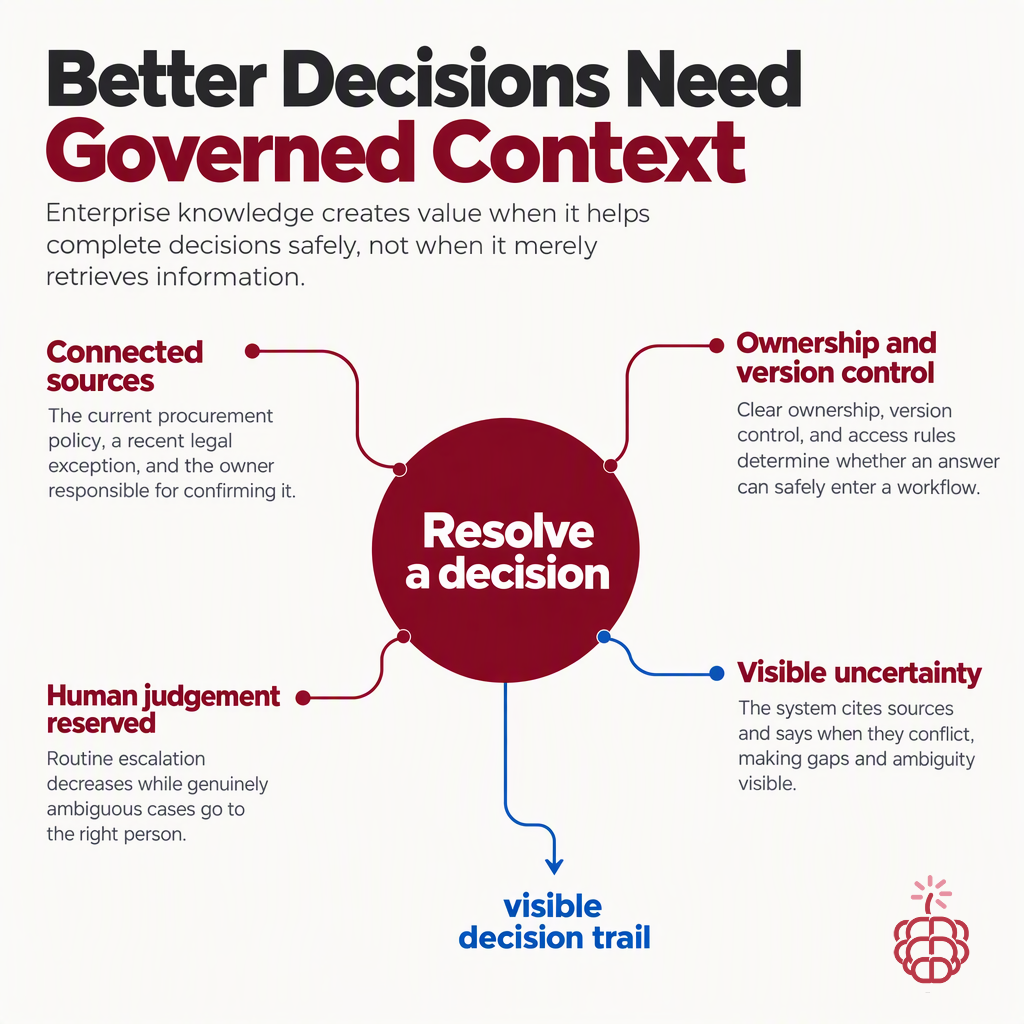
That last point matters more than speed. If an answer is merely plausible, AI can spread a local mistake across the company. If it is grounded in governed sources and makes gaps visible, it can reduce routine escalation while sending genuinely ambiguous cases to the right person. The goal is not to remove human judgement. It is to reserve human judgement for the cases that need it.
The strongest objection is that company information is too messy for dependable answers. That objection is valid. Recordings contain interruptions, documents conflict, and permissions are often inconsistent. Improving retrieval does not repair poor policy or unclear accountability. In some cases, the first useful result of an AI knowledge system will be evidence that the organisation has no agreed answer.
That is still operational progress. A visible gap can be assigned, corrected, and monitored. A hidden gap continues to consume meetings and institutional memory.
Our view is that enterprise AI should be judged less by how much information it can retrieve than by how many decisions it can help complete safely. The business asset is not the archive. It is the organisation’s capacity to act without repeatedly rediscovering what it already knows. That shifts ownership from IT alone to the teams whose policies, exceptions, and decisions make the information useful.