
Most organizations do not have a process problem. They have an access problem. When employees bypass a policy to ask the person who remembers how things work, the business is paying for both the document and the interruption. The commercial decision is simple: make approved guidance available at the point of work, or accept that expertise will remain a private operating system.
The pattern we keep seeing is that documentation is designed for storage, while work is organized around questions. A forty-page approval policy may be accurate, but it does not answer the manager who needs to know, right now, whether a software purchase requires finance review. That manager asks a colleague because the colleague can interpret the rule, identify exceptions and explain what to do next.
This distinction matters. Written procedures hold explicit knowledge; experienced employees carry tacit knowledge built from context and repetition. Knowledge-management research treats both as organizational assets, and identifies search, governance, ownership and integration as practical requirements, not optional features. A document repository preserves information. It does not necessarily preserve the decision that information is meant to support.
Consider a new sales manager submitting a customer discount. The pricing policy sits in a shared drive, and the manager searches it unsuccessfully before messaging the regional director. The director knows that a particular contract structure needs legal review, even though the policy does not make that condition easy to find. The immediate cost is a delayed quote and another interruption. The larger cost is that the organization has made one person a routing layer for routine decisions.
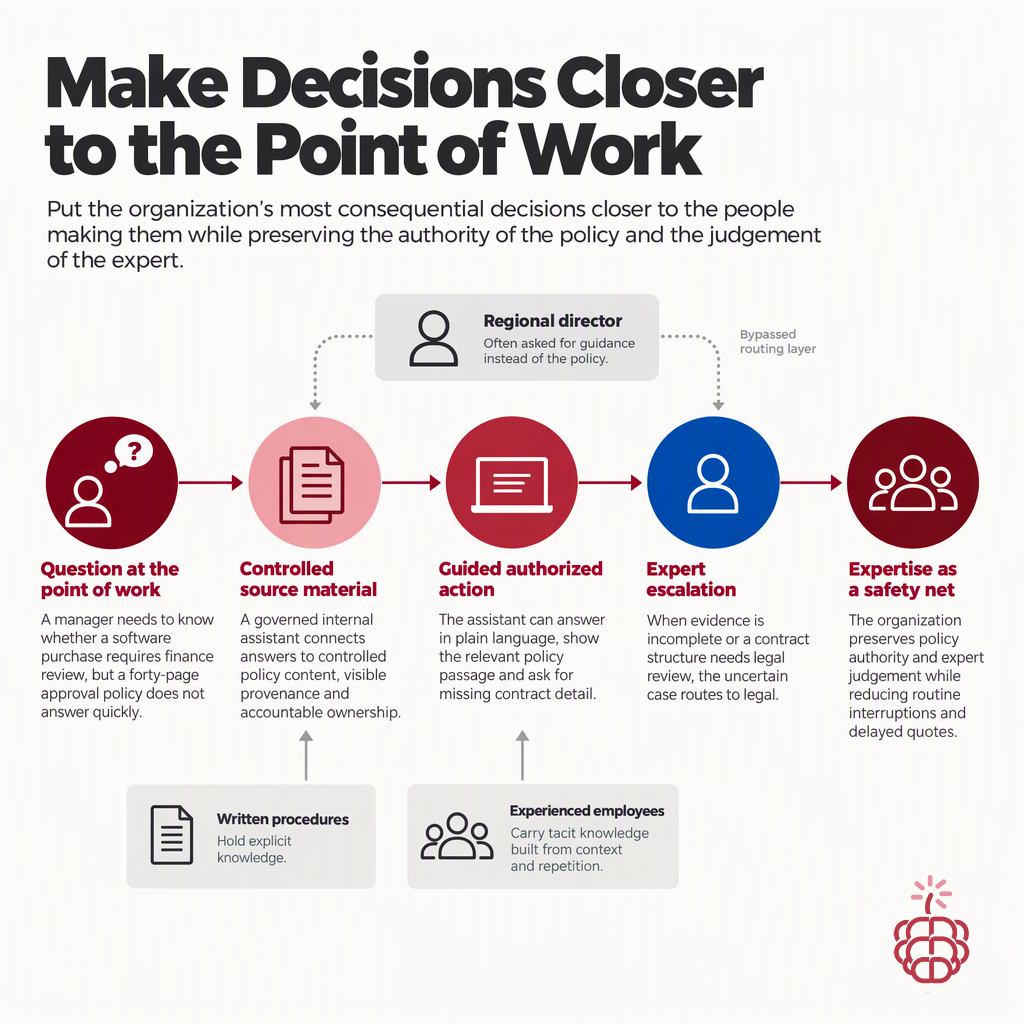
Putting the process where the question is asked can change the workflow. A governed internal assistant could answer the manager in plain language, show the relevant policy passage, ask for the missing contract detail and route an uncertain case to legal. The useful capability is not a fluent answer. It is a shorter path from uncertainty to an authorized action.
That also explains why a compelling demonstration is not an operating capability. A chatbot that produces plausible policy advice may increase risk if its source material is outdated, contradictory or ownerless. Research on enterprise knowledge management flags deployment without adoption, fragmented tools and ungoverned content as common failure modes. An answer surface cannot repair a process that nobody owns.
The difficult part is therefore not making every document conversational. It is deciding which decisions deserve guided answers, who remains accountable for the underlying rule and what happens when the evidence is incomplete. High-value processes usually have recurring questions, costly delays and clear escalation paths. They should be connected to controlled source material, with visible provenance and a route for correction.
Our view is narrower than “put all knowledge into AI.” Put the organization’s most consequential decisions closer to the people making them, while preserving the authority of the policy and the judgement of the expert. That changes expertise from a bottleneck into a safety net. The deeper shift is organizational: a process becomes real not when it is published, but when the business can reliably act on it without asking who has been there longest.