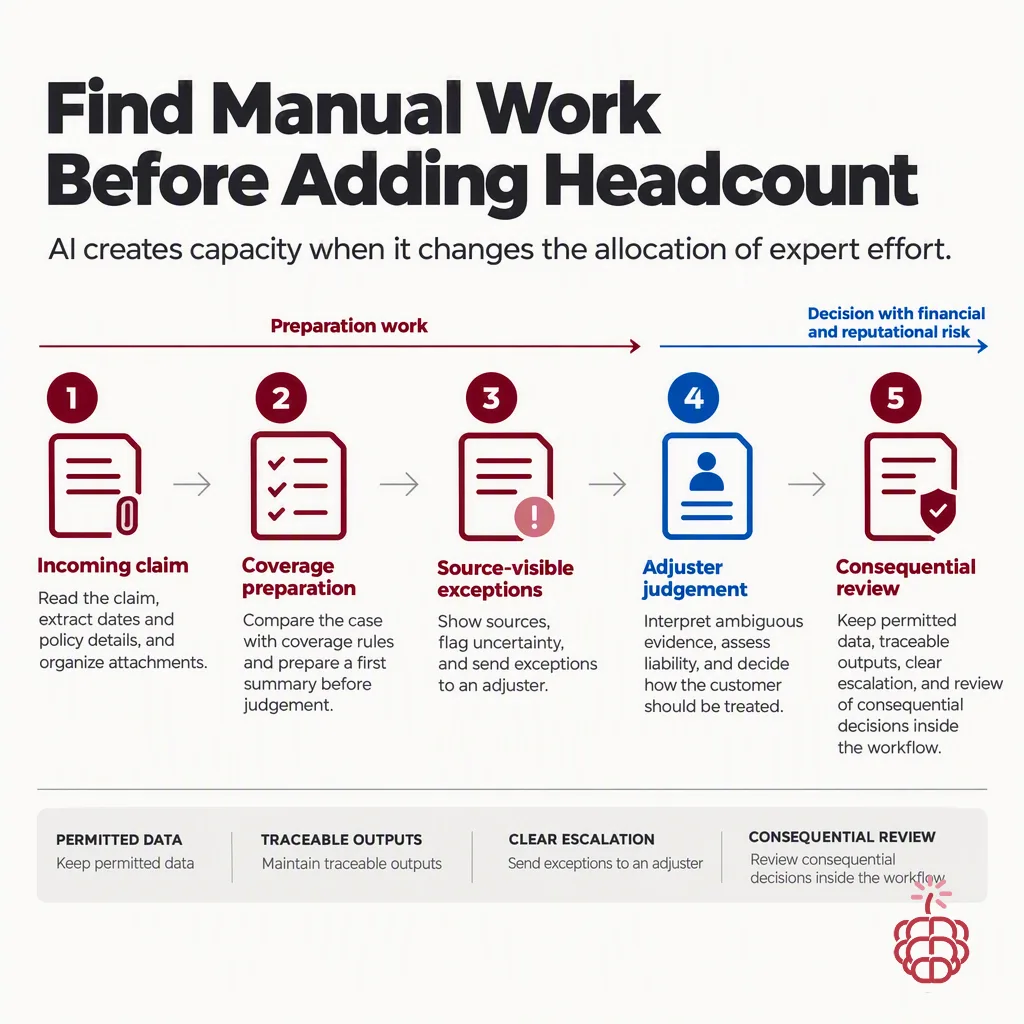
When leaders say they do not need more people, they are often describing a capacity problem, not a staffing strategy. The commercial decision should therefore change: find the repetitive work consuming expert time before asking whether the organization needs another hire. AI matters when it changes that allocation of effort, not when it produces an impressive demonstration.
The pattern we keep seeing is a misleading equation between activity and capacity. A team can be fully occupied and still unable to handle more valuable work. Its specialists may spend hours finding documents, copying information between systems, drafting routine responses, or checking rules that rarely require judgement. Adding people increases the number of hands performing the same process. It may not increase the organization’s ability to make the difficult decisions inside it.
That distinction is commercially significant. Manual work has a hidden cost beyond wages: it delays decisions, creates handoff risk, makes quality dependent on individual care, and leaves expertise trapped in low-value steps. Removing those steps can make existing capacity more responsive without pretending that every task is safe to automate.
The model is not the bottleneck
Consider a commercial insurer’s claims team. Adjusters still need to assess liability, interpret ambiguous evidence, and decide how a customer should be treated. But before that judgement begins, someone may need to read an incoming claim, extract dates and policy details, organize attachments, compare the case with coverage rules, and prepare a first summary.

An AI workflow can handle much of that preparation, provided it shows its sources, flags uncertainty, and sends exceptions to an adjuster. The result is not an autonomous claims department. It is a different sequence of work: the adjuster starts with a structured case and spends more time on the decision that carries financial and reputational risk.
That is the useful unit of analysis: not the job, but the chain of tasks around the decision. Research using Microsoft 365 activity data found that generative AI adoption was associated with increases in both productivity and communication actions, with the larger increase in productivity-oriented activity. The authors also caution that this may shift work towards documentation and away from some forms of communication, so apparent efficiency is not the same as organizational improvement.
The strongest objection is valid. Automating preparation can create faster errors, expose confidential information, or make a weak process harder to inspect. Human involvement does not solve those problems if the person is reduced to approving an opaque recommendation. Controls must sit inside the workflow: permitted data, traceable outputs, clear escalation, and review of consequential decisions.
The sharper claim is not that AI replaces people, or even that it always saves time. It reallocates scarce attention. When repetitive effort disappears, an organization can absorb more demand, improve response quality, or let specialists work on problems that were previously uneconomical to examine. That is an operating change, and it may eventually affect headcount. But treating headcount as the starting point reverses the causal order. The first question is where expertise is being spent badly. The answer determines whether AI creates capacity or merely adds another layer of activity.