
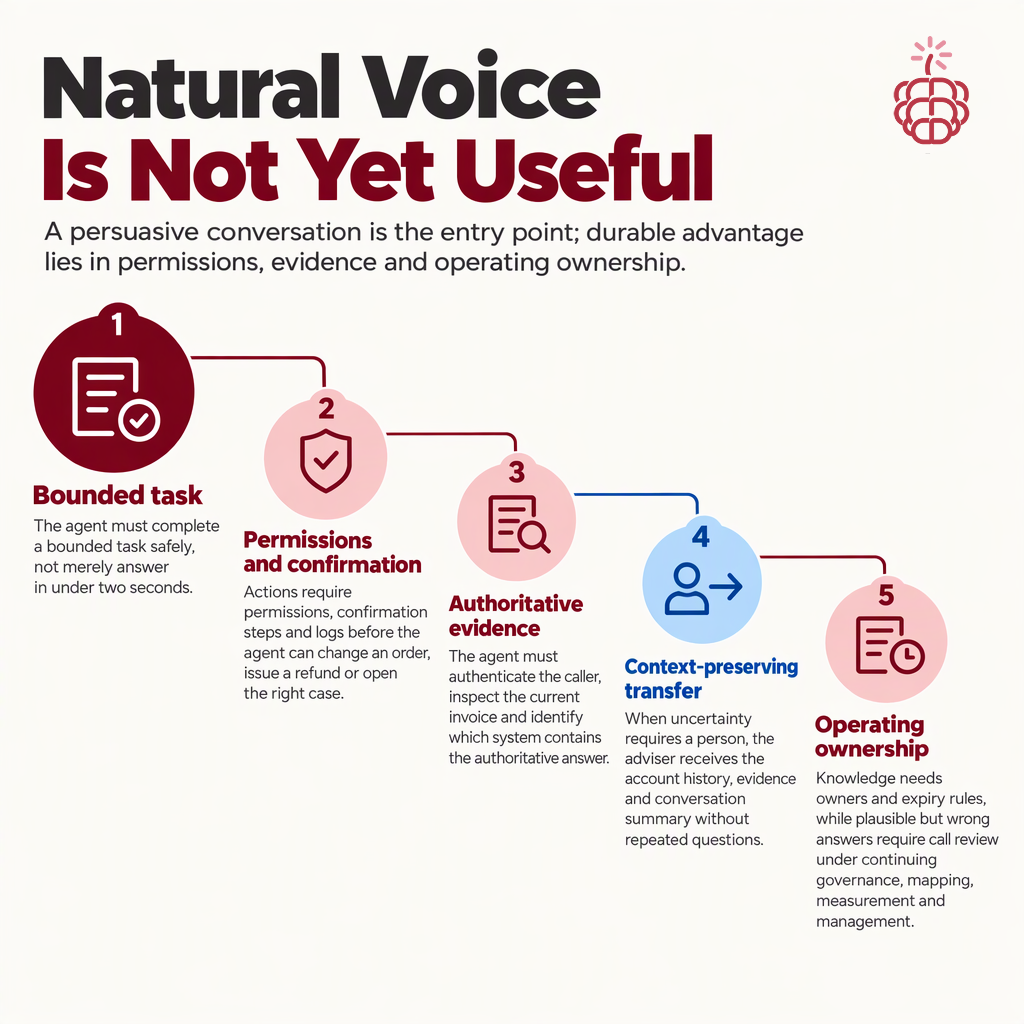
A voice agent that answers in under two seconds can make a convincing demonstration. It does not, by itself, reduce service cost or improve the customer decision that matters. The commercial test is whether the agent can complete a bounded task safely, or transfer the caller with enough context that a person can act without starting again.
The pattern we keep seeing is that conversational fluency receives more attention than operational usefulness. A system can sound like another human while still behaving like an expensive search box. It may retrieve a policy answer, but it cannot authenticate the caller, change an order, explain an exception, or record the decision in the system of record. The voice is natural. The workflow is not.
That distinction matters because phone support is full of consequential requests. Customers call when a payment fails, a delivery is missing, or a claim needs clarification. The difficult part is usually not finding a sentence in company knowledge. It is deciding what the caller is allowed to do, which system contains the authoritative answer, and when uncertainty requires a person.
Consider a telecom billing team using a voice agent for disputed charges. The agent can explain the standard billing policy immediately. Its value changes when it can verify the account, inspect the current invoice, distinguish a routine roaming charge from a suspected error, and open the right case. If the dispute falls outside approved rules, it should pass the caller to an adviser with the account history, evidence and conversation summary attached.
That workflow can remove repeated questions and reduce after-call administration. It can also increase capacity without pretending that every call should be automated. The gain comes from narrowing the work the agent is authorised to do, not from making it sound unrestricted.
This is where the claim of “no training” needs care. Callers may not need to learn a menu, but the organisation still has to prepare the agent. Knowledge must have owners and expiry rules. Actions need permissions, confirmation steps and logs. Escalation must preserve context. Someone must review calls where the answer was plausible but wrong. NIST’s AI Risk Management Framework treats governance, mapping, measurement and management as continuing responsibilities, rather than a one-time deployment checklist.
The strongest objection is that these controls can make an agent slower and less human. That is true in some interactions. A confirmation before a refund adds friction. A transfer can feel like failure. Yet removing those controls simply moves the cost elsewhere, into incorrect credits, privacy incidents, regulatory exposure or a customer who must repair an automated mistake.
Speed still matters. Delayed turn-taking makes a voice conversation awkward, and a clean response can reduce effort. But speed is a service characteristic, not a business outcome. The sharper question is whether each second saved removes work, improves a decision or prevents a handoff from breaking.
Our view is that enterprise voice agents should be judged as frontline workflow operators, not as synthetic colleagues. A persuasive conversation is the entry point. The durable advantage lies in the permissions, evidence and operating ownership behind it. That shifts the decision from “Does it sound human?” to “Which decisions can we safely move closer to the customer?”