
Repeated prompting looks like a productivity problem, but it is usually a process design problem. Reusable instructions can reduce avoidable explanation and make output more consistent, yet they create value only when someone owns the process, checks the result and updates the standard. The decision for leaders is not whether to save prompts. It is which recurring decisions and workflows deserve a maintained operating method.
The pattern we keep seeing is simple: an employee discovers a useful way to ask AI for a weekly report, then treats the discovery as a personal trick. Every Monday, the same context is reconstructed. The waste is visible in the typing, but the larger cost is hidden. The team has learned something about how work should be done, and the organisation has failed to retain it.
Saving the instruction captures part of that knowledge. A good reusable instruction defines the source material, the audience, the required format, the tone, the checks and an example of acceptable output. That changes AI from an empty text box into a repeatable step in a workflow. It also makes the work easier to review because colleagues can see what the system was asked to do.
Consider a revenue operations manager who prepares a Monday pipeline summary for the sales leadership team. Initially, she pastes the same data, explains which deals count as at risk and asks for a concise summary. After several repetitions, she saves the instructions and adds a rule that every flagged deal must be linked to a CRM record. The immediate gain is fewer instructions. The more consequential gain is that the report now exposes a decision rule the team can challenge, improve or assign to someone else.
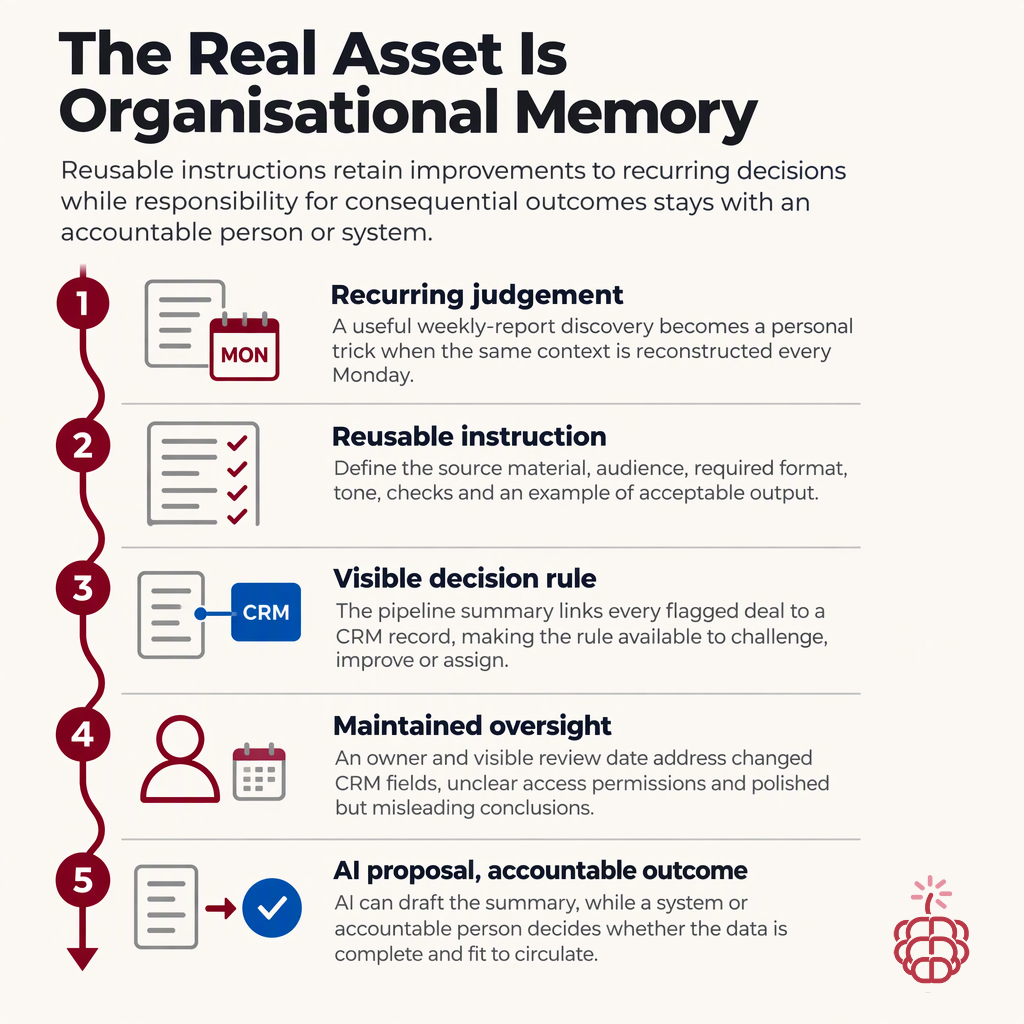
That last point matters. A saved prompt is not automatically a dependable capability. It can preserve a bad assumption as efficiently as a good one. If the CRM field changes, the instruction may produce polished but misleading conclusions. If access permissions are unclear, reuse can spread confidential information. If no one reviews the output, consistency may be mistaken for accuracy.
This is why the strongest enterprise pattern is not full automation. It is a clear boundary between AI-generated proposals and deterministic controls for routing, authorization, validation and final outcomes, a distinction also reflected in recent enterprise application research. The model can draft the summary. A system or accountable person should decide whether the data is complete and whether the summary is fit to circulate.
The objection is fair: maintaining a library of instructions can become another form of administrative work. Most organisations do not need hundreds of templates. They need a small number tied to frequent, costly or high-risk tasks, with an owner and a visible review date. A reusable method that no longer matches the business is technical debt in plain language.
Our view is that the commercial value lies less in asking AI once than in retaining the improvement made after the first attempt. The saved instruction is merely the container. The real asset is an agreed way of making a recurring decision, with enough oversight to improve without starting over.
That reframes AI productivity. The teams that gain capacity will not simply type faster. They will turn repeated judgement into maintained organisational memory, while keeping responsibility for consequential decisions where it belongs.