
Buying an enterprise AI licence does not mean the work has changed. The 88% figure reported by Gartner, covering employees who use personal AI tools despite having employer-provided access, should change the decision leaders make: stop measuring deployment and start examining where approved tools fail to fit the work.
The uncomfortable pattern is that personal use often survives a formal rollout. Leaders read that as resistance, weak training or poor governance. Sometimes it is. More often, it is an operating signal. Employees use the tool that is quickest, least restrictive and already connected to the task in front of them. Access has been provided, but the workflow still belongs to the old system.
That distinction matters commercially. A sanctioned tool can improve control without improving capacity. It may offer enterprise security, administrative visibility and approved data handling, yet still add steps between an employee and a useful result. If the employee must copy information out of a customer system, work in a separate interface and then return the answer manually, the company has bought a destination, not changed the route.
Consider a sales operations manager preparing a weekly forecast. The approved assistant can summarize notes, but it cannot reliably read the fields the manager uses, explain missing data or write a recommendation back into the forecasting process. The manager opens a personal account, pastes in selected material and finishes the analysis faster. The business sees a faster forecast, but also loses the ability to inspect what data left its boundary, which instructions shaped the answer and whether the method can be repeated by the next manager.
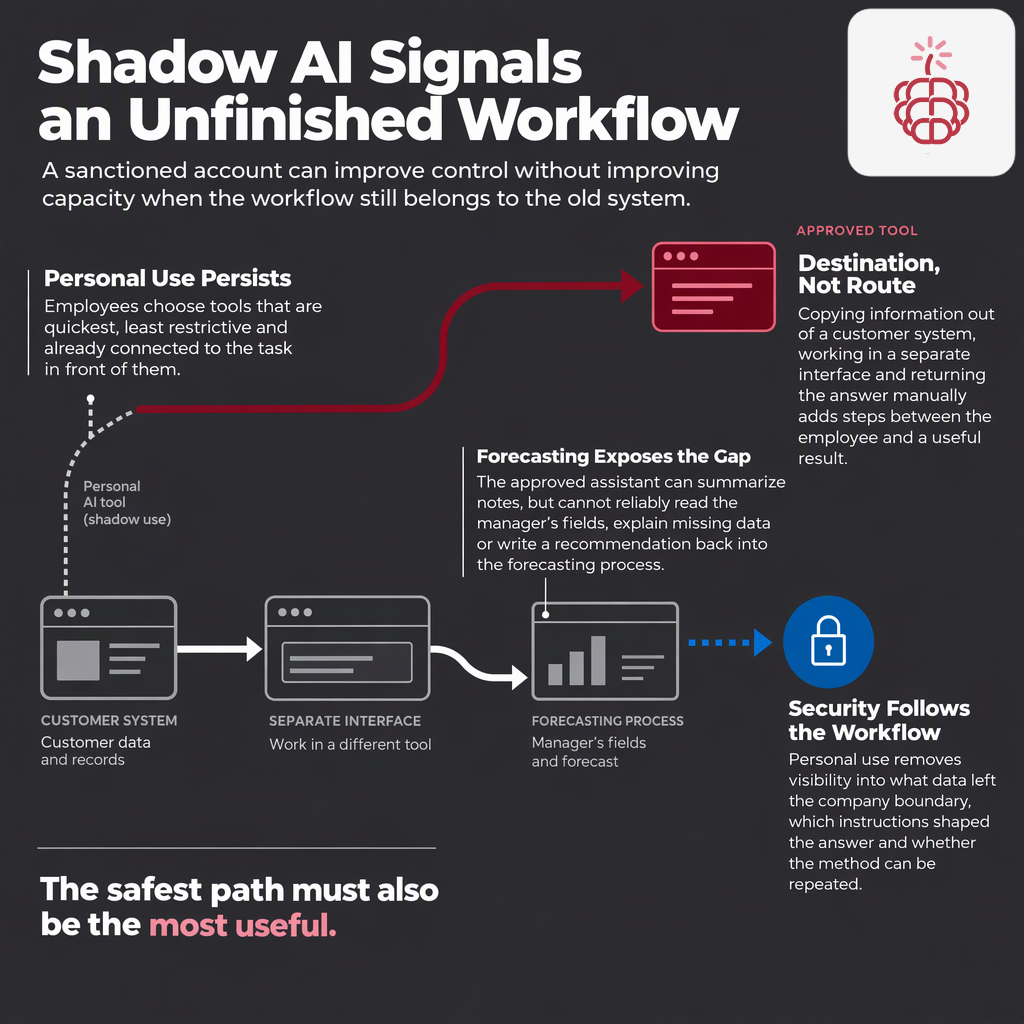
That is why shadow AI is not primarily an account problem. It is a design problem with a security consequence. Verizon’s reporting, cited alongside the Gartner finding, measured personal-account AI access from corporate devices, suggesting that the behaviour is not confined to a few careless individuals. A ban may reduce visible usage while preserving the unmet need. The work still has to be done, so the behaviour moves somewhere less observable.
The strongest objection is that personal tools may simply be better. An approved model can be slower, more heavily filtered or less capable for a particular task. That objection should change the response. Governance cannot mean defending an inferior workflow because procurement has already selected the product. It must allow the business to identify useful patterns, test safer equivalents and retire controls that block legitimate work without reducing material risk.
In practice, the first management question should not be, “Which AI accounts are our employees using?” It should be, “Which decisions and tasks are employees taking outside the workflow we designed?” The answer reveals where the company needs better integration, clearer data boundaries, human review or a different tool. It also separates a compelling demonstration from an operating capability: the latter leaves a trace, has an owner and improves a measured piece of work.
The larger consequence is easy to miss. Unapproved AI use is often treated as evidence that employees have bypassed the organisation. It may instead be evidence that the organisation has not finished building the work around the capability it purchased. Trust will not come from forcing every task through one account. It will come when the safest path is also the most useful one.