
Most enterprise AI spending is not failing because the models are incapable. It is failing because companies add a tool to an unchanged workflow, then measure adoption instead of changed business performance. The decision should be simple: fund AI where it removes or improves a defined piece of work, with an owner accountable for the result.
The statistic is useful, but easy to misuse. A July 2025 MIT report found that roughly 95% of corporate generative AI pilots produced no measurable profit and loss impact. That does not mean 95% of companies bought useless software, or that every pilot was technically poor. It means a demonstration rarely changes the economics of the business by itself.
The pattern we keep seeing is a gap between output and authority. An assistant may draft a response, summarize a case, or classify a document. But if an employee still has to open three systems, verify every field, obtain the same approval, and carry the same liability, the business has gained an extra step. The output may be impressive while the workflow remains untouched.
Consider a procurement team handling invoice exceptions. A model can identify duplicate invoices and suggest the likely resolution. The commercial benefit appears only when that suggestion is connected to the purchasing record, routed to the person who can approve it, and used to close the exception without recreating the analysis manually. The useful unit is not the model’s answer. It is the completed exception at lower cost and with an acceptable error rate.
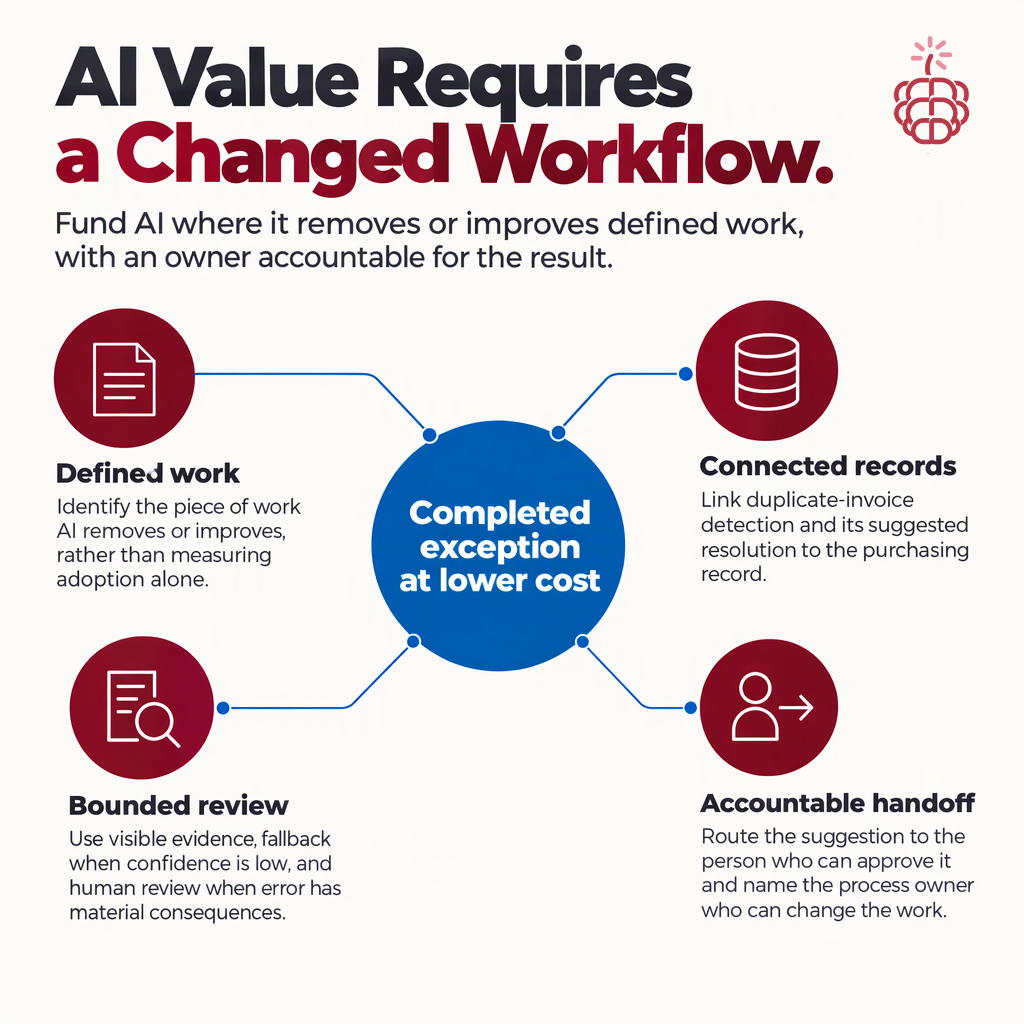
That distinction changes what leaders should build. The system needs access to the company’s relevant history and rules, but context alone is not the solution. It also needs a defined handoff, a fallback when confidence is low, and a process owner who can change the work around it. Without those conditions, employees sensibly treat AI as advisory. Advisory tools accumulate beside the process rather than becoming part of it.
The strongest objection is that this approach introduces risk. Connecting AI to records and approvals can create privacy, control, and audit problems. That objection is valid. A workflow that acts too broadly can cost more than a workflow that does nothing. The answer is not to keep every use case in a sandbox. It is to begin with bounded decisions, visible evidence, and human review where the consequence of error is material. Safety is part of the operating design, not an excuse to avoid one.
The MIT findings also point to where value is more likely to appear: back-office automation, including the removal of outsourced processes and external agency costs, rather than many customer-facing tools that attract AI budgets. That is commercially significant because internal workflows often have clearer inputs, repeatable decisions, and an identifiable cost owner.
Our view is that AI should be purchased as a change in capacity, control, or decision quality, not as a collection of seats. The companies that move beyond pilots will not necessarily have the most sophisticated models. They will be the ones willing to decide which work disappears, who owns the new process, and what evidence proves it improved. The technology shift is therefore also an ownership shift: from buying access to redesigning how the business operates.