
A conversational investment adviser matters commercially only if it changes what happens after a customer asks a question. The decision for banks is therefore not whether an agent can produce a plausible recommendation, but whether it can make suitable advice easier to deliver, review and govern at scale.
The interesting contradiction is that a convincing demonstration can make the hardest work look finished. Charlie, presented as an AI agent for personalized investment guidance, can show how a customer moves from an open question to a clearer proposal. That is useful. It is not yet the operating capability a bank must rely on.
The model is not the bottleneck
In practice, generating an answer is becoming the cheaper part of advice. The difficult part is converting a conversation into an accountable decision: understanding the customer’s objectives, testing whether the available products fit, explaining costs and risk, recording the reasoning, and knowing when a person must intervene.
That distinction changes the business case. A bank does not gain much from producing more fluent explanations if advisers still have to reconstruct the customer’s situation, check the recommendation manually and document the interaction from scratch. The gain comes when the agent removes repetitive preparation without removing the controls that make advice defensible.
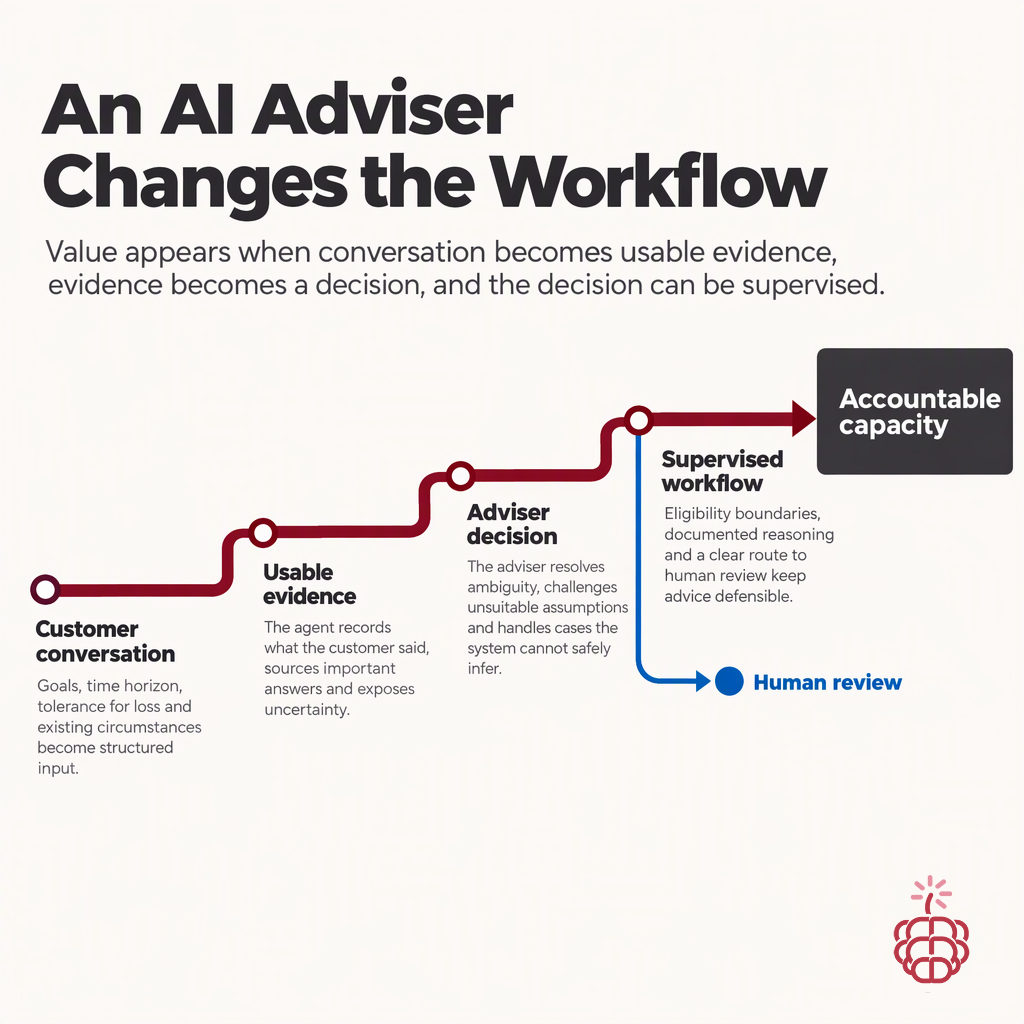
Consider the Charlie concept inside a bank app. A customer asks how to begin investing. The agent asks about goals, time horizon, tolerance for loss and existing circumstances, then narrows the conversation to options the bank permits. It can explain unfamiliar terms in plain language and expose uncertainty before a proposal reaches an adviser or the customer.
The important effect is not that the customer had a better chat. It is that the bank has a structured starting point for a regulated workflow. A human adviser can spend less time collecting basic information and more time resolving ambiguity, challenging an unsuitable assumption or handling a situation the system cannot safely infer. That can increase capacity without pretending that automation has replaced judgement.
The ownership problem
This is also where the risk moves. When advice is produced through conversation, errors are harder to spot than a missing form. A system may ask the wrong follow-up question, interpret a vague answer too generously or present a restricted option with unwarranted confidence. A polished interface can hide weak evidence.
Financial institutions already face a broader governance issue: AI systems sit across customer support, fraud prevention, profiling and investment processes, linking technology risk to conduct, operational and reputational risk. Independent analysis of the European Union’s AI rules describes the practical response as an operating model connecting business, risk, compliance and technology, not an IT policy alone. It also stresses that institutions need a living inventory of the AI they use, including capabilities embedded in vendors.
That makes the strongest objection valid: perhaps a conversational adviser adds too much control work to be worthwhile. Our view is narrower. It is worthwhile when the controls are designed into the workflow, rather than added after the demo. Every important answer needs a source, an eligibility boundary, a record of what the customer said and a clear route to human review.
The larger shift is organisational. An AI adviser will not create value by making investment guidance feel more personal while leaving the bank’s process unchanged. Its value appears when conversation becomes usable evidence, evidence becomes a decision, and the decision can be supervised. The winners will not be the firms with the most persuasive agent. They will be the firms that turn one into accountable capacity.