Most manufacturers do not have an AI problem. They have a control problem: too many operating decisions depend on delayed data, scarce specialists and processes that are difficult to adjust without creating risk. Saltworks Technologies shows why the commercial opportunity is not putting a chatbot in the office, but improving how a plant senses, decides and responds.
That changes the decision executives should make. Instead of asking where AI can automate clerical work, ask which operating decisions are expensive, repetitive and constrained by slow human interpretation. The answer may sit beside a membrane, pump or chemical process rather than inside a back-office workflow.
The pattern we keep seeing is that the model is rarely the bottleneck. The difficult part is building a dependable operating layer around it: connected equipment, usable process data, simulation, clear controls and a defined boundary between recommendation and automatic action. Without that foundation, AI produces an impressive demonstration but not a capability the plant can safely depend on.
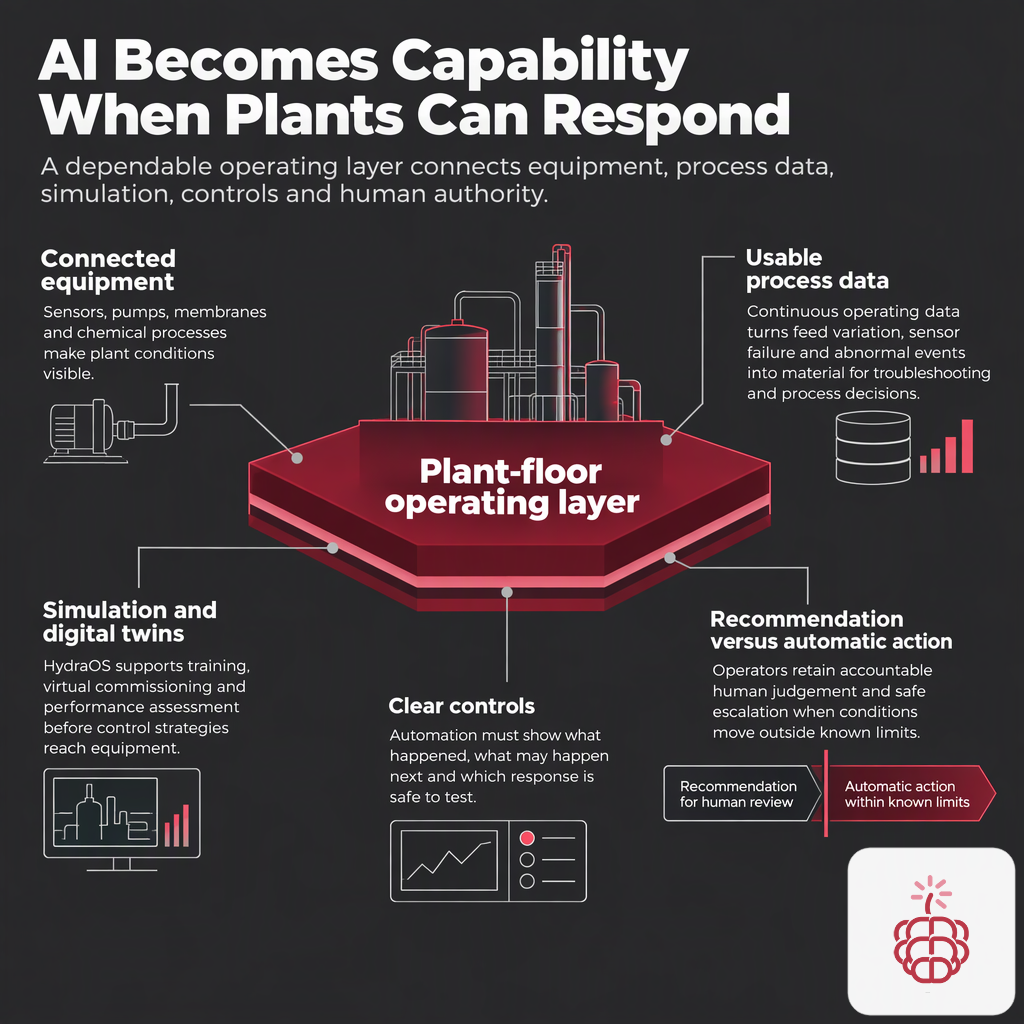
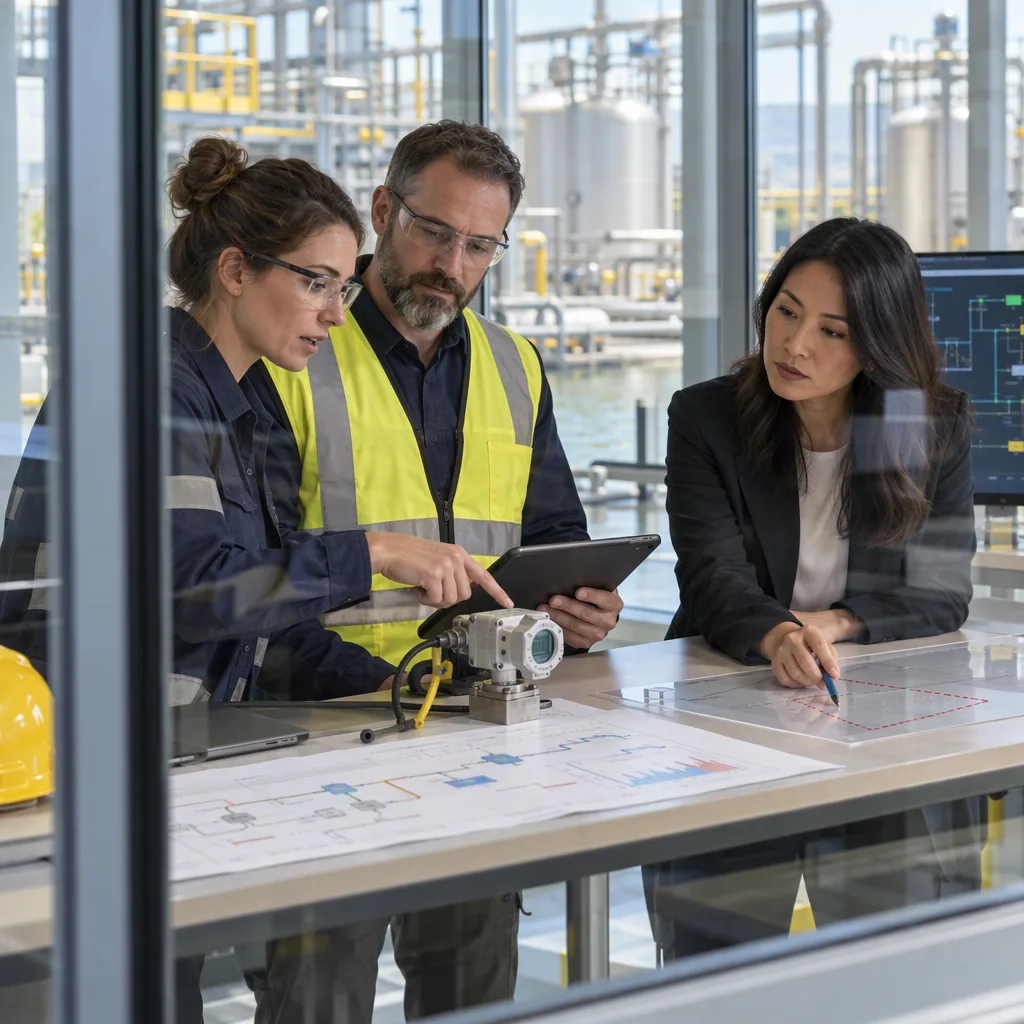
Saltworks designs modular systems for industrial wastewater treatment and lithium processing, combining process equipment with digital control and support. Its HydraOS platform brings together automation, simulation, digital twins, sensors and operator assistance. The business significance is not the label “AI-enabled”. It is the attempt to make plant-wide decisions visible and repeatable, including what happened, what may happen next and which response is safe to test.
Consider Project Aurora, a lithium demonstration plant connected directly to a wellhead. According to a release distributed by EMP Metals, the operation combines continuous-flow processing with Saltworks’ automation and has reached unattended autonomous operation, while collecting data on durability, recovery and processing performance.
The useful point is not that one demonstration proves autonomous plants are ready everywhere. It does not. Conditions vary, sensors fail, feed composition changes and abnormal events still require accountable human judgement. The point is that a continuously operating system can turn those variations into operating data rather than isolated surprises. That can shorten troubleshooting, improve process decisions and reduce the amount of specialist attention needed for routine control.
This is where the economics become more interesting than the demonstration. If operators spend less time assembling context and more time handling exceptions, the organisation gains capacity without simply adding headcount. If engineers can test a control strategy in a digital twin before applying it to equipment, the cost of experimentation and the risk of commissioning may fall. Those outcomes remain claims to validate site by site, not benefits to assume from installing software. Saltworks itself describes simulation and digital-twin tools as ways to support training, virtual commissioning and performance assessment, which is a more credible proposition than promising hands-off autonomy by default.
The strongest objection is also the right one: industrial autonomy has a higher failure cost than an incorrect office summary. That means the winning architecture will not remove operators from the system. It will make their authority more precise, expose the system’s reasoning and preserve safe escalation when conditions move outside known limits.
Our view is that AI on the plant floor is less a software upgrade than an organisational change. It moves advantage towards companies that can combine process knowledge, instrumentation and decision rights into one operating system. The manufacturer that learns to manage that boundary will not merely run existing work with fewer people. It may be able to operate processes, sites and product strategies that were previously too variable or too costly to scale.