An AI team announcement can signal ambition, but it does not demonstrate business value. The commercial test is harder: can the team change a decision, remove work from a process, or increase the organisation’s capacity without adding unacceptable risk? That should change how leaders evaluate AI capability. A list of specialists is less useful than evidence of who owns the workflow and the outcome.
The pattern we keep seeing is a misplaced focus on assembly. Organisations ask whether they have the right mix of engineers, data scientists and product leaders. They ask less often whether those people can alter how work moves through the business. This distinction matters because a capable group can still produce isolated tools that leave approvals, handoffs and accountability untouched.
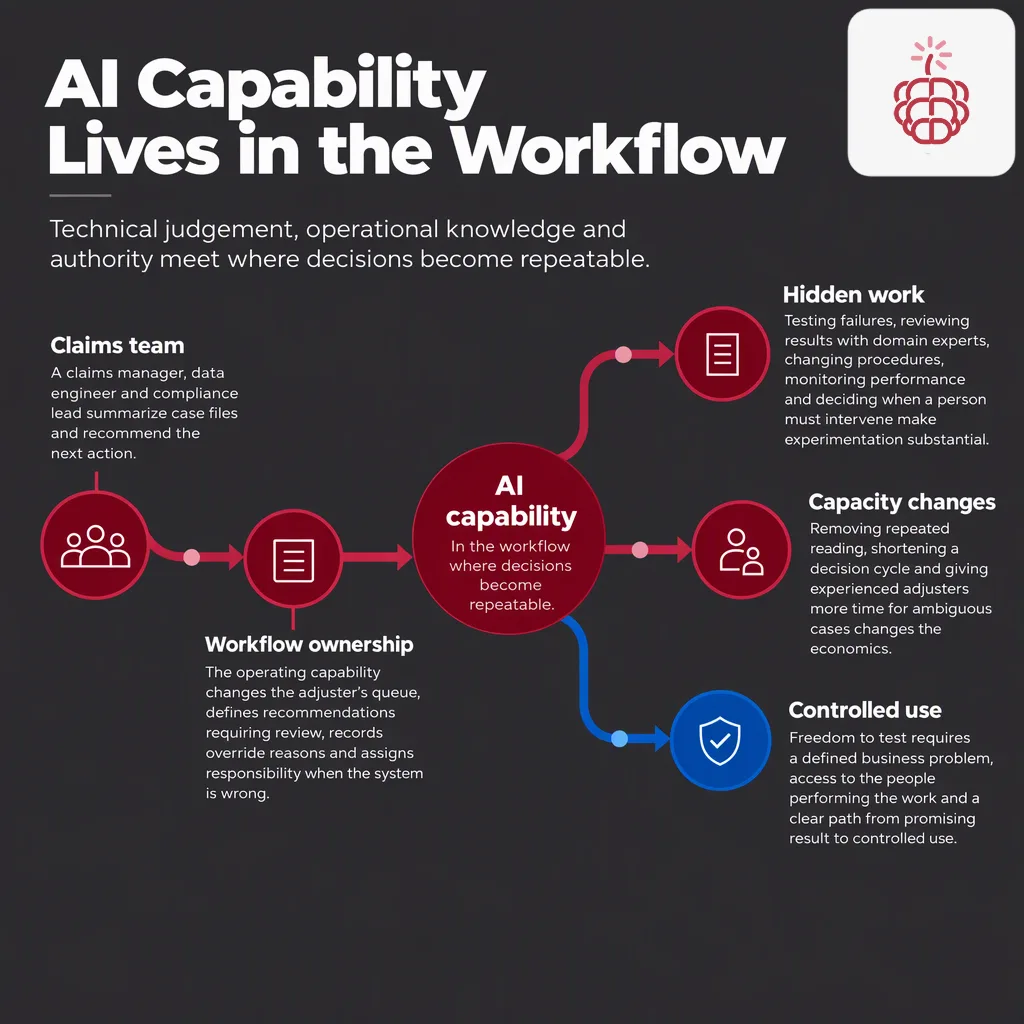
The difficult part is usually not building a convincing demonstration. It is absorbing the hidden work that follows: testing where outputs fail, reviewing results with domain experts, changing procedures, monitoring performance and deciding when a person must intervene. Recent MIT Sloan research describes this experimentation and refinement as substantial work beyond employees’ existing responsibilities. Where organisations failed to support it, participation declined and promising solutions did not scale.

Consider a claims operation. A claims manager, a data engineer and a compliance lead might build a system that summarizes case files and recommends the next action. The demonstration may be impressive. The operating capability appears only when the team also changes the adjuster’s queue, defines which recommendations require review, records the reason for an override and assigns responsibility when the system is wrong.
That last step is where the economics change. If the recommendation merely creates another screen, the business has added cost. If it removes repeated reading, shortens a decision cycle and gives experienced adjusters more time for ambiguous cases, capacity has changed. The model is part of the mechanism, not the outcome.
This is also why AI teams should not be judged only by delivery velocity. A fast team can increase organisational confusion if it creates tools that compete for the same data, produce different answers or sit outside established controls. Conversely, a team that spends time on workflow design may look slower while making adoption more durable.
The strongest objection is that early teams need freedom to experiment. That is true. Heavy approval processes can kill useful learning before it begins. But freedom to test is not the same as freedom to avoid ownership. Experimentation needs a defined business problem, access to the people who perform the work and a clear path from promising result to controlled use.
McKinsey’s recent analysis reaches a similar conclusion from a different angle: organisations reporting the strongest AI outcomes are more likely to redesign workflows rather than distribute tools and wait for productivity to appear. The implication is uncomfortable but useful. AI capability is not housed in a department. It is created at the point where technical judgement, operational knowledge and authority meet.
A team introduction can therefore be more than employer branding, but only if it makes that operating connection visible. The enduring advantage will not belong to the organisation with the most impressive roster. It will belong to the one that turns collective expertise into better decisions, with enough governance to make those decisions repeatable.