Housing innovation should be judged by the decisions it removes from the queue, not by the novelty of the demonstration. The commercial prize is not an impressive model. It is fewer incomplete applications, less rework and more homes moving through an approval process without adding equivalent administrative capacity.
The pattern we keep seeing is simple: the hardest housing problem is often not design. It is coordination. A project can be technically viable and still lose weeks while developers, planners, inspectors and agencies correct missing or inconsistent information. That delay consumes scarce professional time and makes the cost of uncertainty part of every project.
This changes what useful AI looks like. The strongest early application is not an autonomous planning official. It is a system that checks an application before it enters a human workflow, identifies likely omissions and makes the next decision easier. Stateline reports that cities are exploring AI to scan permit applications and flag errors, while leaving final decisions with human reviewers. The intended benefit is fewer correction cycles, not the removal of accountability.
That distinction matters because a polished demonstration can hide the real operating problem. A model may produce a plausible answer in a controlled setting. A permitting team needs reliable handling of local rules, changing documents, exceptions and unclear responsibility. The system must show what it found, identify what it cannot determine and leave a usable record for the person who makes the decision.
Consider Syracuse, New York. Its proposed approach is to help developers submit more complete applications at the outset. The city has said that data governance and algorithm design would be central questions in selecting a vendor, including who owns the information being processed and how it is handled. That is not procurement caution around the edges. It is the operating design.
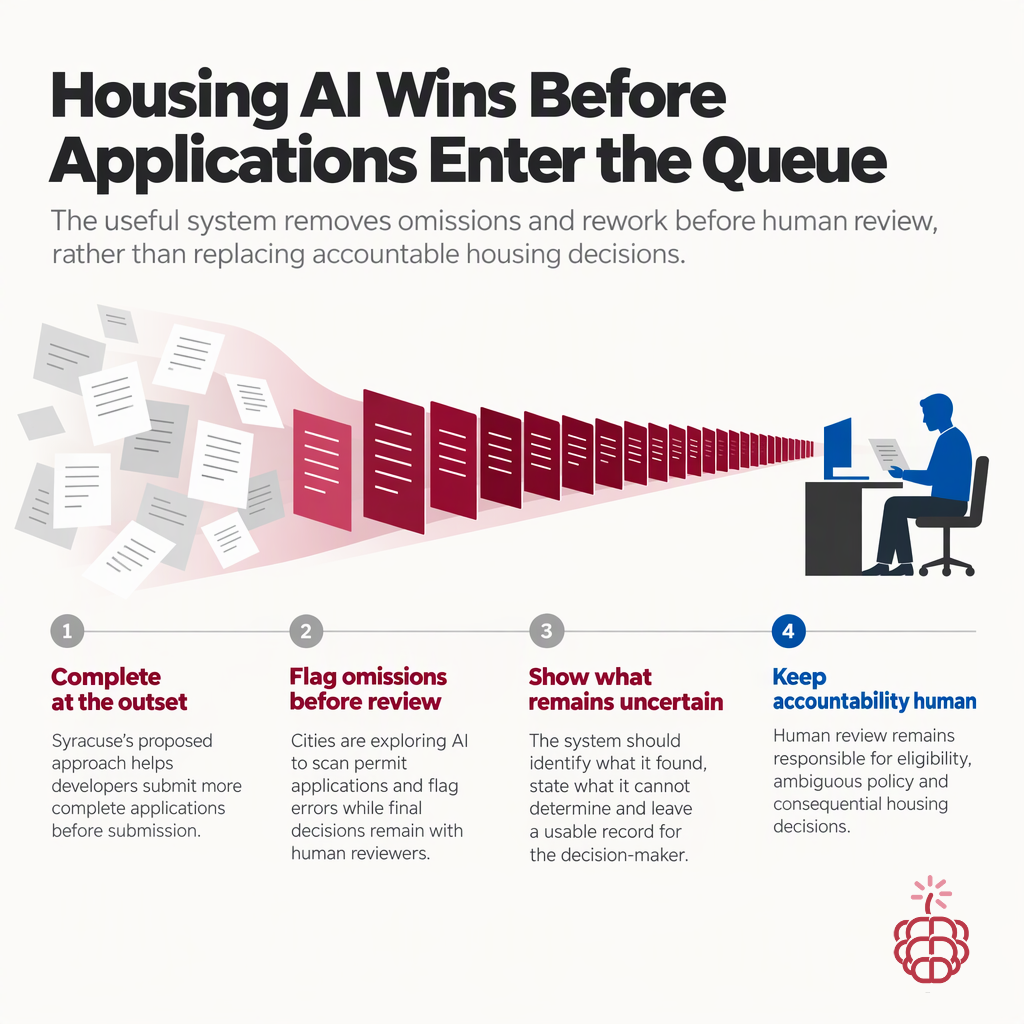
If the tool works, the immediate gain is not a headline efficiency percentage. It is a changed sequence of work. Developers spend less time discovering basic omissions after submission. Reviewers spend more time on substantive judgement rather than repeated corrections. The city can handle more activity without assuming that every increase in housing demand requires a matching increase in staff.
The strongest objection is that housing decisions are too local and consequential for automation. That objection is valid when automation is asked to decide eligibility, interpret ambiguous policy or conceal uncertainty. It is weaker when the system is limited to preparation, consistency checks and transparent routing. Human review does not make a poorly designed tool safe by itself, but a narrow task, clear escalation and an auditable record can make risk manageable.
The difficult part is usually not selecting a model. It is agreeing which decisions should remain human, which evidence the system may use and who is accountable when the information is wrong. Work on AI in housing already spans zoning analysis, design, jobsite monitoring and procurement, but the value of each use case will depend on how well it fits the surrounding workflow.
Housing growth innovation, then, is less about replacing expertise than extending its reach. The organisation that gains capacity will not be the one with the most theatrical prototype. It will be the one that turns scattered information into a better next decision, while making responsibility clearer rather than harder to see.