A workday crowded with 275 interruptions is not mainly a notification problem. It is evidence that too many routine decisions still depend on scarce human attention. The commercial decision should therefore change: use AI agents to reduce avoidable decision traffic, not simply to help people answer messages faster.
Microsoft’s telemetry reports a meeting, email, or chat interruption about every two minutes during core work hours, equivalent to roughly 275 interruptions a day. The figure needs care: it is not an average for every employee, and the methodology includes communication across the workday. Still, the signal is useful. Work is being organized around constant availability rather than completed decisions.
The pattern we keep seeing is that an interruption often carries very little intellectual difficulty. Someone wants an approval, a status check, a missing document, or a routine exception resolved. Yet the request still travels to a manager or specialist because the organization has not encoded the policy, supplied the context, or assigned authority elsewhere.
That makes the interruption expensive in two ways. It consumes the recipient’s attention, and it pauses the sender’s work while the decision waits. Faster replies can improve the symptom while preserving the queue.
Consider a procurement director who receives repeated messages asking whether standard software purchases can proceed. An agent could check the approved supplier list, compare the request with the spending policy, identify missing information, and approve the routine cases within defined limits. It would send the unusual requests to the director with the relevant evidence assembled, rather than forwarding an incomplete question.
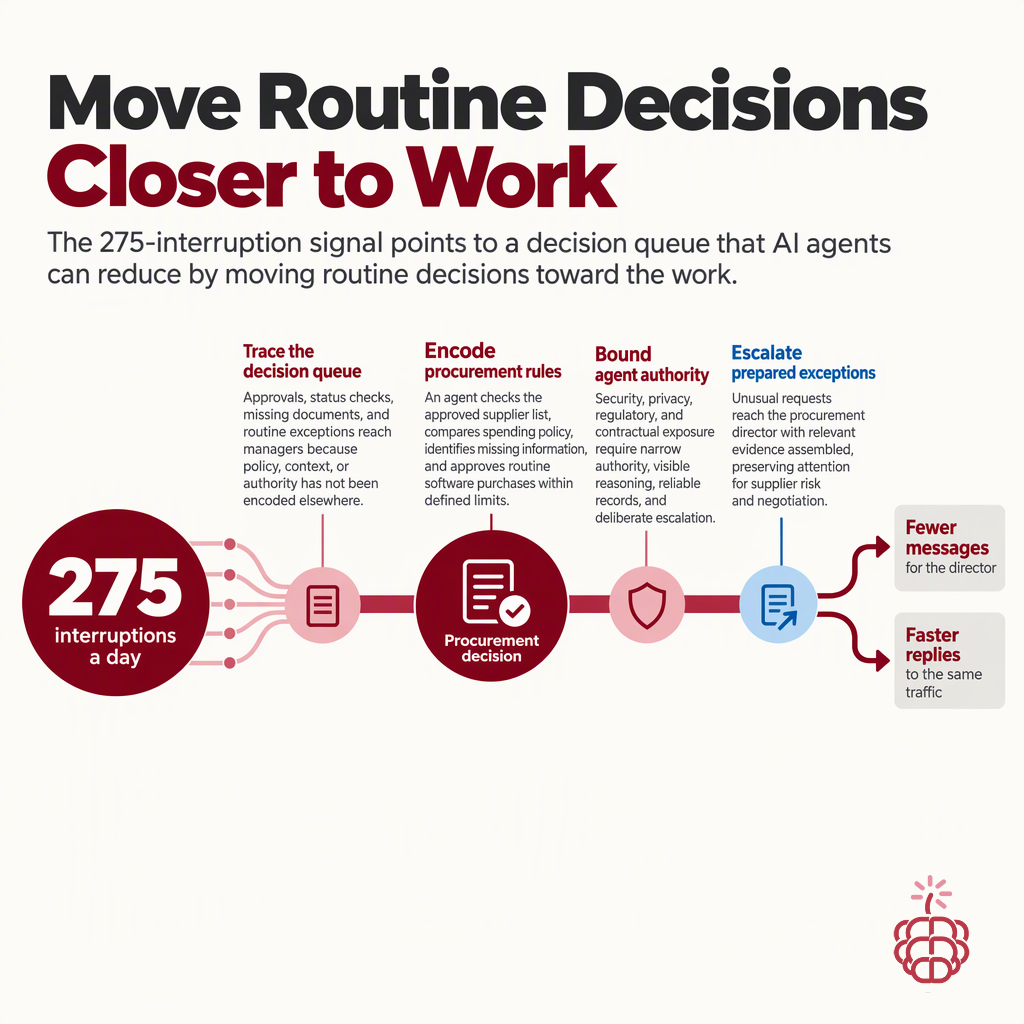
The gain is not that the director answers more messages per hour. The gain is that fewer messages require the director at all. Procurement gets a shorter cycle, the director gets longer blocks for supplier risk and negotiation, and the organization gains capacity without pretending that every decision can be automated.
The strongest objection is also the practical boundary. Routine decisions are not always low risk. A purchase that looks ordinary may create a security, privacy, regulatory, or contractual exposure. An agent that acts confidently without understanding those conditions can turn a small interruption into a large incident.
That is why useful agents need narrow authority, visible reasoning, reliable records, and deliberate escalation. The difficult part is usually not connecting a model to email or workflow software. It is deciding which decisions can be made from stable rules, which require human judgement, and who owns the outcome when the rules are incomplete.
This changes how productivity should be measured. Time recovered matters, but it is a lagging indicator. The more revealing measure is how many decisions are completed without unnecessary escalation, and whether the exceptions reaching leaders are better prepared. A demonstration that drafts replies may save minutes. An operating capability changes where decisions happen.
Our view is that the 275-interruption figure matters less as a universal productivity statistic than as an organizational diagnosis. Companies that treat every interruption as an individual time-management failure will buy tools that make the traffic faster. Companies that trace interruptions back to missing authority, context, and process will use agents to move routine decisions closer to the work. The lasting advantage will belong to the organizations that make fewer people necessary for ordinary decisions, while reserving human attention for the consequences that deserve it.