
ChatGPT can make individual employees faster without making the business better. The commercial decision is not whether to provide access, but which decisions and workflows should change, who owns that change, and how the result will be judged.
That distinction is easy to miss because a chatbot produces an immediate demonstration. An employee drafts a polished email in seconds, summarizes a long document, or turns notes into a presentation. The result looks like productivity. But unless the surrounding work changes, the business has usually gained a faster first draft, not more capacity.
The pattern we keep seeing is local improvement trapped inside an unchanged operating model. People use AI beside the systems that hold the real data, follow the same approval paths, and remain accountable for the same queues. The tool reduces effort at one step while leaving handoffs, rework, exceptions, and decision delays intact. It may even create more material for someone else to review.
Evidence supports a more careful reading of adoption. A study of digital work activity across large international companies found that generative AI use was associated with increases in both productivity and communication actions, but with a larger shift toward individual, documentation-focused work. The researchers also caution that this pattern could reduce the diffusion of diverse information that supports innovation. More output is not automatically better coordination.
Consider a claims team at an insurer. A claims adjuster can ask ChatGPT to summarize a claimant’s correspondence and draft a response. That is useful, but the adjuster still has to search several systems, verify coverage, decide whether the case needs escalation, document the rationale, and wait for approval. The prompt saves minutes. It does not yet change the claim decision or the flow of work.
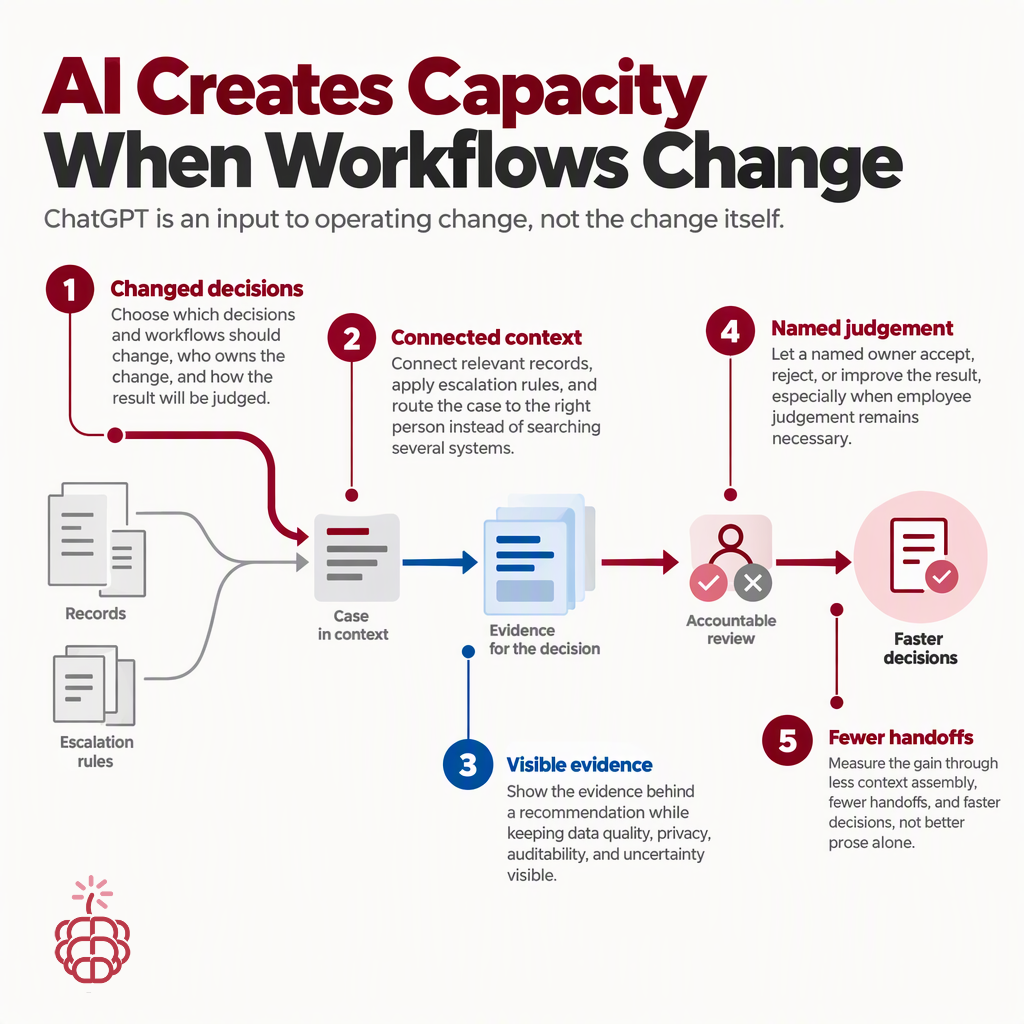
A useful capability would connect the relevant records, apply the organisation’s escalation rules, show the evidence behind a recommendation, and route the case to the right person. The adjuster would spend less time assembling context and more time resolving the cases that require judgement. The gain would come from fewer handoffs and faster decisions, not from better prose.
This is also where the strongest objection deserves weight. Most businesses should not automate high-consequence decisions simply because a model can produce a plausible answer. Data quality, privacy, auditability, and the cost of correcting an error can outweigh the time saved. Employee judgement remains necessary in many workflows, and a system that hides uncertainty can make risk harder to see.
That objection changes the claim, but does not defeat it. The goal is not to put a chatbot everywhere. It is to redesign a bounded workflow so that AI performs a useful part of the work, evidence remains visible, and a named owner can accept, reject, or improve the result. Research on adoption likewise identifies human factors, user proficiency, governance, and unclear process ownership as major barriers to enterprise implementation.\n\nThe business consequence is larger than tool selection. ChatGPT is an input to operating change, not the change itself. Companies that treat access as the finish line will collect scattered efficiency gains. Companies that attach AI to decisions, controls, and accountable workflows may create capacity that individual prompting alone cannot provide.